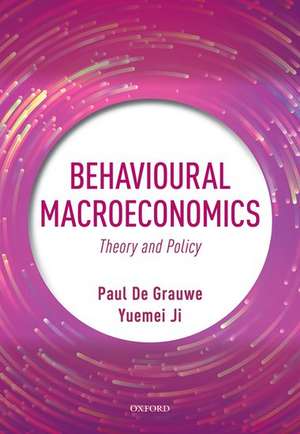
Behavioural Macroeconomics: Theory and Policy
Autor Paul De Grauwe, Yuemei Jien Limba Engleză Hardback – 25 oct 2019
Preț: 396.99 lei
Preț vechi: 549.82 lei
-28%
Puncte Express: 595
Carte tipărită la comandă
Livrare economică 19-24 noiembrie
Livrare prin curier în România Termenul estimat este afișat lângă disponibilitate.
Transport gratuit de la 400.00 lei Plată online sau ramburs, în funcție de opțiunile comenzii.
Retur gratuit în 14 zile Comandă securizată și suport în română.
Specificații
ISBN-13: 9780198832324
ISBN-10: 019883232X
Pagini: 274
Dimensiuni: 179 x 249 x 22 mm
Greutate: 0.66 kg
Editura: OUP OXFORD
Colecția OUP Oxford
Locul publicării:Oxford, United Kingdom
ISBN-10: 019883232X
Pagini: 274
Dimensiuni: 179 x 249 x 22 mm
Greutate: 0.66 kg
Editura: OUP OXFORD
Colecția OUP Oxford
Locul publicării:Oxford, United Kingdom
V-ar putea interesa
-
 -22%Preț: 299.10 lei381.50 lei
 -
 International Money: Postwar Trends and TheoriesPaul De Grauwe-19%Preț: 463.16 lei571.81 lei
 -
 -31%Preț: 921.06 lei1335.01 lei
 -
 -31%Preț: 679.72 lei984.98 lei
 -
 The Political Economy of Structural Reforms in EuropeNauro F. Campos-31%Preț: 572.79 lei827.89 lei
 -
 -12%Preț: 355.13 lei402.96 lei
 -
 Modernizing VATs in AfricaSijbren Cnossen-31%Preț: 744.82 lei1082.44 lei
 -
 -31%Preț: 695.58 lei1008.27 lei
 -
 Economics of the Monetary UnionPaul De GrauwePreț: 452.79 lei
 -
 Economy, Society, and Public PolicyCORE Team-23%Preț: 479.62 lei622.89 lei
 -
 -31%Preț: 663.96 lei965.50 lei
 -
 -23%Preț: 787.77 lei1023.08 lei
 -
 The ECU and European Monetary IntegrationP de Grauwe-18%Preț: 951.26 lei1160.07 lei
 -
 The Exchange Rate in a Behavioral Finance FrameworkPaul De Grauwe-27%Preț: 695.68 lei952.99 lei
 -
 Lectures on Behavioral MacroeconomicsPaul De GrauwePreț: 430.21 lei
 -
 -19%Preț: 561.40 lei693.10 lei
 -
 -19%Preț: 509.13 lei628.56 lei
 -
 -19%Preț: 472.52 lei583.35 lei
Recenzii
Presents new theoretical macroeconomic models based on individuals' complexity, heterogeneity, and cognitive limitations, addressing the current implausible assumptions of mainstream macroeconomics about human behavior and the capacity of human beings to comprehend the world they live in.
this is an excellent book, well written, dealing with interesting and important questions, and doing it well. I hope it has the effect on macro modelling that the authors desire.
this is an excellent book, well written, dealing with interesting and important questions, and doing it well. I hope it has the effect on macro modelling that the authors desire.
Notă biografică
Paul De Grauwe is John Paulson Professor at the London School of Economics, He was a member of the Belgian parliament from 1991 to 2003. He is honorary doctor of the University of St Gallen (Switzerland), the University of Turku (Finland), the University of Genoa, the University of Valencia and Maastricht University. He is a research fellow at the Centre for European Policy Studies in Brussels and CEPR fellow in London. He is vice-chair of the Portuguese Fiscal Council. His research interests are in the economics of monetary unions and behavioural macroeconomics. His book publications include: The Limits of the Market (Oxford University Press, 2017), The Economics of Monetary Union (Oxford University Press, 12th Edition, 2018), and Lectures on Behavioral Macroeconomics (Princeton University Press, 2012).Yuemei Ji is a lecturer in Economics at University College London. She is an associate research fellow at the Centre for European Policy Studies in Brussels. Her research interests cover macroeconomics in general and the European Monetary Union during the post-crisis period in particular. She has done intensive research on the causes of Eurozone debt crisis and its impact on the austerity policies in the Eurozone. She is a co-editor of The Political Economy of Structural Reforms in Europe (Oxford University Press, 2018)