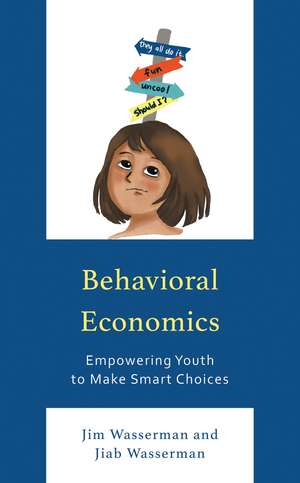
Behavioral Economics: Empowering Youth to Make Smart Choices
Autor Jim Wasserman, Jiab Wassermanen Limba Engleză Hardback – 15 dec 2023
| Toate formatele și edițiile | Preț | Express |
|---|---|---|
| Paperback (1) | 136.61 lei 43-57 zile | |
| Bloomsbury Publishing – 15 dec 2023 | 136.61 lei 43-57 zile | |
| Hardback (1) | 386.40 lei 43-57 zile | |
| Bloomsbury Publishing – 15 dec 2023 | 386.40 lei 43-57 zile |
Preț: 386.40 lei
Preț vechi: 535.79 lei
-28%
Puncte Express: 580
Preț estimativ în valută:
68.41€ • 79.65$ • 59.43£
68.41€ • 79.65$ • 59.43£
Carte tipărită la comandă
Livrare economică 23 februarie-09 martie
Preluare comenzi: 021 569.72.76
Specificații
ISBN-13: 9781475872552
ISBN-10: 1475872550
Pagini: 182
Dimensiuni: 158 x 237 x 20 mm
Greutate: 0.48 kg
Editura: Bloomsbury Publishing
Colecția Rowman & Littlefield Publishers
Locul publicării:New York, United States
ISBN-10: 1475872550
Pagini: 182
Dimensiuni: 158 x 237 x 20 mm
Greutate: 0.48 kg
Editura: Bloomsbury Publishing
Colecția Rowman & Littlefield Publishers
Locul publicării:New York, United States
Cuprins
Contents
Preface
Introduction
Chapter 1: Meet the Chooser (That would be YOU)
Chapter 2: How Do We Make Choices?
Chapter 3: Nonrational Factors in Choosing
Chapter 4: Nudges, or External Factors on Our Choices
Chapter 5: Sway
Chapter 6: The Tween Mind
Chapter 7: Millennial, Gen Z, and Gen A Life
Glossary
Bibliography
Index
About the Authors
Preface
Introduction
Chapter 1: Meet the Chooser (That would be YOU)
Chapter 2: How Do We Make Choices?
Chapter 3: Nonrational Factors in Choosing
Chapter 4: Nudges, or External Factors on Our Choices
Chapter 5: Sway
Chapter 6: The Tween Mind
Chapter 7: Millennial, Gen Z, and Gen A Life
Glossary
Bibliography
Index
About the Authors
Recenzii
The Wassermans know how kids work - and they know how to talk to teachers. The combination is an accessible read of what could be an inaccessible topic. The combination of narrative and related lessons in each of this book's seven chapters makes for a great teaching and learning tool. Students can access the message and teachers can reinforce that learning with accessible and adjustable exercises. I find myself eager for the follow up to this first of two volumes. The Wassermans get their readers started towards understanding the complexities of being a consumer of media and of information in general. They have done important work on behalf of the over-exposed and vulnerable Gen A-ers. I find myself marking great images and metaphors page after page as the Wassermans deliver their messages about choice making, economic realities for consumers and media literacy. I wonderfully accessible writing.
"Empowering Youth to Make Smart Choices" elegantly introduces complex economic topics that equip teachers and parents with knowledge and tools to gently sway the younger generation towards thoughtful decision making. As an Economist and Finance professional (and parent of two), I was impressed with how the authors explained college level concepts in a straightforward but exciting way. This comprehensive guide is a must-have for anyone dedicated to nurturing and nudging the decision-making abilities of young individuals, enabling them to confidently navigate teenage life.
Empowering Youth to Make Smart Choices " is a must-read for middle and high school students in today's influencer-driven economy. With social media bombardment and persuasive messaging at every turn, this indispensable book unveils the hidden forces that shape youthful decision-makers. From recognizing the sway of external influences to honing critical thinking skills, it empowers teens to navigate the complexities of choice with confidence through an extensive set of hands-on activities. Enlightening and essential, this book is a must-have resource for students seeking to make informed decisions and take control of their lives.
For those of us who have chosen to educate-teaching young people how to think, not what to think, requires us to tackle the challenges presented when young people have free and unfettered access to information. This book inspires us to encourage our students to question, be a bit more curious and ask, "Why?" "What if . . .," so they may learn to better navigate their world and make better choices for themselves. Although this book targets teachers of middle schoolers, it is a must read for any teacher and any parent!
The Wasserman's book is a great teaching guide for youth. It also has great learning points for adults as well. Many people don't realize the motives of messages. It's harder to decipher these messages and whether they are genuine or if the person's mindset is already made up (self-swaying as the Wasserman's would say). The lessons in this book are for anyone who wants to learn how to make good choices.
"Empowering Youth to Make Smart Choices" elegantly introduces complex economic topics that equip teachers and parents with knowledge and tools to gently sway the younger generation towards thoughtful decision making. As an Economist and Finance professional (and parent of two), I was impressed with how the authors explained college level concepts in a straightforward but exciting way. This comprehensive guide is a must-have for anyone dedicated to nurturing and nudging the decision-making abilities of young individuals, enabling them to confidently navigate teenage life.
Empowering Youth to Make Smart Choices " is a must-read for middle and high school students in today's influencer-driven economy. With social media bombardment and persuasive messaging at every turn, this indispensable book unveils the hidden forces that shape youthful decision-makers. From recognizing the sway of external influences to honing critical thinking skills, it empowers teens to navigate the complexities of choice with confidence through an extensive set of hands-on activities. Enlightening and essential, this book is a must-have resource for students seeking to make informed decisions and take control of their lives.
For those of us who have chosen to educate-teaching young people how to think, not what to think, requires us to tackle the challenges presented when young people have free and unfettered access to information. This book inspires us to encourage our students to question, be a bit more curious and ask, "Why?" "What if . . .," so they may learn to better navigate their world and make better choices for themselves. Although this book targets teachers of middle schoolers, it is a must read for any teacher and any parent!
The Wasserman's book is a great teaching guide for youth. It also has great learning points for adults as well. Many people don't realize the motives of messages. It's harder to decipher these messages and whether they are genuine or if the person's mindset is already made up (self-swaying as the Wasserman's would say). The lessons in this book are for anyone who wants to learn how to make good choices.