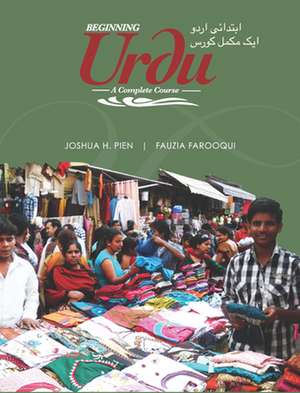
Beginning Urdu
Autor Joshua H. Pienen Limba Engleză Paperback – 18 iun 2012
Preț: 471.47 lei
Preț vechi: 582.06 lei
-19%
Puncte Express: 707
Carte indisponibilă temporar
Livrare prin curier în România Termenul estimat este afișat lângă disponibilitate.
Transport gratuit pentru acest produs Plată online sau ramburs, în funcție de opțiunile comenzii.
Retur gratuit în 14 zile Comandă securizată și suport în română.
Specificații
ISBN-13: 9781589017788
ISBN-10: 1589017781
Pagini: 684
Dimensiuni: 217 x 286 x 35 mm
Greutate: 1.62 kg
Ediția:New.
Editura: Georgetown University Press
ISBN-10: 1589017781
Pagini: 684
Dimensiuni: 217 x 286 x 35 mm
Greutate: 1.62 kg
Ediția:New.
Editura: Georgetown University Press
V-ar putea interesa
-
 The Russian Language TodayLarissa Ryazanova-Clarke-15%Preț: 486.10 lei571.88 lei
 -
 Reaching MillennialsDavid StarkPreț: 113.09 lei
 -
 Managing the MillennialsChip EspinozaPreț: 161.01 lei
 -
 Baby Boomers and Generational ConflictJennie BristowPreț: 383.44 lei
 -
 Qualitative Research DesignJoseph A. Maxwell-15%Preț: 444.88 lei523.39 lei
 -
 InterViewsSteinar Kvale-22%Preț: 668.66 lei857.26 lei
 -
 Writing the Literature Review, First Edition: A Practical GuideSara Efrat EfronPreț: 324.91 lei
 -
 Preț: 79.70 lei
 -
 -22%Preț: 661.70 lei848.34 lei
 -
 Research Design (International Student Edition)John W. Creswell-22%Preț: 667.12 lei855.28 lei
 -
 Leading Intelligence AnalysisBruce E. Pease-18%Preț: 497.35 lei606.53 lei
 -
 -11%Preț: 31.95 lei35.76 lei
Cuprins
About Beginning UrduHow to Use This Book: For TeachersHow to Use This Book: For StudentsAbout the Urdu Language Sound System and ScriptPart I: Sound SystemLesson 1: Sounds nearly identical to EnglishLesson 2: Sounds slightly different from EnglishLesson 3: Aspirated consonants -- p, ch, k, bh, jh, and ghLesson 4: Dental and retroflex consonantsLesson 5: Retroflex flap consonants and the vowels ai and auLesson 6: The consonants q, x, and ghLesson 7: Nasalized vowels and doubled consonantsExercise Answers Part II: ScriptLesson 8: Introduction to the Urdu script: basic conceptsLesson 9: The jim series, sukun and tasdidLesson 10: The dal and re seriesLesson 11: The sin and suad seriesLesson 12: The vowels vao, chot ?i ye, and bar ?i yeLesson 13: fe, qaf, kaf, gaf, and lamLesson 14: Mim, chot ?i he, do casmi he, and nun ghunnaLesson 15: The to and ain seriesLesson 16: Additional symbols representing soundsExercise Answers Unit 1: Me and My School 1. IntroductionsMeeting Somebody NewIdentifying Classroom Items: Using Simple SentencesAsking and Answering QuestionsYes-or-No QuestionsHi, How are You? 2. Me and My ClassmatesPersonal PronounsPlurality and Respect 3. My ClassroomSaying There Is and There AreCounting Items and Using PluralsIndefinites: Koi and Kuch 4. Describing Classroom ItemsAdjectivesAdjectival Question WordsPlurality and Respect with Adjectives and Nouns 5. Giving Commands and Making RequestsThe InfinitiveGiving Commands with the Imperative 6. Unit 1 Review Activities Unit 2: My Family and My Home 7. Locating Places and ObjectsLocating Places in the City Using PostpositionsLocating Places within CountriesLocating ObjectsThe Oblique Case 8. Identifying Family MembersThe Possessive Postposition kaPossessive PronounsStating the Number of Siblings You Have Using X ka Y hona 9. Describing Family MembersDescribing a Person's Physical Appearance Using X ka Y honaStating a Person's Age Using kaOblique Adjectives 10. My Home, My PossessionsFeatures of One's Home: Using X me Y hona'Physical Possessions: Using X ke pas Y honaSummary of Possessive Constructions 11. Making ComparisonsComparativesOblique Pronoun FormsSuperlatives 12. Unit 2 Review Activities Unit 3: Daily Life 13. My Daily RoutineThe Present Habitual Verb TenseClock TimeUsing Postpositions with Verbs 14. My DayUses of the InfinitiveReflexive Pronouns 15. What's Happening: Reporting LiveNarrating Events in Progress: The Present ContinuousConjunct Verbs 16. Weather and ClimateDescribing the WeatherDescribing the Climate 17. Unit 3 Review Activities Unit 4: In the Market 18. Expressing Likes, Needs, and DesiresIndirect ConstructionsContracted ko Pronoun FormsWhat One Likes to Do and Other Useful Expressions 19. Measures 20. Choosing ItemsUsing vala to Indicate an Item 21. Discussing PricesPrice per ItemPrice per Unit of MeasureTranslating 'for' with Prices 22. Unit 4 Review Activities Unit 5: My Childhood 23. My Childhood HomeDescribing Past Circumstances: Using the Simple Past 24. Describing One's ChildhoodDescribing Circumstances over Time: The Habitual Past Tense 25. Describing a Scene in the PastDescribing Events in Progress at a Particular Moment in the Past: Using the Past Continuous 26. Expressions of TimeReference List of Clock-Related Time ExpressionsReference List of Non-Clock Time Expressions 27. Unit 5 Review Activities Unit 6: Rules and Responsibilities 28. What We Can and Can't DoSakna, to be able toV-ne dena, to let, to allowPana, to be able to 29. Expressing CompulsionExpressing Compulsion: Using Indirect Constructions 30. Giving and Following InstructionsBasic Uses of the SubjunctiveVerbs with Irregular Subjunctive FormsExpressing What One Wants from Others 31. Unit 6 Review Activities Unit 7: A Trip to South Asia 32. My PlansThe Future Verb TenseInvitations and Plans 33. My Travel Plans: Definite and PossibleDiscussing Possible Plans Using Subordinating Expressions 34. Arranging Transportation and LodgingHow Long it Takes and How Much it Costs: V-ne me ? lagnaThe Bus Coming from Agra is About to Arrive: V-ne vala 35. Finding One's WayAdverbsPerspective in DirectionsRegional Differences in Subjunctive and Imperative Usage 36. Sharing Information about Locations in South AsiaTalking About Information Known or Perceived: Using the Conjunction ki 37. Unit 7 Review Activities Unit 8: My Experiences 38. My WeekendThe PerfectiveTransitive and Intransitive VerbsThe Perfective of Transitive VerbsAdditional Notes on the Perfective 39. Narrating a StoryThe Past PerfectThe kar Construction 40. My Experience and AccomplishmentsThe Present Perfect Verb TenseStating how long you have been doing somethingThings I have Already Done: Using cukna 41. At the Doctor'sAilments and Physical ConditionsExpressing the Beginning of Something: Using V-ne lagnaCompound Verbs 42. Unit 8 Review Activities Appendix 1: Numbers Appendix 2: Grammar Supplement Appendix 3: Additional Information for Teachers Urdu-English Glossary English-Urdu Glossary
Notă biografică
Joshua H. Pien is a faculty researcher and Hindi-Urdu language specialist at the National Foreign Language Center at the University of Maryland. Previously he was an assistant professor of Hindi at the Defense Language Institute in Monterey, California. He has also taught Hindi at the University of Wisconsin.
Fauzia Farooqui teaches Urdu and Hindi at Princeton University. She has also taught Urdu-Hindi at various other institutions, including the University of Virginia, the Defense Language Institute, University of Michigan, and the American Institute of Indian Studies in Lucknow, India. Her other publications include a monograph on the prose poem in Urdu and various original pieces of poetry, short fiction, and literary criticism, which have appeared in leading Urdu literary journals.
Fauzia Farooqui teaches Urdu and Hindi at Princeton University. She has also taught Urdu-Hindi at various other institutions, including the University of Virginia, the Defense Language Institute, University of Michigan, and the American Institute of Indian Studies in Lucknow, India. Her other publications include a monograph on the prose poem in Urdu and various original pieces of poetry, short fiction, and literary criticism, which have appeared in leading Urdu literary journals.