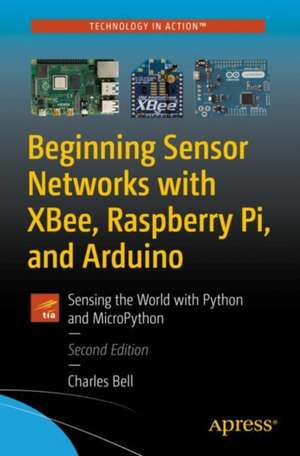
Beginning Sensor Networks with Xbee, Raspberry Pi, and Arduino
Autor Charles Bellen Limba Engleză Paperback – 26 iun 2020
Ecosistemul abordat în această a doua ediție a Beginning Sensor Networks with Xbee, Raspberry Pi, and Arduino este unul complex, dar extrem de bine structurat, acoperind modulele radio XBee 3, microcontrolerele Arduino și mediul de calcul Raspberry Pi. Credem că valoarea adăugată a acestei lucrări constă în modul în care Charles Bell reușește să lege hardware-ul de procesarea robustă a datelor, învățând cititorul să configureze un server MySQL direct pe Raspberry Pi pentru stocarea informațiilor colectate.
Spre deosebire de Building Wireless Sensor Networks Using Arduino de Matthijs Kooijman, care se concentrează predominant pe platforma Arduino ca standard de prototipare, lucrarea de față extinde orizontul către Python și MicroPython, oferind o soluție completă de tip cap-la-cap (end-to-end). Dacă titlul lui Kooijman v-a oferit cadrul teoretic pentru rețele wireless simple, această carte oferă instrumentele practice pentru a construi rețele de senzori sofisticate, capabile să comunice cu baze de date relaționale.
Structura este riguros organizată: primele capitole definesc terminologia și protocoalele XBee, continuând cu instrucțiuni detaliate despre programarea în MicroPython. Reținem progresia logică de la construirea nodurilor individuale de senzori la integrarea acestora într-o rețea mesh XBee-ZB. Această abordare practică este o continuare naturală a temelor explorate de autor în MicroPython for the Internet of Things, unde punea accent pe accesibilitatea limbajului, însă aici accentul cade pe scalabilitate și persistența datelor, reflectând expertiza sa profesională în ecosistemul MySQL.
Preț: 480.56 lei
Preț vechi: 600.71 lei
-20%
Carte tipărită la comandă
Livrare economică 15-29 iunie
Specificații
ISBN-10: 1484257952
Pagini: 716
Ilustrații: XXVI, 716 p. 164 illus., 161 illus. in color.
Dimensiuni: 155 x 235 x 39 mm
Greutate: 1.11 kg
Ediția:2nd edition
Editura: Apress
Locul publicării:Berkeley, CA, United States
V-ar putea interesa
-
 -32%Preț: 412.75 lei609.17 lei
 -
 Arduino for DummiesJohn Nussey-20%Preț: 137.24 lei171.55 lei
 -
 Raspberry Pi for DummiesSean Mcmanus-20%Preț: 112.30 lei140.37 lei
 -
 -28%Preț: 143.57 lei199.07 lei
 -
 -29%Preț: 71.52 lei101.05 lei
 -
 Beginning Node.jsBasarat Syed-20%Preț: 463.91 lei579.90 lei
 -
 -20%Preț: 209.98 lei262.47 lei
 -
 Node.jsSebastian Springer-20%Preț: 269.93 lei337.41 lei
 -
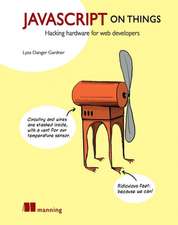 JavaScript on ThingsLyza Danger Gardner-20%Preț: 231.39 lei289.23 lei
 -
 Making Things TalkTom Igoe-20%Preț: 204.26 lei255.32 lei
 -
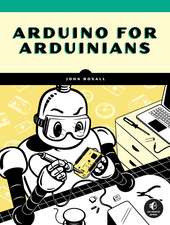 -37%Preț: 192.33 lei303.64 lei
 -
 Python Playground, 2nd Edition: Geeky Projects for the Curious ProgrammerMahesh Venkitachalam-36%Preț: 217.58 lei339.49 lei
 -
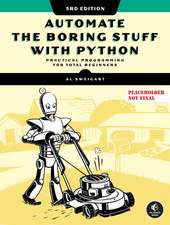 -36%Preț: 275.84 lei430.40 lei
 -
 -37%Preț: 267.04 lei423.74 lei
 -
 Raspberry Pi 3 in Easy StepsMike Mcgrath-20%Preț: 71.17 lei88.97 lei
 -
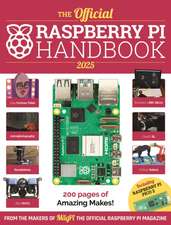 The Official Raspberry Pi Handbook 2025The Makers of the Magpi Magazine-20%Preț: 110.27 lei137.83 lei
 -
 The Official Raspberry Pi Handbook 2026The Makers of Raspberry Pi Official Magazine-20%Preț: 104.14 lei130.17 lei
 -
 Concise Guide to the Internet of ThingsMichael Mccarthy-20%Preț: 423.91 lei529.89 lei
 -
 Tales for MakersEnrico Miglino-20%Preț: 245.59 lei306.98 lei
 -
 AI and MicroservicesDileep Kumar Pandiya-20%Preț: 253.04 lei316.29 lei
De ce să citești această carte
Recomandăm această carte pasionaților de IoT și inginerilor care doresc să treacă de la simple proiecte de amator la rețele de senzori profesionale. Veți câștiga abilități practice de interfațare între Arduino și MySQL, învățând să gestionați datele nu doar la nivel de semnal, ci și la nivel de stocare pe termen lung. Este un ghid esențial pentru oricine dorește să stăpânească ecosistemul XBee 3 folosind Python.
Despre autor
Dr. Charles Bell este Senior Software Engineer la Oracle, ocupând poziția de dezvoltator principal pentru soluțiile de backup în cadrul echipei MySQL Backup and Replication. Cu un doctorat în inginerie obținut la Virginia Commonwealth University, Bell îmbină rigoarea academică cu experiența practică din industria software. Interesele sale de cercetare includ sistemele de baze de date, web-ul semantic și dezvoltarea agilă, elemente care se reflectă în claritatea cu care explică integrarea bazelor de date în proiectele hardware. Este un autor prolific în zona tehnologiilor emergente, publicând lucrări de referință despre MicroPython, imprimare 3D și soluții IoT.
Cuprins
Chapter Goal: Demonstrate how to create sensor nodes using an Arduino including introducing the Arduino platform.
•Local Storage Options for the Raspberry Pi
Chapter Goal: Introduce MySQL Connector/Arduino and demonstrate how to connect Arduino directly to a MySQL server to store data via several example projects.
•Project: Building an Arduino MySQL Client
Notă biografică
Charles Bell conducts research in emerging technologies. He is a member of the Oracle MySQL Development team and is the team lead for the MySQL Utilities team. He lives in a small town in rural Virginia with his loving wife. He received his Doctor of Philosophy in Engineering from Virginia Commonwealth University in 2005. Dr. Bell is an expert in the database field and has extensive knowledge and experience in software development and systems engineering. His research interests include 3D printers, microcontrollers, three-dimensional printing, database systems, software engineering, and sensor networks. He spends his limited free time as a practicing Maker focusing on microcontroller projects and refinement of three-dimensional printers. Dr. Bell maintains a blog on his research projects and many other interests.
Caracteristici
Illustrates how to use Python and MicroPython to build sensor nodes versus using more complicated languages and commands
Combines example projects and just enough academic principles to make sensor networks accessible for all readers
Descriere
- Code your sensor nodes with Python and MicroPython
- Work with new XBee 3 modules
- Host your data on Raspberry Pi
- Get started with MySQL
- Create sophisticated sensor networks