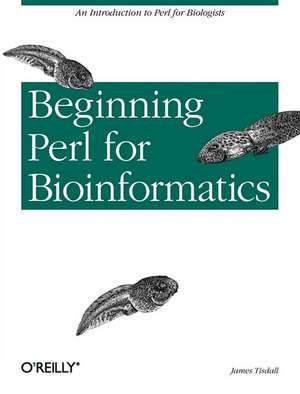
Beginning Perl for Bioinformatics
Autor James Tisdallen Limba Engleză Paperback – 27 noi 2001
Preț: 199.00 lei
Preț vechi: 248.75 lei
-20%
Puncte Express: 299
Carte disponibilă
Livrare economică 31 octombrie-14 noiembrie
Livrare prin curier în România Termenul estimat este afișat lângă disponibilitate.
Transport gratuit de la 400.00 lei Plată online sau ramburs, în funcție de opțiunile comenzii.
Retur gratuit în 14 zile Comandă securizată și suport în română.
Specificații
ISBN-13: 9780596000806
ISBN-10: 0596000804
Pagini: 384
Ilustrații: 1, black & white illustrations
Dimensiuni: 182 x 238 x 24 mm
Greutate: 0.63 kg
Editura: O'Reilly
ISBN-10: 0596000804
Pagini: 384
Ilustrații: 1, black & white illustrations
Dimensiuni: 182 x 238 x 24 mm
Greutate: 0.63 kg
Editura: O'Reilly
V-ar putea interesa
-
 First CourseEdward Hill-20%Preț: 56.63 lei70.78 lei
 -
 Data Structures in CNoel Kalicharan-20%Preț: 206.73 lei258.41 lei
 -
 Parallel and Concurrent Programming in HaskellSimon Marlow-20%Preț: 275.93 lei344.92 lei
 -
 Python Pocket ReferenceMark Lutz-20%Preț: 114.44 lei143.06 lei
 -
 Lift CookbookRichard Dallaway-20%Preț: 150.73 lei188.41 lei
 -
 C++ for C ProgrammersMR J. T. Kalnay-20%Preț: 93.07 lei116.34 lei
 -
 The REXX Language on TSOGabriel F. Gargiulo-20%Preț: 123.20 lei154.00 lei
 -
 The Big Book of Raspberry PiMiss Alison Watson-20%Preț: 70.96 lei88.70 lei
 -
 -20%Preț: 313.09 lei391.35 lei
 -
 Ruby Pocket ReferenceMichael Fitzgerald-20%Preț: 68.35 lei85.45 lei
 -
 Beginning PHP & MySQL DevelopmentPawprints Learning Technologies-20%Preț: 93.44 lei116.79 lei
 -
 Curso de Programacion Con IOSAngel Arias-20%Preț: 222.50 lei278.12 lei
 -
 PHPCodewell Academy-20%Preț: 58.80 lei73.49 lei
 -
 Python Para InformaticosDr Charles Russell Severance-20%Preț: 65.48 lei81.85 lei
 -
 Absolute Beginner (Part 1) Java 4 Selenium WebdriverRex Allen Jones II-20%Preț: 75.69 lei94.62 lei
 -
 Build a Fantastic Web Browser in Java in 5 Steps!Marcelo Cintra Bitencourt-20%Preț: 55.44 lei69.31 lei
 -
 Effective Python Development for BiologistsDr Martin Jones-20%Preț: 222.61 lei278.27 lei
 -
 A World Tour of True BasicArscott, John R.-20%Preț: 226.93 lei283.66 lei
 -
 JavaScriptFelix Alvaro-20%Preț: 104.93 lei131.16 lei
 -
 Android ProgrammingSchuler, Mitchell-20%Preț: 67.57 lei84.46 lei
 -
 Gradle EssentialsKunal Dabir-20%Preț: 172.96 lei216.19 lei
 -
 Magento 2 Developers GuideBranko Ajzele-20%Preț: 236.23 lei295.28 lei
 -
 Programming Ruby 1.9 & 2.0Dave Thomas-20%Preț: 341.10 lei426.37 lei
Cuprins
Preface; What Is Bioinformatics?; About This Book; Who This Book Is For; Why Should I Learn to Program?; Structure of This Book; Conventions Used in This Book; Comments and Questions; Acknowledgments; Chapter 1: Biology and Computer Science; 1.1 The Organization of DNA; 1.2 The Organization of Proteins; 1.3 In Silico; 1.4 Limits to Computation; Chapter 2: Getting Started with Perl; 2.1 A Low and Long Learning Curve; 2.2 Perl's Benefits; 2.3 Installing Perl on Your Computer; 2.4 How to Run Perl Programs; 2.5 Text Editors; 2.6 Finding Help; Chapter 3: The Art of Programming; 3.1 Individual Approaches to Programming; 3.2 Edit-Run-Revise (and Save); 3.3 An Environment of Programs; 3.4 Programming Strategies; 3.5 The Programming Process; Chapter 4: Sequences and Strings; 4.1 Representing Sequence Data; 4.2 A Program to Store a DNA Sequence; 4.3 Concatenating DNA Fragments; 4.4 Transcription: DNA to RNA; 4.5 Using the Perl Documentation; 4.6 Calculating the Reverse Complement in Perl; 4.7 Proteins, Files, and Arrays; 4.8 Reading Proteins in Files; 4.9 Arrays; 4.10 Scalar and List Context; 4.11 Exercises; Chapter 5: Motifs and Loops; 5.1 Flow Control; 5.2 Code Layout; 5.3 Finding Motifs; 5.4 Counting Nucleotides; 5.5 Exploding Strings into Arrays; 5.6 Operating on Strings; 5.7 Writing to Files; 5.8 Exercises; Chapter 6: Subroutines and Bugs; 6.1 Subroutines; 6.2 Scoping and Subroutines; 6.3 Command-Line Arguments and Arrays; 6.4 Passing Data to Subroutines; 6.5 Modules and Libraries of Subroutines; 6.6 Fixing Bugs in Your Code; 6.7 Exercises; Chapter 7: Mutations and Randomization; 7.1 Random Number Generators; 7.2 A Program Using Randomization; 7.3 A Program to Simulate DNA Mutation; 7.4 Generating Random DNA; 7.5 Analyzing DNA; 7.6 Exercises; Chapter 8: The Genetic Code; 8.1 Hashes; 8.2 Data Structures and Algorithms for Biology; 8.3 The Genetic Code; 8.4 Translating DNA into Proteins; 8.5 Reading DNA from Files in FASTA Format; 8.6 Reading Frames; 8.7 Exercises; Chapter 9: Restriction Maps and Regular Expressions; 9.1 Regular Expressions; 9.2 Restriction Maps and Restriction Enzymes; 9.3 Perl Operations; 9.4 Exercises; Chapter 10: GenBank; 10.1 GenBank Files; 10.2 GenBank Libraries; 10.3 Separating Sequence and Annotation; 10.4 Parsing Annotations; 10.5 Indexing GenBank with DBM; 10.6 Exercises; Chapter 11: Protein Data Bank; 11.1 Overview of PDB; 11.2 Files and Folders; 11.3 PDB Files; 11.4 Parsing PDB Files; 11.5 Controlling Other Programs; 11.6 Exercises; Chapter 12: BLAST; 12.1 Obtaining BLAST; 12.2 String Matching and Homology; 12.3 BLAST Output Files; 12.4 Parsing BLAST Output; 12.5 Presenting Data; 12.6 Bioperl; 12.7 Exercises; Chapter 13: Further Topics; 13.1 The Art of Program Design; 13.2 Web Programming; 13.3 Algorithms and Sequence Alignment; 13.4 Object-Oriented Programming; 13.5 Perl Modules; 13.6 Complex Data Structures; 13.7 Relational Databases; 13.8 Microarrays and XML; 13.9 Graphics Programming; 13.10 Modeling Networks; 13.11 DNA Computers; Appendix A: Resources; A.1 Perl; A.2 Computer Science; A.3 Linux; A.4 Bioinformatics; A.5 Molecular Biology; Appendix B: Perl Summary; B.1 Command Interpretation; B.2 Comments; B.3 Scalar Values and Scalar Variables; B.4 Assignment; B.5 Statements and Blocks; B.6 Arrays; B.7 Hashes; B.8 Operators; B.9 Operator Precedence; B.10 Basic Operators; B.11 Conditionals and Logical Operators; B.12 Binding Operators; B.13 Loops; B.14 Input/Output; B.15 Regular Expressions; B.16 Scalar and List Context; B.17 Subroutines and Modules; B.18 Built-in Functions; Colophon;