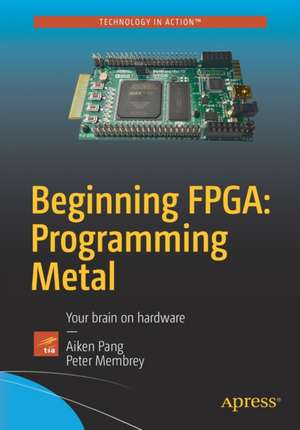
Beginning FPGA: Programming Metal
Autor Aiken Pang, Peter Membreyen Limba Engleză Paperback – 24 dec 2016
Subliniem structura progresivă a acestui volum, care ghidează cititorul de la conceptul fundamental de poartă logică până la implementarea fizică pe siliciu. Considerăm că Beginning FPGA: Programming Metal reușește să demistifice arhitectura Field-Programmable Gate Array, transformând un subiect adesea intimidant într-o suită de experimente accesibile. Spre deosebire de alte resurse academice, autorii Aiken Pang și Peter Membrey nu solicită o diplomă în inginerie electronică, ci mizează pe curiozitatea celor care au experimentat deja cu ecosistemele Arduino sau Raspberry Pi. Dacă FPGA-Based Embedded System Developer's Guide v-a oferit cadrul teoretic și o privire de ansamblu asupra tehnologiei VLSI, această carte oferă instrumentele practice și codul sursă necesar pentru a „programa metalul” în mod direct. Apreciem modul în care este organizat cuprinsul: Partea I și II pun bazele toolchain-ului și ale limbajului VHDL, introducând algebra booleană și logica secvențială într-un stil prietenos. Ulterior, accentul se mută pe aplicații concrete. Cititorul învață să construiască un senzor de lumină transformat în barieră laser, un termometru digital și să utilizeze un accelerometru pentru măsurarea vitezei. Un punct forte al lucrării este capitolul dedicat comunicării I2C, unde FPGA-ul este configurat să dialogheze cu un Raspberry Pi, demonstrând versatilitatea acestor dispozitive în proiecte complexe de tip Internet of Things. Stilul narativ este tehnic, dar extrem de practic, axat pe rezultate imediate care pot fi vizualizate pe afișaje LED sau monitorizate prin senzori, oferind o bază solidă în VHDL, o competență extrem de căutată în industria hardware actuală.
Preț: 391.32 lei
Preț vechi: 489.14 lei
-20%
Carte tipărită la comandă
Livrare economică 05-19 decembrie
Specificații
ISBN-10: 1430262478
Pagini: 408
Ilustrații: XV, 387 p. 339 illus., 312 illus. in color.
Dimensiuni: 178 x 254 x 23 mm
Greutate: 0.7 kg
Ediția:1st edition
Editura: Apress
Locul publicării:Berkeley, CA, United States
V-ar putea interesa
-
 Fundamentals of Digital Logic with Verilog DesignStephen Brown-18%Preț: 1491.35 lei1818.72 lei
 -
 -40%Preț: 488.78 lei820.18 lei
 -
 Electronics For Dummies, UK EditionCathleen ShamiehPreț: 145.47 lei
 -
 Learning the Art of ElectronicsThomas C. Hayes-8%Preț: 582.56 lei633.22 lei
 -
 SoPC SystemChu-9%Preț: 897.28 lei986.02 lei
 -
 Designing the Internet of ThingsAdrian Mcewen-20%Preț: 121.71 lei152.14 lei
 -
 Adventures in ArduinoBecky StewartPreț: 111.83 lei
 -
 Arduino for DummiesJohn Nussey-20%Preț: 147.60 lei184.49 lei
 -
 -26%Preț: 278.04 lei374.10 lei
 -
 -31%Preț: 176.73 lei257.72 lei
 -
 Digital Electronics: A Practical Approach with VHDLWilliam Kleitz-13%Preț: 581.68 lei668.61 lei
 -
 -26%Preț: 91.29 lei122.92 lei
 -
 -20%Preț: 608.92 lei761.16 lei
 -
 -19%Preț: 297.86 lei369.37 lei
 -
 -19%Preț: 282.20 lei348.18 lei
 -
 -34%Preț: 244.01 lei372.06 lei
 -
 Quick Start Guide to VHDLBrock J. LameresPreț: 518.91 lei
 -
 FPGA Programming and Hardware EssentialsDogan IbrahimPreț: 266.96 lei
Public țintă
Popular/generalDe ce să citești această carte
Recomandăm această carte pasionaților de electronică și programare care doresc să depășească limitele microcontrolerelor clasice. Veți câștiga o înțelegere profundă a modului în care funcționează hardware-ul la nivel logic, învățând VHDL prin proiecte distractive și utile. Este resursa ideală pentru a trece de la simpla utilizare a componentelor la proiectarea propriilor circuite integrate digitale, folosind platforma accesibilă BeMicro MAX 10.
Despre autor
Aiken Pang și Peter Membrey sunt specialiști cu o vastă experiență în inginerie și sisteme integrate. Aiken Pang aduce expertiza tehnică necesară pentru implementările hardware de precizie, în timp ce Peter Membrey este un autor consacrat în literatura IT, cunoscut pentru capacitatea de a explica tehnologii complexe pe înțelesul tuturor. Împreună, aceștia au adaptat metodologia de învățare pentru a servi comunității maker, punând accent pe accesibilitatea uneltelor și pe relevanța practică a limbajului VHDL în contextul dezvoltării hardware moderne.
Descriere scurtă
You don't need an electronics engineering degree or even any programming experience to get the most out of Beginning FPGA: Programming Metal. Just bring your curiosity and your Field-Programmable Gate Array. This book is for those who have tinkered with Arduino or Raspberry Pi, and want to get more hands-on experience with hardware or for those new to electronics who just want todive in.
You'll learn the theory behind FPGAs and electronics, including the math and logic you need to understand what's happening - all explained in a fun, friendly, and accessible way. It also doesn't hurt that you'll be learning VHDL, a hardware description language that is also an extremely marketable skill.
- Learn what an FPGA is and how it's different from a microcontroller or ASIC
- Set up your toolchain
- Use VHDL, a popular hardware description language, to tell your FPGA what to be
- Explore the theory behind FPGA and electronics
- Use your FPGA with a variety of sensors and to talk to a Raspberry Pi
Cuprins
1. What is an FPGA and What Can It Do?
2. Our Weapon of Choice
3. Lock and Load
4. Hello World!
Part II: Time out for Theory
5. FPGA Development Timeline
6. VHDL 101
7. Number Theory for FPGAs
8. Telling the Truth: Boolean Algebra and Truth Tables
9. Simplifying Boolean Algebra for FPGA
10. Sequential Logic: IF this, THEN that
11. Combinatorial Logic: Putting it all together on the FPGA
Part III: Let's Make Something!
12. Light Sensors: Turning a Laser Pointer into a Hi-tech Tripwire
13. Temperature Sensors: Is it Hot in Here, or Is It Just Me?
14. How Fast Can You Run? Ask the Accelerometer!
Part IV: Taking It Further: Talking to the Raspberry Pi and LED Displays
15. I2C: Two-way Communications with Your Raspberry Pi
16. Up in Lights: How to Drive LED Segment Displays
Notă biografică
Aiken followed his passion for computing into more formal studies and holds a BEng in Electronics Engineering and an MSc in Computer Engineering from the Hong Kong Polytechnic University and the University of Massachusetts at Lowell respectively. He has been using VHDL to design hardware in FPGAs for over 10 years.
He lives in the USA with his wife France and their daughter Mayah.