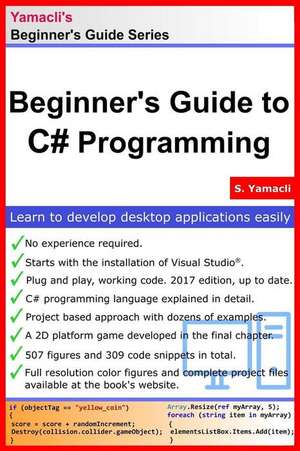
Beginner's Guide to C# Programming
Autor Serhan Yamaclien Limba Engleză Paperback – 3 iul 2017
Cititorul care a parcurs C#: A Beginner's Guide de Pat McGee va găsi în lucrarea lui Serhan Yamacli elementul practic ce completează teoria: o abordare vizuală masivă, susținută de peste 500 de figuri și capturi de ecran. Considerăm că Beginner's Guide to C# Programming se distinge prin modul în care prioritizează interfața grafică (GUI) încă din primele capitole. În timp ce alte cursuri introductive amână contactul cu elementele vizuale, această carte introduce Visual Studio și Windows Forms imediat după instalarea mediului de lucru.
Recomandăm acest volum pentru structura sa tehnică riguroasă, împărțită în 16 capitole ce progresează de la elemente de bază — variabile, bucle și tablouri de date — către concepte complexe de programare orientată pe obiecte. Un aspect diferențiator major față de titluri precum C# de Raj Ali este includerea capitolului dedicat bazelor de date ADO.NET, unde cititorul învață să conecteze aplicațiile la baze de date Access pentru stocarea permanentă a informațiilor. Mai mult, finalul cărții face tranziția către dezvoltarea de jocuri, oferind un ghid practic pentru motorul Unity. Stilul de scriere este unul aplicat, axat pe proiecte de tip 'test drive', care permit validarea imediată a codului scris. Documentația este completată de resurse online, oferind fișierele de proiect în format complet pentru a asigura o experiență de învățare fără blocaje tehnice.
Preț: 229.70 lei
Preț vechi: 287.13 lei
-20%
Carte disponibilă
Livrare economică 12-26 noiembrie
Specificații
ISBN-10: 1548495174
Pagini: 442
Greutate: 0.59 kg
Editura: CreateSpace Independent Publishing Platform
V-ar putea interesa
-
 Learning SQL: Generate, Manipulate, and Retrieve DataAlan Beaulieu-20%Preț: 324.02 lei405.03 lei
 -
 Learn C# in One Day and Learn It WellJamie Chan-20%Preț: 66.22 lei82.77 lei
 -
 The Book of RTilman M. Davies-34%Preț: 311.42 lei473.44 lei
 -
 The Beginner's Guide to CEric R Frick-20%Preț: 87.31 lei109.14 lei
 -
 Learn Visual C# 2019 EditionPhilip Conrod-19%Preț: 534.70 lei660.12 lei
 -
 Visual C# and Databases 2019 EditionPhilip Conrod-19%Preț: 537.70 lei663.82 lei
De ce să citești această carte
Recomandăm această carte începătorilor care doresc o metodă de învățare bazată pe vizualizare și practică imediată. Spre deosebire de manualele teoretice, volumul oferă un parcurs clar de la 'Hello World' la un joc 2D funcțional în Unity. Este un instrument excelent pentru cei care vor să construiască aplicații desktop cu interfețe grafice complexe și să înțeleagă integrarea bazelor de date în C#, totul într-un format pas-cu-pas ușor de urmărit.
Descriere
This book covers C# programming with a practical approach.
The author assumes you have no experience in programming. The book starts with the installation of the required programming environment. Then, the simplest "Hello World" program is developed step by step. In the next three chapters (Chapters 4 to 6), Windows forms (the visual part of desktop programs) and their components are studied with practical examples. Screenshots and code snippets are clearly given in the book to guide the reader. After teaching the graphical user interface (GUI) design, C# programming is covered in an organized manner in the following eight chapters (Chapters 7 to 14) with dozens of example projects. As the reader follows the development of the sample projects, he/she will learn designing user interfaces, connecting interface objects to code, developing efficient C# code and generating standalone programs. Connecting to Access databases from our C# programs for permanent data storage is explained in Chapter 15. In the last Chapter, the basics of Unity game engine are given and a simple 2D platform game is developed in Unity using C#.
Chapters of the book and the contents of these chapters are as follows:
Chapter 1. Introduction: General info on C# and .NET environment.
Chapter 2. Setting up your development environment: Installing and configuring Visual Studio.
Chapter 3. Test drive - the "Hello World" project: Creating a new Visual C# project, adding and positioning a Label and building the project.
Chapter 4. Form (GUI) elements: Containers, menus, dialog windows, components, controls, properties and events of controls.
Chapter 5. Common controls: Using common controls like Buttons, TextBoxes and ProgressBars in our projects (a total of 21 commonly used controls are studied).
Chapter 6. Menus, dialogs and containers: Utilizing various menu types, using dialog windows to take user input, file open/save operations and incorporating containers to organize the form layout.
Chapter 7. Variables and constants: Organized C# programming begins in this chapter. Declaring variables, variable types, type conversions and constants.
Chapter 8. Conditional statements: Operators, various types of if-else structures and switch-case statements.
Chapter 9. Loops: The need for loops in our programs. Utilization of for, foreach, while and do-while loops. Break and continue statements.
Chapter 10. Arrays and collections: Declaring arrays, using multidimensional arrays and array operations. Hashtable and ArrayList structures for storing multiple types of variables together.
Chapter 11. Methods: Method declarations, scopes of methods, passing variables by value and by reference.
Chapter 12. Classes and objects: The class-object concept. Declaring and using classes. Creating objects. Utilizing several constructor methods for flexibility.
Chapter 13. Frequently used classes in C#: Utilizing the methods of the String class, the StringBuilder class and the Math class.
Chapter 14. Handling Errors: Preventing our programs from crashes in case of errors. Try-catch, try-catch-finally structures and the throw keyword.
Chapter 15. Database connections using ADO.NET: Creating Access databases from scratch, reading and modifying database entries from our C# programs.
Chapter 16. Developing a 2D game in Unity using C#: Installing the Unity game engine. Using C# in Unity to develop our own 2D platform game called Random Platformer. Exporting the game as a standalone program.
This book includes 507 figures and 309 code snippets that are used to explain C# programming and GUI development concepts clearly. Full resolution colour figures and complete project files can be downloaded from the book's companion website: www.yamaclis.com/csharp.