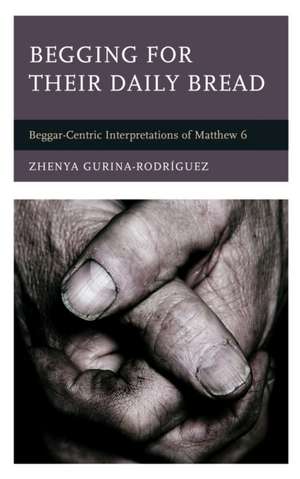
Begging for Their Daily Bread: Beggar-Centric Interpretations of Matthew 6
Autor Zhenya Gurina-Rodríguezen Limba Engleză Hardback – 29 sep 2022
Preț: 492.33 lei
Preț vechi: 716.89 lei
-31%
Puncte Express: 738
Preț estimativ în valută:
87.13€ • 101.83$ • 75.65£
87.13€ • 101.83$ • 75.65£
Carte tipărită la comandă
Livrare economică 19 februarie-05 martie
Preluare comenzi: 021 569.72.76
Specificații
ISBN-13: 9781978710627
ISBN-10: 1978710623
Pagini: 152
Dimensiuni: 160 x 239 x 19 mm
Greutate: 0.41 kg
Editura: Bloomsbury Publishing
Colecția Fortress Academic
Locul publicării:New York, United States
ISBN-10: 1978710623
Pagini: 152
Dimensiuni: 160 x 239 x 19 mm
Greutate: 0.41 kg
Editura: Bloomsbury Publishing
Colecția Fortress Academic
Locul publicării:New York, United States
Cuprins
Chapter 1: Positioning a Beggars-Centric Hermeneutic in New Testament Studies
Chapter 2: Socio-Economic Profile of Beggars in Antiquity
Chapter 3: On Receiving Alms (Matthew 6:1-4)
Chapter 4: On Praying and Fasting (Matthew 6:5-18)
Chapter 5: On Treasures, Eyes, Masters, and Worries (Matthew 6:19-34)
Chapter 6: Conclusion
Chapter 2: Socio-Economic Profile of Beggars in Antiquity
Chapter 3: On Receiving Alms (Matthew 6:1-4)
Chapter 4: On Praying and Fasting (Matthew 6:5-18)
Chapter 5: On Treasures, Eyes, Masters, and Worries (Matthew 6:19-34)
Chapter 6: Conclusion
Recenzii
Gurina-Rodriguez has produced a thoughtful, socially engaged, and methodologically
innovative study. It is a valuable resource not only for New Testament scholars but also for clergy, theologians, and practitioners committed to justice-oriented readings of Scripture. The study challenges traditional paradigms and offers an interpretive model that foregrounds the voices of the marginalized, thereby embodying the very ethics it seeks to explore.
Begging for Their Daily Bread offers a validly creative and challenging reading of the Sermon on the Mount ... While the author's main audience appears to be Christian ("in our faith tradition"), whoever seeks to stand in solidarity with the poor today through biblical interpretation would find this book enlightening.
This insightful and thought-provoking study aligns with other NT studies that examine the interactions between the majority, low-status, first-century, 'common folks' and NT texts. Yet Zhenya Gurina-Rodriguez presses into largely unexamined territory: how might the lowest of the low, beggars who pervaded the Roman world, engage Matthew's Sermon on the Mount? Employing several critical methods to construct a 'beggars-centric hermeneutic,' and recognizing the diverse experiences of beggars, she reads the Sermon with three beggars - Georgios, Elpida, and Kopreias. The result is an intriguing, multivalent, and compelling study.
This is a project of historical imagination, a proposal for how first-century beggars might have heard and responded to passages from the Sermon on the Mount. Inspired by the author's own concern about modern day inequities and how they affect the most vulnerable among us, the book prompts readers to consider how Jesus' most well-known teachings intersect with both ancient and modern economic realities.
Zhenya Gurina-Rodriguez's carefully constructed exposé into the lives of ancient beggars is a must-read for anyone interested in the daily realities of poverty in the Roman world. Her creation of a beggars-centric hermeneutic and her willingness to utilize historical imagination produce a fresh perspective on Matthew. Perhaps the most stimulating discussion is her profound attention to the ways in which Gospel teachings alienate beggars and others with little to no financial means.
innovative study. It is a valuable resource not only for New Testament scholars but also for clergy, theologians, and practitioners committed to justice-oriented readings of Scripture. The study challenges traditional paradigms and offers an interpretive model that foregrounds the voices of the marginalized, thereby embodying the very ethics it seeks to explore.
Begging for Their Daily Bread offers a validly creative and challenging reading of the Sermon on the Mount ... While the author's main audience appears to be Christian ("in our faith tradition"), whoever seeks to stand in solidarity with the poor today through biblical interpretation would find this book enlightening.
This insightful and thought-provoking study aligns with other NT studies that examine the interactions between the majority, low-status, first-century, 'common folks' and NT texts. Yet Zhenya Gurina-Rodriguez presses into largely unexamined territory: how might the lowest of the low, beggars who pervaded the Roman world, engage Matthew's Sermon on the Mount? Employing several critical methods to construct a 'beggars-centric hermeneutic,' and recognizing the diverse experiences of beggars, she reads the Sermon with three beggars - Georgios, Elpida, and Kopreias. The result is an intriguing, multivalent, and compelling study.
This is a project of historical imagination, a proposal for how first-century beggars might have heard and responded to passages from the Sermon on the Mount. Inspired by the author's own concern about modern day inequities and how they affect the most vulnerable among us, the book prompts readers to consider how Jesus' most well-known teachings intersect with both ancient and modern economic realities.
Zhenya Gurina-Rodriguez's carefully constructed exposé into the lives of ancient beggars is a must-read for anyone interested in the daily realities of poverty in the Roman world. Her creation of a beggars-centric hermeneutic and her willingness to utilize historical imagination produce a fresh perspective on Matthew. Perhaps the most stimulating discussion is her profound attention to the ways in which Gospel teachings alienate beggars and others with little to no financial means.