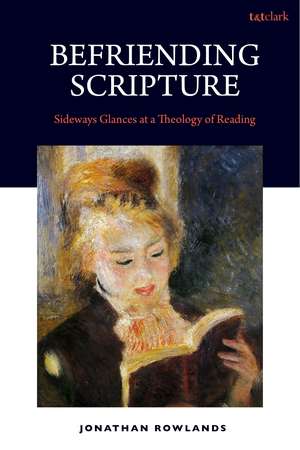
Befriending Scripture: Sideways Glances at a Theology of Reading: T&T Clark
Autor Dr Jonathan Rowlandsen Limba Engleză Hardback – 13 noi 2025
What cultures of reading are currently at play in the Church and the academy? What cultures of reading ought to be at play? In Befriending Scripture, Jonathan Rowlands suggests that much modern biblical hermeneutics has paid insufficient attention to the foundations of theological reading. For theological interpretation to make meaningful progress in both methodology and results, the very foundations of what it means to read, and to read theologically, must be examined and articulated afresh.
In this detailed and wide-ranging work, Rowlands addresses various topics relating to the Scripture's reading in the Church, including questions of Scripture's ontology, biblical hermeneutics, literary theory, antisemitism, historiography, and spiritual formation, amongst others. By rethinking Theological Interpretation of Scripture from its very foundations, Rowlands mediates between historical and theological approaches. In doing so, he offers a vision for theological reading that bridges the continuing disciplinary divide between biblical studies and systematic theology.
Din seria T&T Clark
- nou
 Preț: 251.73 lei
 - 44%
 Preț: 193.75 lei
 - 17%
 Preț: 121.19 lei
 - 42%
 Preț: 204.82 lei
 - 44%
 Preț: 476.43 lei
 - 44%
 Preț: 196.06 lei
 - 23%
 Preț: 308.75 lei
 - 45%
 Preț: 847.37 lei
 - 26%
 Preț: 206.16 lei
 -
 Preț: 155.84 lei
 - 46%
 Preț: 343.36 lei
 - 21%
 Preț: 320.71 lei
 - 24%
 Preț: 206.13 lei
 - 17%
 Preț: 356.75 lei
 - 7%
 Preț: 181.19 lei
 - 23%
 Preț: 273.18 lei
 - 44%
 Preț: 492.70 lei
 - 38%
 Preț: 372.63 lei
 - 21%
 Preț: 262.30 lei
 - 23%
 Preț: 238.95 lei
 - 33%
 Preț: 550.78 lei
 - 27%
 Preț: 438.54 lei
 - 27%
 Preț: 504.55 lei
 - 26%
 Preț: 210.68 lei
 - 19%
 Preț: 170.03 lei
 - 24%
 Preț: 200.81 lei
 - 25%
 Preț: 188.72 lei
 - 25%
 Preț: 208.34 lei
 - 25%
 Preț: 291.03 lei
 - 21%
 Preț: 273.32 lei
 - 52%
 Preț: 212.93 lei
 - 48%
 Preț: 894.33 lei
 - 26%
 Preț: 207.74 lei
 - 50%
 Preț: 243.97 lei
 - 25%
 Preț: 214.54 lei
 - 26%
 Preț: 143.12 lei
 - 19%
 Preț: 340.37 lei
 - 25%
 Preț: 184.54 lei
 - 21%
 Preț: 270.74 lei
 - 26%
 Preț: 207.19 lei
 - 25%
 Preț: 181.53 lei
 - 30%
 Preț: 437.98 lei
 -
 Preț: 236.11 lei
 - 18%
 Preț: 261.29 lei
 - 25%
 Preț: 178.97 lei
 - 24%
 Preț: 836.81 lei
 - 20%
 Preț: 169.95 lei
 - 24%
 Preț: 207.84 lei
Preț: 550.25 lei
Preț vechi: 816.49 lei
-33%
Puncte Express: 825
Carte tipărită la comandă
Livrare economică 30 noiembrie-14 decembrie
Livrare prin curier în România Termenul estimat este afișat lângă disponibilitate.
Transport gratuit pentru acest produs Plată online sau ramburs, în funcție de opțiunile comenzii.
Retur gratuit în 14 zile Comandă securizată și suport în română.
Specificații
ISBN-13: 9780567717351
ISBN-10: 0567717356
Pagini: 192
Dimensiuni: 154 x 236 x 16 mm
Greutate: 0.45 kg
Editura: Bloomsbury Publishing
Colecția T&T Clark
Seria T&T Clark
Locul publicării:London, United Kingdom
ISBN-10: 0567717356
Pagini: 192
Dimensiuni: 154 x 236 x 16 mm
Greutate: 0.45 kg
Editura: Bloomsbury Publishing
Colecția T&T Clark
Seria T&T Clark
Locul publicării:London, United Kingdom
Cuprins
Introduction
1. Theological Interpretation in Recent History
2. Outline of Befriending Scripture
3. Conclusion
Chapter 1 - The Benefits of Theological Reading
1. Problems Facing Biblical Studies
2. The Emergence of Reception History
3. A Way forward for Biblical Studies?
4. Conclusion
Chapter 2 - Scripture's Ontology and Theological Reading
1. John Webster on Scripture's Ontology
2. Textuality and Meaning
3. Conclusion
Chapter 3 - The Hermeneutics of Theological Reading
1. Gadamer and Hirsch on Reading and Meaning
2. Different Games, Competing Doxae
3. Doxa in Practice: An Example
4. Conclusion
Chapter 4 - 'Mood' and Theological Reading
1. Heidegger, Dasein, and 'Mood'
2. Reading with Suspicion
3. An Alternative 'Mood' for Reading Scripture
4. Conclusion
Chapter 5 - Formation and Theological Reading
1. Reading Scripture on the Road to Emmaus
2. Prayer and Theological Speech
3. Conclusion
Chapter 6 - Supercessionism and Theological Reading
1. The Old Testament as Jewish Literature
2. The New Testament as Jewish Literature
3. Conclusion
Chapter 7 - Historiography and Theological Reading
1. The Literal Sense of Scripture
2. Historie, Geschichte, and Myth in Bultmann's Demythologizing
3. Theology, Historiography, and Resurrection
4. Conclusion
Chapter 8 - In Place of a Conclusion
1. Summary of Befriending Scripture
2. Areas for Further Reflection
3. Sachkritik and Barth's Römerbrief
4. Conclusion
Bibliography
1. Theological Interpretation in Recent History
2. Outline of Befriending Scripture
3. Conclusion
Chapter 1 - The Benefits of Theological Reading
1. Problems Facing Biblical Studies
2. The Emergence of Reception History
3. A Way forward for Biblical Studies?
4. Conclusion
Chapter 2 - Scripture's Ontology and Theological Reading
1. John Webster on Scripture's Ontology
2. Textuality and Meaning
3. Conclusion
Chapter 3 - The Hermeneutics of Theological Reading
1. Gadamer and Hirsch on Reading and Meaning
2. Different Games, Competing Doxae
3. Doxa in Practice: An Example
4. Conclusion
Chapter 4 - 'Mood' and Theological Reading
1. Heidegger, Dasein, and 'Mood'
2. Reading with Suspicion
3. An Alternative 'Mood' for Reading Scripture
4. Conclusion
Chapter 5 - Formation and Theological Reading
1. Reading Scripture on the Road to Emmaus
2. Prayer and Theological Speech
3. Conclusion
Chapter 6 - Supercessionism and Theological Reading
1. The Old Testament as Jewish Literature
2. The New Testament as Jewish Literature
3. Conclusion
Chapter 7 - Historiography and Theological Reading
1. The Literal Sense of Scripture
2. Historie, Geschichte, and Myth in Bultmann's Demythologizing
3. Theology, Historiography, and Resurrection
4. Conclusion
Chapter 8 - In Place of a Conclusion
1. Summary of Befriending Scripture
2. Areas for Further Reflection
3. Sachkritik and Barth's Römerbrief
4. Conclusion
Bibliography
Recenzii
Scholarly yet accessible, Jonathan Rowlands' Befriending Scripture invites us to consider what it might look like to think with Scripture rather than against it. In suggesting we become more Christlike readers of the Bible, he does not sidestep the difficult questions involved in doing so responsibly in today's world. The prose is energetic, the mood is upbeat and the enthusiasm for the task is infectious.
"Let us befriend Scripture." With these words Jonathan Rowlands invites all Christian readers, and not only academic scholars, into a proper relationship with the word of the Lord delivered to the church by the embassy of the apostles and prophets. Because "Christ is alive," all is changed-not just readers but reading, not just texts but meaning, not just history but historiography. Rowlands calls it "resurrection historiography." This book is a rousing call to unapologetic and thorough-going but not uncritical theological interpretation of Holy Scripture as the church's book. Which is to say, as the book of the Spirit of Christ. I hope Rowlands finds a hearing in both theology and biblical studies and not a few eavesdroppers beyond those disciplines. He deserves it, because this is a major contribution to academic, ecclesial, and theological hermeneutics.
Befriending Scripture rightly raises questions about the cultures of reading that sustain hermeneutical theories and fund methods of biblical exegesis, in particular, theological interpretation. I welcome Rowlands's suggestion that Christian readers adopt a congenial rather than critical posture towards the Scriptures more in keeping with its Sache - its subject matter, namely, the active living subject Jesus Christ - and with their own aspiration to Christlikeness.
"Let us befriend Scripture." With these words Jonathan Rowlands invites all Christian readers, and not only academic scholars, into a proper relationship with the word of the Lord delivered to the church by the embassy of the apostles and prophets. Because "Christ is alive," all is changed-not just readers but reading, not just texts but meaning, not just history but historiography. Rowlands calls it "resurrection historiography." This book is a rousing call to unapologetic and thorough-going but not uncritical theological interpretation of Holy Scripture as the church's book. Which is to say, as the book of the Spirit of Christ. I hope Rowlands finds a hearing in both theology and biblical studies and not a few eavesdroppers beyond those disciplines. He deserves it, because this is a major contribution to academic, ecclesial, and theological hermeneutics.
Befriending Scripture rightly raises questions about the cultures of reading that sustain hermeneutical theories and fund methods of biblical exegesis, in particular, theological interpretation. I welcome Rowlands's suggestion that Christian readers adopt a congenial rather than critical posture towards the Scriptures more in keeping with its Sache - its subject matter, namely, the active living subject Jesus Christ - and with their own aspiration to Christlikeness.