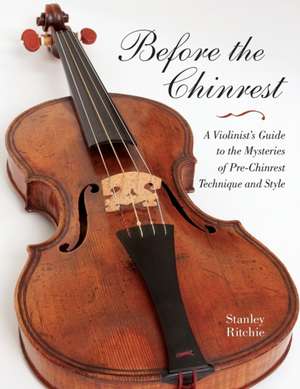
Before the Chinrest
Autor Stanley Ritchieen Limba Engleză Paperback – 16 iul 2012
Prezentat într-un format paperback practic, de 168 de pagini, volumul Before the Chinrest – A Violinist`s Guide to the Mysteries of Pre–Chinrest Technique and Style este conceput pentru a rezista pe pupitrul de studiu. Calitatea hârtiei permite o parcurgere facilă a celor 260 de exemple muzicale inserate, oferind claritatea necesară pentru exercițiile tehnice zilnice. Subliniem faptul că acest ghid nu este doar o incursiune istorică, ci un instrument de lucru riguros, ancorat în cele patru decenii de expertiză ale profesorului Stanley Ritchie. Notăm cu interes modul în care autorul sistematizează tranziția către vioara barocă și clasică, pornind de la fundamentul tehnic al lui Francesco Geminiani. Structura este progresivă: de la susținerea instrumentului fără bărbie, la mecanica subtilă a greutății brațului drept și complexitatea schimbărilor de poziție pentru mâna stângă. Credem că valoarea adăugată constă în secțiunea dedicată interpretării, unde sunt explorate concepte precum retorica, „tirania măsurii” și nuanțele armonice. Abordarea amintește de Violin Technique and Performance Practice in the Late Eighteenth and Early Nineteenth Centuries de Robin Stowell prin rigoarea cercetării tratatelor istorice, dar adaugă o dimensiune pedagogică imediată, transformând teoria în exerciții aplicabile chiar și pe instrumentul modern. Această lucrare completează viziunea autorului începută în The Accompaniment in "Unaccompanied" Bach, unde acesta explora profunzimile repertoriului pentru vioară solo. Dacă în opera anterioară accentul cădea pe interpretarea operelor lui Bach, aici Stanley Ritchie lărgește orizontul către întreaga estetică a secolelor XVII-XIX, oferind soluții concrete pentru intonație, vibrato și dinamica gesturilor muzicale.
Preț: 235.83 lei
Carte tipărită la comandă
Livrare economică 24 decembrie 26 - 07 ianuarie 27
Specificații
ISBN-10: 0253223180
Pagini: 168
Ilustrații: 260 music exx. and 1 b&w illustration
Dimensiuni: 220 x 288 x 15 mm
Greutate: 0.47 kg
Editura: Indiana University Press
V-ar putea interesa
-
 Accompaniment in "Unaccompanied" BachStanley RitchiePreț: 219.09 lei
-
 Preț: 336.10 lei
-
 Killed Strangely – The Death of Rebecca CornellElaine Forman CranePreț: 484.29 lei
-
 The Art of LifeJohn KekesPreț: 468.33 lei
-
 Horizons of the Sacred – Mexican Traditions in U.S. CatholicismTimothy Matovina-27%Preț: 767.00 lei1050.68 lei
-
 -23%Preț: 450.45 lei585.00 lei
-
 Preț: 204.12 lei
-
 Preț: 373.98 lei
-
 -23%Preț: 869.70 lei1129.47 lei
-
 Seeing the Gawain-PoetSarah Stanbury-11%Preț: 574.69 lei645.72 lei
-
 -23%Preț: 651.56 lei846.19 lei
-
 -23%Preț: 656.04 lei852.00 lei
-
 Visual PedagogyBrian GoldfarbPreț: 262.78 lei
-
 Neglected PoliciesIra L StrauberPreț: 262.37 lei
-
 Managing Your Hazardous Wastes: A Step-by-Step RCRA Compliance GuideJames K. Voyles, Esq.-35%Preț: 716.51 lei1097.37 lei
-
 Preț: 159.02 lei
-
 God, Time and BeingGhislain LafontPreț: 334.15 lei
-
 Hungry for Heaven.Ronda Desola ChervinPreț: 181.32 lei
-
 Academic Freedom, Logic, and ReligionMorton White-11%Preț: 661.80 lei743.60 lei
-
 Tuesdays at TenCornelius Weygandt-11%Preț: 670.86 lei753.78 lei
-
 An Analysis of Production of Worsted Sales YarnAlfred H Williams-11%Preț: 659.98 lei741.56 lei
-
 American-Russian Rivalry in the Far EastEdward H Zabriskie-11%Preț: 665.66 lei747.93 lei
-
 The Present and Future of the Telescope of Moderate SizeFrank Bradshaw Wood-11%Preț: 665.66 lei747.93 lei
-
 Philadelphia LibrariesBibliographical Planning Committee-11%Preț: 670.83 lei753.73 lei
-
 Fulcher of ChartresMartha Evelyn McGinty-11%Preț: 657.99 lei739.30 lei
-
 Metaphor, Sound, and Meaning in Bridges' the Testament of BeautyElizabeth Cox Wright-11%Preț: 670.86 lei753.78 lei
-
 Invisible FatherLouis BouyerPreț: 262.95 lei
-
 Why Catholic?John PasquiniPreț: 155.74 lei
De ce să citești această carte
Recomandăm această carte violoniștilor și violiștilor care doresc să descopere autenticitatea sunetului pre-bărbie. Cititorul câștigă o înțelegere profundă a tehnicilor de arcuș și a retoricii baroce, esențiale pentru o interpretare informată istoric. Este un ghid practic ce transformă misterele tehnicii vechi în abilități concrete, utile atât pe instrumente de epocă, cât și în adaptarea stilistică pe vioara modernă.
Descriere scurtă
Cuprins
Recenzii
"Useful and elegantly written, Stanley Ritchie's book will be a most valuable resource to accomplished modern violinists wishing to learn to play the baroque violin." Marc Destrube, violinist "Before the Chinrest is aimed at modern violinists and viola players who are 'curious to learn about technique and style as understood and practised by their seventeenth and eighteenth-century predecessors', so it is designed as a practical guide and includes a wealth of information, musical examples and technical exercises... Ritchie divides the book into four sections: right-hand technique, left-hand technique, interpretation, and a technique and intonation practice guide. I found myself in agreement with a great number of his points about matters technical and interpretative, and many of his technical exercises would be extremely helpful to those new to period playing. However, I would have expected more information on how the baroque violin differs in its setup from the modern and how the bow developed over the years, as well as some advice as to how to go about getting hold of the instruments, bows and gut strings... Before the Chinrest is highly recommended for what is included, but disappointing as to what is omitted. My recommendation to modern-trained players would be to buy Judy Tarling's Baroque String Playing for Ingenious Learners as an ideal reference book for this music and then use this new book for a more detailed practical guide to playing the instrument."-Classical Music, Dec 2012