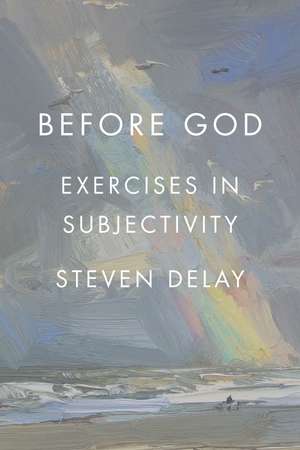
Before God: Exercises in Subjectivity
Autor Steven DeLayen Limba Engleză Hardback – 2 dec 2019
| Toate formatele și edițiile | Preț | Express |
|---|---|---|
| Paperback (1) | 242.75 lei 6-8 săpt. | |
| Bloomsbury Publishing – 16 iun 2022 | 242.75 lei 6-8 săpt. | |
| Hardback (1) | 690.18 lei 6-8 săpt. | |
| Bloomsbury Publishing – 2 dec 2019 | 690.18 lei 6-8 săpt. |
Preț: 690.18 lei
Preț vechi: 997.92 lei
-31%
Puncte Express: 1035
Preț estimativ în valută:
122.23€ • 142.75$ • 106.18£
122.23€ • 142.75$ • 106.18£
Carte tipărită la comandă
Livrare economică 21 februarie-07 martie
Preluare comenzi: 021 569.72.76
Specificații
ISBN-13: 9781786613165
ISBN-10: 1786613166
Pagini: 199
Dimensiuni: 152 x 230 x 18 mm
Greutate: 0.42 kg
Editura: Bloomsbury Publishing
Colecția Rowman & Littlefield Publishers
Locul publicării:New York, United States
ISBN-10: 1786613166
Pagini: 199
Dimensiuni: 152 x 230 x 18 mm
Greutate: 0.42 kg
Editura: Bloomsbury Publishing
Colecția Rowman & Littlefield Publishers
Locul publicării:New York, United States
Cuprins
1. Divine Things and the Fluidity of Thought / 2. The Interlacement of Self and God / 3.What is the Problem of Intersubjectivity? / 4. Forgiveness / 5. Making Peace / 6. A Sketch of Silence and Evil / 7. Suffering and Salvation: A Note on Art / 8. The Light that Lights Every Man
Recenzii
Before God is a richly insightful, frequently opinionated, and sometimes idiosyncratic book well worth the effort. This is philosophically-inspired discussion at the service of spiritual growth, enrichment, and conversion. It is a book I recommend and will very happily return to.
DeLay's account of a life lived before God succeeds in its task of shedding light on the world from the perspective of faith. This is in part because while the existence of God might not be a matter to be settled by description or argument, DeLay does provide a rich phenomenological characterization of what living with a secure faith and trust in God involves. It is a work of immense wisdom, compelling arguments, and rich phenomenological descriptions. It is, finally, a refreshing reminder of what draws most of us to philosophy in the first place: to grapple with ultimate questions of human existence, with clarity of thought and expression, and without methodological evasions.
The preposition "before", coram in the Latin, has had a distinguished intellectual history since Luther discovered its importance in Jerome's translation of the Bible. Steven DeLay comes after many theologians and philosophers who have described what man is "before God" - and who have done so because they found it fruitless to speak of man as he "is", substantially and before all relation. This clear and precise book summarizes a long episode. An original contribution to philosophy, it also brings noteworthy precisions.
Henry David Thoreau once wrote that "there are nowadays professors of philosophy, but no philosophers." In this brief claim, Thoreau challenges the hyper-professionalization of a discourse in which far too many scholars write books about what someone else has said, but rarely write books actually saying something worth hearing. Steven DeLay is a striking and exciting counter to this trend. In the very best sense of the term: DeLay is a philosopher in that he is devoted to a life in which he sees his task as in line with Thoreau's description: "to love wisdom and to live according to its dictates." In this strikingly original account, he offers a constructive vision of philosophy as religiously implicated. Far from simply being a book "about" philosophers and theologians, Before God itself stands as an "exercise" in thinking and living well. Ultimately, whether one offers "amens" or criticisms in response, DeLay invites us all to rethink our assumptions about God, others, and ourselves.
DeLay's account of a life lived before God succeeds in its task of shedding light on the world from the perspective of faith. This is in part because while the existence of God might not be a matter to be settled by description or argument, DeLay does provide a rich phenomenological characterization of what living with a secure faith and trust in God involves. It is a work of immense wisdom, compelling arguments, and rich phenomenological descriptions. It is, finally, a refreshing reminder of what draws most of us to philosophy in the first place: to grapple with ultimate questions of human existence, with clarity of thought and expression, and without methodological evasions.
The preposition "before", coram in the Latin, has had a distinguished intellectual history since Luther discovered its importance in Jerome's translation of the Bible. Steven DeLay comes after many theologians and philosophers who have described what man is "before God" - and who have done so because they found it fruitless to speak of man as he "is", substantially and before all relation. This clear and precise book summarizes a long episode. An original contribution to philosophy, it also brings noteworthy precisions.
Henry David Thoreau once wrote that "there are nowadays professors of philosophy, but no philosophers." In this brief claim, Thoreau challenges the hyper-professionalization of a discourse in which far too many scholars write books about what someone else has said, but rarely write books actually saying something worth hearing. Steven DeLay is a striking and exciting counter to this trend. In the very best sense of the term: DeLay is a philosopher in that he is devoted to a life in which he sees his task as in line with Thoreau's description: "to love wisdom and to live according to its dictates." In this strikingly original account, he offers a constructive vision of philosophy as religiously implicated. Far from simply being a book "about" philosophers and theologians, Before God itself stands as an "exercise" in thinking and living well. Ultimately, whether one offers "amens" or criticisms in response, DeLay invites us all to rethink our assumptions about God, others, and ourselves.