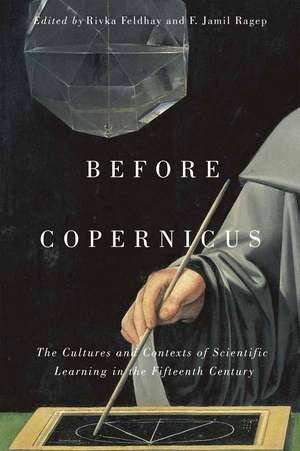
Before Copernicus: The Cultures and Contexts of Scientific Learning in the Fifteenth Century: McGill-Queen's Studies in the History of Ideas, cartea 71
Editat de Rivka Feldhay, F. Jamil Ragepen Limba Engleză Paperback – 12 iun 2017
Considerăm că volumul Before Copernicus reprezintă o resursă esențială pentru înțelegerea modului în care sinteza cunoștințelor teoretice din spații culturale divergente a facilitat revoluția științifică modernă. Aplicabilitatea sa practică rezidă în reevaluarea surselor astronomiei copernicane, demonstrând că trecerea la heliocentrism nu a fost un act de geniu izolat, ci rezultatul unui dialog intercultural complex între savanții europeni, islamici și evrei din secolul al XV-lea. Suntem de părere că această abordare globală oferă o perspectivă mult mai nuanțată asupra istoriei ideilor decât narațiunile eurocentrice clasice.
Structura volumului, editat de Rivka Feldhay și F. Jamil Ragep, îmbină istoria tehnică a astronomiei cu analiza contextului cultural. Cititorii familiarizați cu Mathematical Astronomy in Copernicus' De Revolutionibus de N. M. Swerdlow vor aprecia modul în care acest nou volum extinde discuția dincolo de metodologia greacă, explorând influența directă a modelelor planetare islamice asupra lui Copernicus. În timp ce Swerdlow se concentrează pe aspectele matematice riguroase, Before Copernicus adaugă dimensiunea umanistă și sociologică a circulației manuscriselor.
Această lucrare continuă preocupările editorului Rivka Feldhay pentru demontarea miturilor istoriografice, temă prezentă și în Galileo and the Church. Dacă în lucrarea despre Galileo autorul chestiona opoziția binară dintre credință și rațiune, în volumul de față investighează continuitatea dintre cunoașterea pre-clasică și modernitate. Volumul se integrează organic în seria McGill-Queen's Studies in the History of Ideas, oferind o analiză riguroasă a tranziției de la cosmologia medievală la cea modernă prin prisma schimburilor intelectuale din pragul Renașterii.
Din seria McGill-Queen's Studies in the History of Ideas
-
 Preț: 374.40 lei
 -
 Preț: 274.63 lei
 - 23%
 Preț: 847.14 lei
 -
 Preț: 351.41 lei
 -
 Preț: 293.13 lei
 -
 Preț: 360.99 lei
 -
 Preț: 316.99 lei
 -
 Preț: 291.84 lei
 -
 Preț: 375.09 lei
 -
 Preț: 444.00 lei
 -
 Preț: 221.19 lei
 - 23%
 Preț: 654.96 lei
 - 23%
 Preț: 630.49 lei
 -
 Preț: 239.04 lei
 -
 Preț: 291.92 lei
 -
 Preț: 330.44 lei
 -
 Preț: 318.39 lei
 -
 Preț: 336.42 lei
 -
 Preț: 322.40 lei
 -
 Preț: 312.58 lei
 - nou
 Preț: 289.90 lei
 - 23%
 Preț: 654.96 lei
 -
 Preț: 232.01 lei
 -
 Preț: 176.16 lei
Preț: 328.49 lei
Carte disponibilă
Livrare economică 06-20 noiembrie
Livrare express 23-29 octombrie pentru 42.02 lei
Specificații
ISBN-10: 0773550100
Pagini: 368
Ilustrații: 22 figures, 4 tables
Dimensiuni: 152 x 229 x 25 mm
Greutate: 0.54 kg
Ediția:1
Editura: McGill-Queen's University Press
Colecția McGill-Queen's University Press
Seria McGill-Queen's Studies in the History of Ideas
V-ar putea interesa
-
 Bomber BoysPatrick BishopPreț: 106.77 lei
 -
 The Blair YearsAlastair Campbell-16%Preț: 105.03 lei125.60 lei
 -
 -18%Preț: 90.00 lei109.22 lei
 -
 Children of EnglandAlison Weir-39%Preț: 65.85 lei107.79 lei
 -
 ByzantiumJudith Herrin-28%Preț: 78.20 lei108.67 lei
 -
 -16%Preț: 68.53 lei81.60 lei
 -
 The White WarMark ThompsonPreț: 109.17 lei
 -
 Resistance: Memoirs of Occupied FranceAgnes Humbert-26%Preț: 78.65 lei106.74 lei
 -
 Mary Tudor: The First QueenLinda Porter-27%Preț: 78.27 lei106.72 lei
 -
 Preț: 127.04 lei
 -
 Edward VI: The Lost King of EnglandChris Skidmore-26%Preț: 69.75 lei93.96 lei
 -
 -26%Preț: 68.98 lei93.50 lei
 -
 InfidelAyaan Hirsi Ali-18%Preț: 65.89 lei80.03 lei
 -
 The Kingdom of the IslesR. Andrew McDonaldPreț: 222.29 lei
 -
 Spitfire PilotDavid Crook-18%Preț: 59.07 lei72.11 lei
De ce să citești această carte
Recomandăm această carte istoricilor și studenților interesați de rădăcinile globale ale științei moderne. Cititorul câștigă o înțelegere profundă a modului în care astronomia islamică și filosofia europeană a secolului al XV-lea s-au întrepătruns pentru a face posibilă opera lui Copernicus. Este un motiv concret pentru a depăși viziunea tradițională asupra Revoluției Științifice, descoperind un peisaj intelectual vibrant și multicultural.
Despre autor
Rivka Feldhay este profesor emerit la Universitatea din Tel Aviv, specializată în istoria și filosofia științei, cu un interes marcat pentru relația dintre religie și cunoaștere în perioada modernă timpurie. F. Jamil Ragep este un expert recunoscut în istoria astronomiei islamice, deținând catedra de Istoria Științei în Islam la Universitatea McGill. Împreună, cei doi editori aduc o expertiză complementară ce acoperă atât tradiția iezuită și europeană (Feldhay), cât și pe cea a Orientului Mijlociu (Ragep), oferind o viziune unitară asupra contextului în care a activat Copernicus.