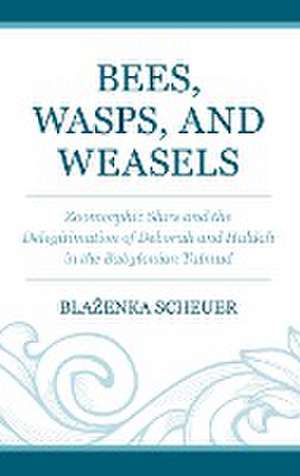
Bees, Wasps, and Weasels: Zoomorphic Slurs and the Delegitimation of Deborah and Huldah in the Babylonian Talmud: Coniectanea Biblica
Autor Blazenka Scheueren Limba Engleză Hardback – 8 aug 2023


Preț: 518.46 lei
Preț vechi: 769.22 lei
-33%
Puncte Express: 778
Carte tipărită la comandă
Livrare economică 28 noiembrie-12 decembrie
Livrare prin curier în România Termenul estimat este afișat lângă disponibilitate.
Transport gratuit pentru acest produs Plată online sau ramburs, în funcție de opțiunile comenzii.
Retur gratuit în 14 zile Comandă securizată și suport în română.
Specificații
ISBN-13: 9781978714526
ISBN-10: 1978714521
Pagini: 232
Ilustrații: 11 b/w photos;
Dimensiuni: 150 x 230 x 22 mm
Greutate: 0.51 kg
Editura: Bloomsbury Publishing
Colecția Fortress Academic
Seria Coniectanea Biblica
Locul publicării:New York, United States
ISBN-10: 1978714521
Pagini: 232
Ilustrații: 11 b/w photos;
Dimensiuni: 150 x 230 x 22 mm
Greutate: 0.51 kg
Editura: Bloomsbury Publishing
Colecția Fortress Academic
Seria Coniectanea Biblica
Locul publicării:New York, United States
Cuprins
Introduction
Chapter One: Deborah, Huldah, and the Formation of Zoomorphic Slurs
Part One: Deborah
Chapter Two: Deborah: A Bee or a Wasp?
Chapter Three: Deborah in the Jewish Diaspora
Chapter Four: Deborah and the Question of a Female Divine
Part Two: Huldah
Chapter Five: Huldah: A Weasel-Prophetess
Chapter Six: Huldah and the Question of Interpretive Authority
Part Three: Deborah, Huldah, and Virgin Mary
Chapter Seven: Deborah, Huldah, and the Virgin Mary
Chapter Eight: Concluding Remarks
Chapter One: Deborah, Huldah, and the Formation of Zoomorphic Slurs
Part One: Deborah
Chapter Two: Deborah: A Bee or a Wasp?
Chapter Three: Deborah in the Jewish Diaspora
Chapter Four: Deborah and the Question of a Female Divine
Part Two: Huldah
Chapter Five: Huldah: A Weasel-Prophetess
Chapter Six: Huldah and the Question of Interpretive Authority
Part Three: Deborah, Huldah, and Virgin Mary
Chapter Seven: Deborah, Huldah, and the Virgin Mary
Chapter Eight: Concluding Remarks
Recenzii
This study is an excellent example of where gender studies in biblical and rabbinic literature is going. The author concentrates on one rabbinic text, which is a comment on two biblical episodes. The episodes are about the two most prominent prophetesses in the Bible-Deborah and Huldah-both bearing the zoomorphic names of bee and weasel. These names are interpreted in the Babylonian Talmud negatively. This saying prompted the author to investigate the biblical prophetesses-and the animals that their names denote in the Bible-in rabbinic literature, in ancient Near Eastern contexts, in Greco-Roman contexts, and finally, in Early Christianity, in association with Mariology. The ability of one scholar to master all these separate disciplines and languages is staggering, and the breadth and depth of the study is most impressive. It is no longer possible to study biblical feminine prophecy, and the rabbinic reaction to it, without reading this book.