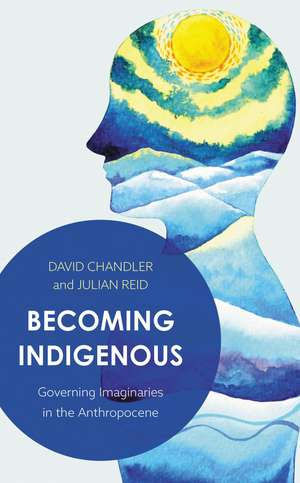
Becoming Indigenous: Governing Imaginaries in the Anthropocene
Autor David Chandler, Julian Reiden Limba Engleză Hardback – 4 oct 2019
Becoming Indigenous provides an agenda-setting critique, analysing how and why indigeneity has been reduced to instrumental imaginaries of perseverance and resilience. Indigenous 'alternatives' are today central to a range of governing discourses, which promise empowerment but are highly disciplinary. Critical theorists often endorse these framings, happy to instrumentalise indigenous peoples as caretakers of the environment or as teaching the moderns about their 'more-than-human' responsibilities.
Chandler and Reid argue that these discourses have little to do with indigenous struggles or with challenging settler-colonial power. In fact, instrumentalising indigeneity in these ways merely reinforces neoliberal hegemony, marginalising critical alternatives for both indigenous and non-indigenous peoples alike.
| Toate formatele și edițiile | Preț | Express |
|---|---|---|
| Paperback (1) | 297.88 lei 43-57 zile | |
| Bloomsbury Publishing – 3 oct 2019 | 297.88 lei 43-57 zile | |
| Hardback (1) | 727.18 lei 43-57 zile | |
| Bloomsbury Publishing – 4 oct 2019 | 727.18 lei 43-57 zile |
Preț: 727.18 lei
Preț vechi: 1051.08 lei
-31%
Puncte Express: 1091
Preț estimativ în valută:
128.74€ • 149.91$ • 111.84£
128.74€ • 149.91$ • 111.84£
Carte tipărită la comandă
Livrare economică 23 februarie-09 martie
Preluare comenzi: 021 569.72.76
Specificații
ISBN-13: 9781786605719
ISBN-10: 1786605716
Pagini: 160
Dimensiuni: 159 x 231 x 20 mm
Greutate: 0.48 kg
Editura: Bloomsbury Publishing
Colecția Rowman & Littlefield Publishers
Locul publicării:New York, United States
ISBN-10: 1786605716
Pagini: 160
Dimensiuni: 159 x 231 x 20 mm
Greutate: 0.48 kg
Editura: Bloomsbury Publishing
Colecția Rowman & Littlefield Publishers
Locul publicării:New York, United States
Cuprins
1. Introduction: Becoming Indigenous
2. Dispossession
3. Speculative Analytics
4. Perseverance
5. Pluriversal Politics
6. Resilience
7. Governing Imaginaries
8. Conclusion
2. Dispossession
3. Speculative Analytics
4. Perseverance
5. Pluriversal Politics
6. Resilience
7. Governing Imaginaries
8. Conclusion
Recenzii
Written by two of the most important political theorists writing on the Anthropocene, Becoming Indigenous is an agenda-setting critique. It deftly indicts and exposes the shocking ways in which indigenous peoples are being framed and saturated with meaning by others; reduced to tropes of mere adaptation and resilience or to sites of speculation: reducing meaningful resistance and politics.
Faced with the end times of climate catastrophe, we are all compelled to 'become indigenous'. Chandler and Reid track the adoption of indigenous knowledge across Western scholarship, government policy and activism-not to address historic dispossession and exclusion, but as resources for newly imagined Western futures.
This important and provocative book exposes fault lines in the most influential critical theory of our times. Tracking relationships between the colonization of indigenous imagination and the policing of indigenous imaginaries, Becoming Indigenous clears new ground for differently figured politics of coexistence.
This important book questions Anthropocene theory's growing celebration of a life defined by entanglement, limits, vulnerability, and dispossession. Instead Chandler and Reid argue that both governments and critical theorists' discursive deployments of such qualities, ascribed to the lives of all indigenous peoples, serve not to empower but rather discipline populations and morally shore up ideology. It is highly recommended.
Faced with the end times of climate catastrophe, we are all compelled to 'become indigenous'. Chandler and Reid track the adoption of indigenous knowledge across Western scholarship, government policy and activism-not to address historic dispossession and exclusion, but as resources for newly imagined Western futures.
This important and provocative book exposes fault lines in the most influential critical theory of our times. Tracking relationships between the colonization of indigenous imagination and the policing of indigenous imaginaries, Becoming Indigenous clears new ground for differently figured politics of coexistence.
This important book questions Anthropocene theory's growing celebration of a life defined by entanglement, limits, vulnerability, and dispossession. Instead Chandler and Reid argue that both governments and critical theorists' discursive deployments of such qualities, ascribed to the lives of all indigenous peoples, serve not to empower but rather discipline populations and morally shore up ideology. It is highly recommended.