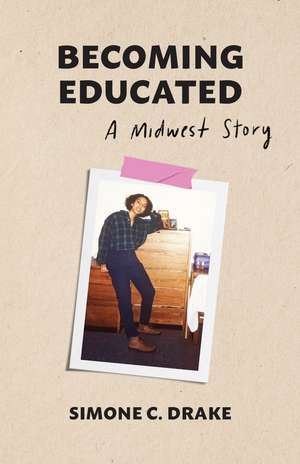
Becoming Educated: A Midwest Story
Autor Simone C. Drakeen Limba Engleză Paperback – 22 iun 2026
A memoir of race, public schooling, and identity as an "integration guinea pig" in the 1980s Midwest.
Becoming Educated is Simone C. Drake’s engaging and bold memoir about race, class, gender, and the meaning of education in the urban Midwest. Drake, a scholar of literature, culture, and law, uses her own story as a Black girl attending recently desegregated Columbus public schools in the 1980s and 1990s to explore the United States’ most entrenched social problems and how local systems have tried to combat them. From starting kindergarten the year after an Ohio court decision called for busing to end school segregation, to climbing the ranks of academia, to her decision to send her sons to highly rated but largely white suburban schools, Drake weaves a lively and erudite accounting of her identity formation as an “integration guinea pig.” She punctuates her story with rich evocations of the music, TV, and film that shaped her generation, powerful reflections on relevant works by Black writers and artists from Dawoud Bey to Jay-Z, and images of her own artwork. This prismatic book is a must-read for Gen Xers, Midwesterners, and Americans of any race wanting to think more deeply about how our nation’s educational systems—and by extension, all of us—must reckon with inequalities past and present.
Becoming Educated is Simone C. Drake’s engaging and bold memoir about race, class, gender, and the meaning of education in the urban Midwest. Drake, a scholar of literature, culture, and law, uses her own story as a Black girl attending recently desegregated Columbus public schools in the 1980s and 1990s to explore the United States’ most entrenched social problems and how local systems have tried to combat them. From starting kindergarten the year after an Ohio court decision called for busing to end school segregation, to climbing the ranks of academia, to her decision to send her sons to highly rated but largely white suburban schools, Drake weaves a lively and erudite accounting of her identity formation as an “integration guinea pig.” She punctuates her story with rich evocations of the music, TV, and film that shaped her generation, powerful reflections on relevant works by Black writers and artists from Dawoud Bey to Jay-Z, and images of her own artwork. This prismatic book is a must-read for Gen Xers, Midwesterners, and Americans of any race wanting to think more deeply about how our nation’s educational systems—and by extension, all of us—must reckon with inequalities past and present.
Preț: 132.15 lei
Puncte Express: 198
Carte disponibilă
Livrare economică 14-28 noiembrie
Livrare prin curier în România Termenul estimat este afișat lângă disponibilitate.
Transport gratuit de la 400.00 lei Plată online sau ramburs, în funcție de opțiunile comenzii.
Retur gratuit în 14 zile Comandă securizată și suport în română.
Specificații
ISBN-13: 9780814259849
ISBN-10: 0814259847
Pagini: 260
Ilustrații: 36 images
Dimensiuni: 140 x 216 x 15 mm
Greutate: 0.41 kg
Editura: Ohio State University Press
Colecția Trillium
ISBN-10: 0814259847
Pagini: 260
Ilustrații: 36 images
Dimensiuni: 140 x 216 x 15 mm
Greutate: 0.41 kg
Editura: Ohio State University Press
Colecția Trillium
Recenzii
“In revisiting her educational journey, Simone Drake shines a poignant light upon the endurance of Black girlhood in this wise and bighearted memoir.” —Wil Haygood, author of The War Within a War: The Black Struggle in Vietnam and at Home
“Set against the often-discounted ‘flyover’ terrain of the Midwest, Becoming Educated braids memoir and educational becoming, music and murals, and the quiet violence of policy, distilling how race, class, geography, and law choreograph our lives long after the gavel falls.” —T. Denean Sharpley-Whiting, Gertrude Conaway Vanderbilt Distinguished Professor in Humanities, Vanderbilt University
“Becoming Educated was a fascinating read: Blending art and personal history, it offers stories of life as a child and young adult winding through an urban Midwest education as well as Simone’s life as a mama bear ensuring her sons are educated safely in culturally alien suburbs. Simone Drake and I share a hometown and a high school (shout-out to CAHS class of ’92!), but her distinctive journey will resonate with anyone willing to think deeply about this nation’s complex racial history and the ways it intimately shapes our most vulnerable and precious population: school-age children.” —Candice M. Jenkins, University of Illinois Urbana-Champaign
“Becoming Educated is magnificent in its dramatization of Simone Drake’s education and that of her sons, illuminated by her own visual creations and deft readings of literary, visual, and sonic texts that capture the feelings generated at the intersection of race and class in a Midwestern city. To read Becoming Educated is to understand that the critical and artistic sensibilities that make up Drake’s rich interior life resonate across a host of spatial and political registers.” —Herman Beavers, poet and author of Geography and the Political Imaginary in the Novels of Toni Morrison
“This memoir is imbued with authenticity and intellectual rigor. Simone Drake interrogates the complexities of race, colorism, and class with a musical rhythm and visual vibrancy that brings to life a multisensory narrative of Black womanhood, illuminating how personal and collective histories are shaped by law and geography. Constructing a coming-of-age narrative that is as real to the Black American experience as it is emotionally resonant to us Black mothers, professionals, and daughters, she challenges the persistent erasure of Black women’s genius and is refreshingly unapologetic about her own intellectual achievements. A vital contribution to the contemporary discourse on identity and resistance.” —Stacia Jones, Esq., Employment Lawyer and Global Human Resources Leader
Notă biografică
Simone C. Drake is the Hazel C. Youngberg Trustees Distinguished Professor of English at The Ohio State University and holds a courtesy appointment in the Moritz College of Law. A proud graduate of Columbus City Schools, she lives in central Ohio with her family. She recently returned to making art and cannot believe she had tucked it away for so many decades.
Extras
Riding the Bus with My White Boy
I finally was a big girl. I got to ride the bus to school. A long maize-colored bus, like one of those delightful colors included in my big girl box of twenty-four Crayola crayons. No more primary colors for me.
Hair braided in two pigtails, or maybe divided hemispherically and down the middle in four neat plaits. Eyes wide. Mind ready to continue the lessons Mommy taught me at home.
What I was not prepared for—surprised by, really—was that school involved other people. Lots of kids in my classroom and throughout the school. Large groups of people unsettled me. My first five years of life involved a closed group of people. My brother, Jason—only fourteen months younger—was my best friend, and my parents allowed only my maternal grandparents, known to us as Oma and Opa, to watch us. Preschool, consequently, had been a grand crying fest for me.
Riding the bus was far more socially manageable for me than negotiating an entire building streaming with children and teachers. So, in spite of the smell of old vinyl seats that I worriedly noticed had no seatbelts (I knew that a girl my age and her family, who lived one street over, all died in a car accident, wearing no seat belts) and smelly exhaust fumes, especially in the back of the bus, I enjoyed riding the bus.
My enjoyment was influenced by Allen B. He was older than me. Maybe it was only by a couple of years, but it did not matter, because Allen was a big boy. I was a little girl who enjoyed the idea of school and riding the bus, but nonetheless was timid and shy.
Allen was white and had orange hair and freckles. He wore plaid shirts and corduroy pants. He smiled a lot and was happy to see me when I got on the bus. Maybe he was the only white boy on the bus. Maybe not. We both were, after all, two guinea pigs living in the legislative experiment of forced integration—my Black working-class neighborhood and his white working-class neighborhood sending its Black and white kids to school in the same building, in the same classrooms, learning the same lessons.
One day we got to draw our bodies at school. I loved drawing. We got long sheets of brown paper, the length of our little selves. I drew my two pigtails, my wide eyes, my arms and legs, my torso and appendages. As soon as I got on the bus, I showed Allen my masterpiece. He laughed, a good-hearted laugh. And then he blurted out, “Why do you have a tail?!” I was horrified. My self-portrait did indeed have a tail, right between my legs. I made a downward V-shape instead of an upward V-shape when drawing my legs. It seemed right then, but as soon as Allen poked fun at it, I knew it was wrong. Oh, well. I bet my parents saved it and it is still in a box in their basement.
Monday through Friday, my parents would drop me off at the bus stop. On the bus, the sound of soul and funk music streamed across the long row of bench-style seats. I distinctly remember the local WVKO radio station often playing a song about a bus that became the theme song for my first year riding the school bus. Gimme a “ho” if you got your funky bus fare! It seemed like Frankie Smith’s “Double Dutch Bus” (1981) played every time I got on the bus.
And much like I did not yet register racial segregation and was still learning basic techniques of drawing the human figure, I did not fully understand this song. I heard “double Dutch” and associated it with the new form of jumping rope I had discovered at school. Despite being the fastest (single) jump-roper, I would be quickly excluded from the group of Black girls who jumped double Dutch, because I turned the rope “double handed.” I never have determined if that was a rhythm issue or a left-hander issue. Consequently, I learned my husband was allowed to join the Black girls jumping double Dutch, as he impressed his sixth-grade students with his jumping (and hula hooping) skills when he taught for the District of Columbia Public Schools.
I wasn’t wrong for associating the song with a jump rope game. The music video, which I never saw as a child, includes both double Dutch jump roping and actual buses from the Philadelphia transit system. Smith tells Dick Clark on American Bandstand that the song is a tribute to girls, and especially girls in his neighborhood, who use their mothers’ clotheslines to create an art form. Jumping double Dutch was born out of a Black vernacular culture, and so was the funk music genre that filters through my memories of my primary education experiences.
Riding the bus with Allen reduced my anxiety around being in what felt like a jungle full of kids on the bus and at school. Allen talked to me and created a safe space amidst so many foreign experiences. The other kids seemed busy being wild. Or scary. There was a fifth grader who terrified me. Her brother, David, was in my grade. David got in trouble a lot. I suspect his sister, Yvette did too (or was her name Chevette; I keep thinking Chevette, but that was an automobile name), because she once got me in trouble.
I had long thick, curly hair. I did not get out of my house much prior to elementary school, so my hair seemed normal to me. In hindsight, I think Yvette thought I was a cute little girl, a cute little Black girl with “good hair,” and that is why she told me to let her do my hair one day in the back of the bus. I say “do,” but it was really undo and redo. I should have stayed in the front of the bus with Allen and not let Yvette take me to the back of the bus with the wild kids.
When I got home, my mother demanded to know what had happened to my hair. The style was no different; the back of the bus was no beauty salon, so Yvette had no tools beyond a rat-tailed comb she whipped out of thin air, but the braids were not my mother’s braids. I told my mother that the big girl with the bad brother made me let her do my hair. My mother told me I was never to let anyone play with my hair again. My mother’s instruction was ironic. So often Black women are concerned about white people touching their hair, and here I was being told to tell the big Black girl on the bus that she couldn’t unbraid and rebraid my hair.
And then there was Allen who didn’t seem to notice my hair. Just that we could talk. About what, I don’t remember. Why he wanted to talk to a little girl is beyond me. What I know is riding the bus with Allen made going to school with lots of people just a little bit easier. And while at that time I knew nothing of certain ignorant narratives of white people believing Black people had tails, I feel certain his commentary on my self-portrait was merely an innocent (and factual) observation. Decades later, when painting a self-portrait, I remembered fondly that embarrassing kindergarten tail mishap and appreciated Allen’s kindness all the more.
I finally was a big girl. I got to ride the bus to school. A long maize-colored bus, like one of those delightful colors included in my big girl box of twenty-four Crayola crayons. No more primary colors for me.
Hair braided in two pigtails, or maybe divided hemispherically and down the middle in four neat plaits. Eyes wide. Mind ready to continue the lessons Mommy taught me at home.
What I was not prepared for—surprised by, really—was that school involved other people. Lots of kids in my classroom and throughout the school. Large groups of people unsettled me. My first five years of life involved a closed group of people. My brother, Jason—only fourteen months younger—was my best friend, and my parents allowed only my maternal grandparents, known to us as Oma and Opa, to watch us. Preschool, consequently, had been a grand crying fest for me.
Riding the bus was far more socially manageable for me than negotiating an entire building streaming with children and teachers. So, in spite of the smell of old vinyl seats that I worriedly noticed had no seatbelts (I knew that a girl my age and her family, who lived one street over, all died in a car accident, wearing no seat belts) and smelly exhaust fumes, especially in the back of the bus, I enjoyed riding the bus.
My enjoyment was influenced by Allen B. He was older than me. Maybe it was only by a couple of years, but it did not matter, because Allen was a big boy. I was a little girl who enjoyed the idea of school and riding the bus, but nonetheless was timid and shy.
Allen was white and had orange hair and freckles. He wore plaid shirts and corduroy pants. He smiled a lot and was happy to see me when I got on the bus. Maybe he was the only white boy on the bus. Maybe not. We both were, after all, two guinea pigs living in the legislative experiment of forced integration—my Black working-class neighborhood and his white working-class neighborhood sending its Black and white kids to school in the same building, in the same classrooms, learning the same lessons.
One day we got to draw our bodies at school. I loved drawing. We got long sheets of brown paper, the length of our little selves. I drew my two pigtails, my wide eyes, my arms and legs, my torso and appendages. As soon as I got on the bus, I showed Allen my masterpiece. He laughed, a good-hearted laugh. And then he blurted out, “Why do you have a tail?!” I was horrified. My self-portrait did indeed have a tail, right between my legs. I made a downward V-shape instead of an upward V-shape when drawing my legs. It seemed right then, but as soon as Allen poked fun at it, I knew it was wrong. Oh, well. I bet my parents saved it and it is still in a box in their basement.
Monday through Friday, my parents would drop me off at the bus stop. On the bus, the sound of soul and funk music streamed across the long row of bench-style seats. I distinctly remember the local WVKO radio station often playing a song about a bus that became the theme song for my first year riding the school bus. Gimme a “ho” if you got your funky bus fare! It seemed like Frankie Smith’s “Double Dutch Bus” (1981) played every time I got on the bus.
And much like I did not yet register racial segregation and was still learning basic techniques of drawing the human figure, I did not fully understand this song. I heard “double Dutch” and associated it with the new form of jumping rope I had discovered at school. Despite being the fastest (single) jump-roper, I would be quickly excluded from the group of Black girls who jumped double Dutch, because I turned the rope “double handed.” I never have determined if that was a rhythm issue or a left-hander issue. Consequently, I learned my husband was allowed to join the Black girls jumping double Dutch, as he impressed his sixth-grade students with his jumping (and hula hooping) skills when he taught for the District of Columbia Public Schools.
I wasn’t wrong for associating the song with a jump rope game. The music video, which I never saw as a child, includes both double Dutch jump roping and actual buses from the Philadelphia transit system. Smith tells Dick Clark on American Bandstand that the song is a tribute to girls, and especially girls in his neighborhood, who use their mothers’ clotheslines to create an art form. Jumping double Dutch was born out of a Black vernacular culture, and so was the funk music genre that filters through my memories of my primary education experiences.
Riding the bus with Allen reduced my anxiety around being in what felt like a jungle full of kids on the bus and at school. Allen talked to me and created a safe space amidst so many foreign experiences. The other kids seemed busy being wild. Or scary. There was a fifth grader who terrified me. Her brother, David, was in my grade. David got in trouble a lot. I suspect his sister, Yvette did too (or was her name Chevette; I keep thinking Chevette, but that was an automobile name), because she once got me in trouble.
I had long thick, curly hair. I did not get out of my house much prior to elementary school, so my hair seemed normal to me. In hindsight, I think Yvette thought I was a cute little girl, a cute little Black girl with “good hair,” and that is why she told me to let her do my hair one day in the back of the bus. I say “do,” but it was really undo and redo. I should have stayed in the front of the bus with Allen and not let Yvette take me to the back of the bus with the wild kids.
When I got home, my mother demanded to know what had happened to my hair. The style was no different; the back of the bus was no beauty salon, so Yvette had no tools beyond a rat-tailed comb she whipped out of thin air, but the braids were not my mother’s braids. I told my mother that the big girl with the bad brother made me let her do my hair. My mother told me I was never to let anyone play with my hair again. My mother’s instruction was ironic. So often Black women are concerned about white people touching their hair, and here I was being told to tell the big Black girl on the bus that she couldn’t unbraid and rebraid my hair.
And then there was Allen who didn’t seem to notice my hair. Just that we could talk. About what, I don’t remember. Why he wanted to talk to a little girl is beyond me. What I know is riding the bus with Allen made going to school with lots of people just a little bit easier. And while at that time I knew nothing of certain ignorant narratives of white people believing Black people had tails, I feel certain his commentary on my self-portrait was merely an innocent (and factual) observation. Decades later, when painting a self-portrait, I remembered fondly that embarrassing kindergarten tail mishap and appreciated Allen’s kindness all the more.
Cuprins
Contents
List of Illustrations
Part One: Becoming
To the Midwest, with Love
Tell Me What You Hear
On Becoming
Stories to the Tune of Midwest Life
Tension, 1971
Learning Unlimited
Riding the Bus with My White Boy
Mrs. DeLoache
Separatist Aesthetics
Soul Town Kindergarten
High Noon on Sunday and Other Times Too
Stay Off the Grass
Glass Doorknobs
Teacher’s Pet
Childhood Can Be a Drag
They Weren’t There to Be Our Friends
I Wanted to Be Whitley Gilbert, but I Didn’t Want to Attend an HBCU
Someone Walked Off with All My Portraits
Girl Meets Boy, Boy Meets Girl
Big Brother Blackman
A Friend Lost and Found
Part Two: Knowing
Republican Suburbia
Birthing Black Babies
Chicka Chicka Boom Boom House
Dyslexia and Us
Black Boys Don’t
Mansion Magic
Going South: Verse 1
Going South: Verse 2
She Had The Autobiography of Malcolm X on Her Bookshelf
The Push, May 2019
Quarantine Buddies
Thank God for Our Bodies, Ourselves
Red Stilettos
Grandfather to Grandson
Sho’ Nuff Brother
Blue Space
Overeducated. Black. Woman.
Never Seeing Myself
My Best Things
Acknowledgments
Appendix 1 Linden McKinley Black History Week Assembly Pamphlet
Appendix 2 Important Dates
Notes
List of Illustrations
Part One: Becoming
To the Midwest, with Love
Tell Me What You Hear
On Becoming
Stories to the Tune of Midwest Life
Tension, 1971
Learning Unlimited
Riding the Bus with My White Boy
Mrs. DeLoache
Separatist Aesthetics
Soul Town Kindergarten
High Noon on Sunday and Other Times Too
Stay Off the Grass
Glass Doorknobs
Teacher’s Pet
Childhood Can Be a Drag
They Weren’t There to Be Our Friends
I Wanted to Be Whitley Gilbert, but I Didn’t Want to Attend an HBCU
Someone Walked Off with All My Portraits
Girl Meets Boy, Boy Meets Girl
Big Brother Blackman
A Friend Lost and Found
Part Two: Knowing
Republican Suburbia
Birthing Black Babies
Chicka Chicka Boom Boom House
Dyslexia and Us
Black Boys Don’t
Mansion Magic
Going South: Verse 1
Going South: Verse 2
She Had The Autobiography of Malcolm X on Her Bookshelf
The Push, May 2019
Quarantine Buddies
Thank God for Our Bodies, Ourselves
Red Stilettos
Grandfather to Grandson
Sho’ Nuff Brother
Blue Space
Overeducated. Black. Woman.
Never Seeing Myself
My Best Things
Acknowledgments
Appendix 1 Linden McKinley Black History Week Assembly Pamphlet
Appendix 2 Important Dates
Notes
Descriere
An engaging and bold memoir about race, class, gender, and the meaning of education in the urban Midwest.