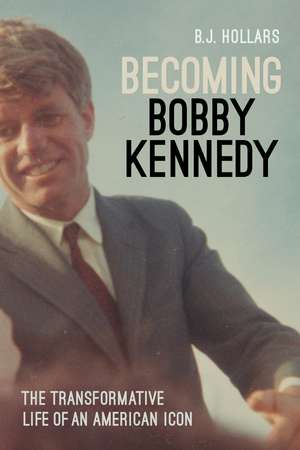
Becoming Bobby Kennedy: The Transformative Life of an American Icon
Autor B. J. Hollarsen Limba Engleză Hardback – noi 2026
Although his brother’s assassination in 1963 marked the turning point, it was Bobby’s own encounters with suffering and injustice that truly recalibrated his moral compass. From summiting Canada’s Mount Kennedy to speaking in apartheid-era South Africa, from descending into Chilean coal mines to navigating the piranha-infested waters of the Amazon, Kennedy sought to understand the lives of those the world ignored. His moral awakening continued closer to home—in the hunger-stricken shacks in the Mississippi Delta, the impoverished hills and hollers of eastern Kentucky, and the backroads of Pine Ridge Indian Reservation in South Dakota.
Kennedy’s final journey—his 1968 campaign for the presidency—cost him his life, but it also secured his legacy. Becoming Bobby Kennedy traces his remarkable evolution into a symbol of peace, justice, empathy, and moral courage, revealing a man whose vision for America remains as urgent and transformative today as it was half a century ago. In this intimate, character-driven retelling of Kennedy’s last six years, B.J. Hollars focuses on the experiences that fundamentally transformed the man Kennedy became in the final chapter of his life. Rare interviews and archival research provide new dimensions to this profile.
Preț: 201.27 lei
Nou
Puncte Express: 302
Carte disponibilă
Livrare economică 07-21 decembrie
Livrare prin curier în România Termenul estimat este afișat lângă disponibilitate.
Transport gratuit de la 400.00 lei Plată online sau ramburs, în funcție de opțiunile comenzii.
Retur gratuit în 14 zile Comandă securizată și suport în română.
Specificații
ISBN-13: 9781640126886
ISBN-10: 1640126880
Pagini: 232
Ilustrații: 19 photographs, 1 illustration, index
Dimensiuni: 152 x 229 mm
Greutate: 0.51 kg
Editura: Potomac Books Inc
Colecția Potomac Books
Locul publicării:United States
ISBN-10: 1640126880
Pagini: 232
Ilustrații: 19 photographs, 1 illustration, index
Dimensiuni: 152 x 229 mm
Greutate: 0.51 kg
Editura: Potomac Books Inc
Colecția Potomac Books
Locul publicării:United States
Notă biografică
B.J. Hollars is a writer, documentarian, and professor of English at the University of Wisconsin–Eau Claire. He is the author of more than fifteen books, including Wisconsin for Kennedy: The Primary That Launched a President and Changed the Course of History and Go West Young Man: A Father and Son Rediscover America on the Oregon Trail (Bison Books, 2021). His historical writing and documentary work have received numerous honors, including the Truman Capote Award for Literary Nonfiction, the James B. MacMillan Prize in Southern History for Culture, and an Upper Midwest Emmy Award.
Extras
1
The Fifty-Mile Walk
February 1963
McLean, Virginia, to Camp David, Maryland
The morning of February 9, 1963, started cold and clear. Attorney General
Robert F. Kennedy rose long before the sun, slipping into khakis and a
dark-colored zippered pullover before leaving the sleepy stillness of Hickory
Hill. Seven miles away, his brother John was probably fast asleep in
the White House residence. Bobby had a long day ahead of him, and an
even longer walk.
If you had asked him weeks earlier, the idea of walking fifty miles would
have seemed like madness—not to mention a waste of time and shoe
leather. All that changed after Commandant of the Marine Corps General
David M. Shoup unearthed a 1908 executive order from President Theodore
Roosevelt calling upon Marines to test their mettle by completing a
fifty-mile march in under twenty hours.
General Shoup knew President Kennedy valued physical fitness, so he
shared Roosevelt’s order with the president as a historic curiosity. However,
Kennedy saw it as something more: an opportunity to test the vigor of
the modern Marine. He urged Shoup to issue the march as a challenge:
“Should your report to me indicate that the strength and stamina of the
modern Marine is at least equivalent to that of his antecedents,” Kennedy
told Shoup, “I will then ask Mr. [Pierre] Salinger to look into the matter
personally and give me a report on the fitness of the White House Staff.”
It made for a cheeky joke. While the White House staff was known
for their brains, they were less well known for their brawn. Salinger—the
president’s cigar-chomping press secretary—might have seemed the
staff’s best chance at completing the journey, though, since leaving the
U.S. Navy in 1946, he had admittedly lost some of his vigor.
Nevertheless, at Kennedy’s request, Salinger begrudgingly gathered the
press and attempted the fifty-mile march, managing six and a half miles
in over two and a half hours before ingloriously calling it quits. “I may
be plucky but I’m not stupid,” Salinger told reporters before returning to
the comforts of the White House.
Bobby Kennedy wasn’t stupid, either, and he also had some pluck.
Appointed U.S. attorney general at age thirty-five, he was one of the
youngest cabinet members in American history, second only to the thirty-four-
year-old Treasury Secretary Alexander Hamilton. While Kennedy’s
youth had proved to be a liability in some situations, it was a strength
when it came to fifty-mile walks. Aside from hot fudge sundaes and the
occasional celebratory Heineken, scotch, or cigar, Bobby Kennedy was
a paragon of good health, especially compared to other members of the
White House staff and cabinet.
Yet, compared to other Kennedy men, it was a different story. While
standing alongside his brothers in family photos, Bobby looked like a
mere mortal among Adonises. As a child he was bucktoothed, bashful, and
brooding. His mother, Rose Kennedy, affectionately called him her “pet.”
Growing up he possessed neither Joe Jr.’s athleticism nor Jack’s charm nor
Ted’s physical strength. He was nobody’s first choice for anything. “Nothing
came easily for him,” confirmed longtime friend Dave Hackett, who
had witnessed Bobby’s mediocrity throughout high school.
As an adult Kennedy’s five-foot-ten-inch frame carried his 160 pounds
in wiry proportions. Although he lacked a football player’s physique, this
did not stop him from making the Harvard team. He “carried himself with
a taut energy,” remarked one friend. He had a “runner’s frame”; he was
“sinewy”; and, on one occasion, he drew a comparison to Bugs Bunny. Yet
Kennedy’s most apt description—which applied not only to his physical
characteristics but also to his demeanor—came from his father. Joe Sr.
once remarked that Bobby had “the fight of a bull terrier.”
This fight compelled Bobby to lace up his oxfords on that chilly predawn
Saturday morning to prove to his brother and the nation that walking fifty
miles in twenty hours is possible. You did not have to be a Marine to pull
it off; you simply had to put one foot in front of the other.
What had his brother said? That every accomplishment starts with the
decision to try? Bobby Kennedy called for his dog, who hopped into the
car and settled in alongside him. Together they would remind the country
what vigor was.
At five o’clock that morning Ed Guthman—Bobby Kennedy’s
forty-three-year-old press secretary—stood shivering by the Chain Bridge,
which connected Virginia to dc across the Potomac River. A light frost
coated the leaves in the overhead trees and the cold began to seep into
the press secretary’s bones.
Located just three miles from Hickory Hill, the Chain Bridge seemed
like a fitting starting point. The plan was to follow the Chesapeake and
Ohio Canal towpath northeast to Harpers Ferry, then catch a ride to Camp
David in Maryland, where they would reunite with their wives. The only
thing separating them from their goal was a fifty-mile stretch of cold,
slippery terrain.
Ed exhaled, mentally preparing himself for the physical challenge ahead.
This was not how he intended to spend his Saturday, a sentiment shared
by the others Kennedy had also coerced into the challenge. Alongside Ed
were forty-three-year-old Lou Oberdorfer (assistant attorney general of the
Justice Department Tax Division), thirty-five-year-old James Symington
(Kennedy’s administrative assistant), and thirty-six-year-old Dave Hackett.
What had begun as an office joke the previous day had suddenly turned
real. “I think I’ll take a fifty-mile hike tomorrow,” Kennedy had casually
informed the men.
“Have a great time,” Ed had replied.
“Well, you’re going with me, aren’t you?” Kennedy asked. “You’re not
going to let me go alone, are you?” The men sighed. What choice did
they have?
When Kennedy met his walking companions at the bridge, the men
were neither surprised nor thrilled to discover they would also be joined
by Brumus, Kennedy’s loyal pet. In the years ahead Kennedy would earn
a reputation as a hero for the underdog. However, when it came to actual
underdogs of the canine variety, there was no better example than Brumus.
Aside from Kennedy—who adored him—Brumus was generally despised.
He was “a big shaggy mountain of an immovable object at rest,” one
Kennedy friend wrote, “gregarious but snappish in any social situation,
with bad breath, and ability to drool at will.” Some dogs are trained to sit
or fetch, but Brumus’s talent, the friend continued, was “wearing out his
welcome in a hurry.” Another friend described Brumus in only slightly
more flattering terms: “Like Lennie in Of Mice and Men, he wanted to be
friendly, but his size was an obstacle to his wish.”
Brumus’s size was not his only problem; the dog also had a rather dark
sense of humor. Once, during a party at Hickory Hill, he approached
two well-dressed women sitting on the lawn and proceeded to lift his
leg and urinate across their backs. Brumus was immediately put under
house arrest, yet he somehow escaped, found the same women again, and
urinated on them a second time.
When Brumus was not harassing guests at Hickory Hill, he was harassing
visitors to the Justice Department, where he accompanied Kennedy
most days. fbi Director J. Edgar Hoover grew so fed up with Brumus’s
behavior—there was no one and nothing he would not urinate on—that
Hoover called on his deputies to explore which federal statute might be
used to ban the dog from government buildings. What pleasure Kennedy
must have taken, watching the mighty Hoover stymied by a shaggy dog
hell-bent on making the world his bathroom.
For all his faults, Brumus was the perfect companion for a fifty-mile
walk. His thunderous heft propelled him forward by momentum alone.
While Kennedy felt confident in Brumus’s ability to finish the walk, he
doubted the same of his human companions. Fifty miles far exceeded what
his colleagues usually traveled when driving their cars down Pennsylvania
Avenue. To keep their plans secret, Ed, Lou, Dave, and James mostly
kept their intentions to themselves, telling only their wives. Kennedy also
invited Village Voice reporter Jack Newfield to join them, because someone
needed to witness their achievement—if they succeeded.
A few minutes past 5:00 a.m. Kennedy and Brumus exited the car
and joined their walking companions beneath Chain Bridge. The men
exchanged glances, wondering what they had gotten themselves into.
However, knowing that getting the answer to that question would not
bring them any closer to their destination, they set off without fanfare,
along the slush-covered
path.
Cuprins
List of Illustrations
Acknowledgments
Author’s Note
Cast of Characters
Prologue
1. The Fifty-Mile Walk: February 1963
2. Climbing Mount Kennedy: March 1965
3. New Life in Latin America: November–December 1965
4. The Ripple: June 1966
5. Deliverance in the Delta: April 1967
6. Eyes Wide in Kentucky: February 1968
7. Breaking Bread with Cesar: March 1968
8. The Ides of March: March 1968
9. Taming the Savageness of Man: April 1968
10. Pretty Boy at Pine Ridge: April 1968
11. Along the Endless Shore: May 1968
12. California Nightmare: June 1968
Epilogue
Sources
Bibliography
Index
Recenzii
“By demonstrating how Kennedy discovered and pursued a life dedicated to ending human suffering and injustice, Hollars solidifies Kennedy’s legacy at a time when such virtues are waning in the political sphere.”—Carol Haggas, Booklist
“[Becoming Bobby Kennedy is] a story of moral courage, boldly written in a style that mirrors Kennedy’s constant need to tell the truth. And it’s a book that I’ll return to in these difficult days, as I fight to keep the resilience and belief in our country which Bobby Kennedy inspired in me through Hollars’ outstanding work.”—Tim McCarthy, Boswell Book Company, Milwaukee, WI
“With its creative and inviting approach, Becoming Bobby Kennedy brings a fresh perspective and new insights into Robert F. Kennedy’s life and the people and events who shaped him. In B.J. Hollars’s hands, the story of Kennedy’s life and work resonates in ways that are still sharply relevant today.”—Ellen Meacham, journalist and author of Delta Epiphany: Robert F. Kennedy in Mississippi
“President John F. Kennedy once observed that what made journalism and history so enthralling for readers came from the work required to answer an essential question: ‘What’s he like?’ In Becoming Bobby Kennedy, B.J. Hollars has deftly attempted to answer that question for a man who represented different things to different people. It is a fascinating journey, and Hollars is a first-rate guide.”—Ray E. Boomhower, author of Robert F. Kennedy and the 1968 Indiana Primary
“This is a very good book that succeeds in bringing Bobby Kennedy to life while providing valuable insights into his character and transformation.”—mrbooksbookreviews.com
Descriere
Becoming Bobby Kennedy reevaluates a historical figure through a new critical lens, narrating twelve key moments in Senator Robert F. Kennedy’s final years and contextualizing his evolution for readers struggling to understand American politics today.