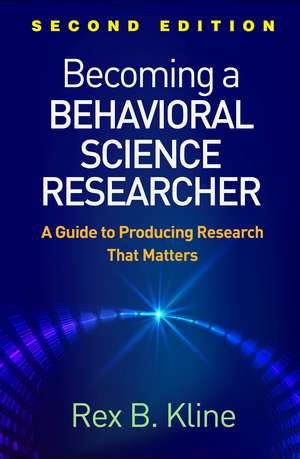
Becoming a Behavioral Science Researcher, Second Edition: A Guide to Producing Research That Matters
Autor Rex B. Klineen Limba Engleză Paperback – 19 dec 2019
Considerăm că a doua ediție a lucrării Becoming a Behavioral Science Researcher reprezintă o resursă indispensabilă pentru studenții de la nivel licență și master care se pregătesc pentru susținerea tezelor sau pentru publicarea primelor articole științifice. Relevanța acestui text pentru mediul academic actual este critică, oferind instrumentele necesare pentru a naviga între cursurile introductive de design de cercetare și execuția independentă a unui studiu riguros. Remarcăm efortul autorului Rex B. Kline de a actualiza conținutul cu peste 50%, abordând direct „crizele cercetării” din ultimul deceniu.
Structura volumului este organizată logic pentru a ghida progresia cercetătorului novice. Prima parte, „Promise and Problems”, analizează triada design-măsurare-analiză, în timp ce a doua parte, „Remedies”, introduce standardele moderne de raportare și reforma statisticii. Ultima secțiune se concentrează pe abilități practice de scriere și prezentare. Comparabil cu A Student's Guide to Open Science de Charlotte Pennington în ceea ce privește accentul pus pe transparență, volumul lui Kline se distinge prin abordarea pragmatică a metodelor mixte și prin exercițiile aplicate. De asemenea, este la fel de riguros ca Principles of Research in Behavioral Science, dar aduce un plus de actualitate prin capitolele dedicate mișcării „open science”.
În contextul operei sale, această lucrare completează expertiza tehnică demonstrată în Principles and Practice of Structural Equation Modeling, traducând concepte complexe de psihometrie și analiză de date într-un limbaj accesibil și conversațional. Credem că această ediție reușește să transforme procesul adesea arid al metodologiei într-o parcurs structurat către o știință mai reproductibilă și mai etică.
Preț: 378.88 lei
Carte disponibilă
Livrare economică 18 mai-01 iunie
Livrare express 02-08 mai pentru 37.76 lei
Specificații
ISBN-10: 1462538797
Pagini: 364
Dimensiuni: 156 x 234 x 20 mm
Greutate: 0.53 kg
Ediția:2nd edition
Editura: Guilford Publications
Colecția Guilford Press
Public țintă
Professional Practice & DevelopmentDe ce să citești această carte
Recomandăm această carte oricărui tânăr cercetător care dorește să producă studii cu impact real. Dincolo de teorie, câștigați abilități practice pentru a evita erorile statistice comune și pentru a stăpâni noile standarde de transparență cerute de revistele internaționale. Este ghidul esențial pentru a trece de la statutul de student la cel de autor publicat, oferind soluții concrete pentru criza replicării în științele comportamentale.
Despre autor
Rex B. Kline este doctor în psihologie și profesor asociat la Universitatea Concordia din Montreal, fiind membru al facultății de Psihologie Clinică. Cu o dublă specializare, ca psiholog clinician pentru copii și ca metodolog, Kline aduce o perspectivă echilibrată între practica aplicată și rigoarea statistică. Cercetările sale vizează evaluarea psihologică a copiilor în contexte clinice și școlare. Este recunoscut la nivel internațional pentru lucrările sale despre modelarea ecuațiilor structurale, experiența sa vastă în metodologie fiind fundamentul pe care a construit acest ghid esențial pentru noua generație de cercetători în științe sociale.
Descriere scurtă
New to This Edition
*Addresses critical "research crises" that have come to the fore in the last decade--and ways to remedy them.
*New chapters on the replication crisis, reporting standards, the open-science movement, and statistics reform.
*Extensively revised chapters on effect size estimation and psychometrics.
*Updated discussions of how to write publishable journal articles and create effective presentations.
Cuprins
1. Introduction
2. Research Trinity: Design, Measurement, and Analysis
3. Crises
II. Remedies
4. Reporting Standards: Quantitative, Qualitative, and Mixed Methods Research
5. Open Science
6. Statistics Reform
Appendix 6.A. Significance Testing Glossary
7. Effect Size
Appendix 7.A. Source Tables for Two Factorial Examples
8. Psychometrics
III. Skills
9. Practical Data Analysis
10. Writing
11. Presentations
Appendix 11.A. Example Thesis Student Slideshow
Appendix 11.B. Example Handout
Recenzii
“An outstanding book is now even better! In the decade since the first edition, we’ve seen the replication crisis and, in reply, the rise of open science. Researchers now need a deep understanding of preregistration, replication, the new statistics, the dangers of p hacking, and much, much more. Kline once again speaks with great authority and clarity in providing the ideal guide for beginning researchers finding their way in a rapidly changing research world. Every graduate student and postdoc in psychology needs this book as a constant companion. It will also be of great value for education and other social and behavioral sciences."--Geoff Cumming, DPhil, Professor Emeritus, School of Psychology and Public Health, La Trobe University, Melbourne, Australia
“This book is different in that it bridges the gap between how research methods are traditionally taught and how they are put into practice. As such, it can help researchers apply the concepts they are learning about. I applaud the updated coverage of qualitative studies and the practical information about what researchers should know about significance testing. This information fills in concepts that are sometimes missing in graduate research education.”--Julie Peterson Combs, EdD, Department of Educational Leadership, Sam Houston State University
“Kline’s writing is excellent and entertaining. In the second edition, the chapter on research crises is excellent and much needed, and the open-science chapter provides great database resources for students. I use this book as a supplemental text in my classes and recommend it to colleagues."--Craig D. Marker, PhD, Department of Clinical Psychology, Mercer University
“This excellent resource supports students' evolving understanding of the planning, implementation, and analysis of independent research. For example, the chapter on analysis leads readers through a step-by-step process of thinking about their data. I recommend Kline’s book for both class use and independent honors, master’s thesis, and dissertation guidance. It is a 'must read' for my students at all levels."--Diana P. F. Montague, PhD, Department of Psychology, La Salle University-This book represents an insightful perspective on many topics related to beginning a behavioral science research career….The domain of behavioral science is expanding to data science, big data, and data analytics, artificial intelligence, and the behavior of machines. Kline focuses on many issues that are central to psychology, as well as other disciplines….The book showcases the author's depth of understanding of many aspects of behavioral science research as well as expertise reflected in his research and publications. Kline authoritatively presents a well-organized review and analysis of important issues in behavioral science research.--Family and Consumer Research Journal, 9/1/2020ƒƒAn extremely flexible resource that can be used in a variety of classes….Because of Kline's wonderfully comprehensive work, the book is an easy reference for all researchers looking for more modern approaches to research design and analysis. Even the most informed psychologist is likely to learn something by reading this book....A superb resource for students and teachers alike....It would enhance any psychology curriculum and help the students of today become first-rate researchers of tomorrow. (on the first edition)--PsycCRITIQUES, 6/1/2009ƒƒThis could easily be a standalone book for a course or seminar as well as a supplemental text for any graduate or advanced level course in research methods....I love this book. (on the first edition)--Doody's Review Service, 2/20/2009ƒƒRecommended. Graduate students through researchers and faculty. (on the first edition)--Choice Reviews, 2/3/2009