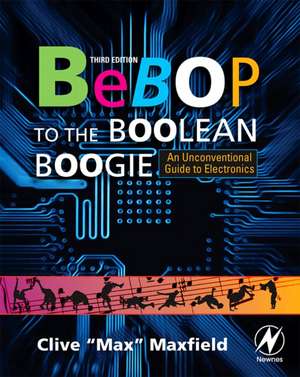
Bebop to the Boolean Boogie: An Unconventional Guide to Electronics
Autor Clive Maxfielden Limba Engleză Paperback – 5 dec 2008
Ecosistemul tehnologic actual se bazează pe o înțelegere profundă a circuitelor integrate, a logicii digitale și a proceselor de fabricație, elemente pe care Bebop to the Boolean Boogie le explorează într-o manieră tehnică, dar extrem de accesibilă. Notăm cu interes că această a treia ediție extinde materialul original, oferind aproximativ 400 de ilustrații care transformă conceptele abstracte de fizică a semiconductorilor în mecanisme vizuale clare. Dacă Bits on Chips de Harry Veendrick v-a oferit cadrul teoretic asupra microelectronicii, lucrarea lui Clive Maxfield oferă instrumentele practice și contextul industrial necesar pentru a naviga prin terminologia densă a ingineriei electronice.
Credem că valoarea acestui volum rezidă în structura sa progresivă, organizată în trei secțiuni strategice. Prima secțiune pune bazele fundamentale, de la structura atomului și funcțiile logice primitive până la hărțile Karnaugh și mașinile de stare. A doua secțiune trece la nivelul componentelor și proceselor, analizând circuitele integrate, memoriile, dispozitivele programabile (FPGA) și tehnologiile System-in-Package (SiP). În final, autorul abordează instrumentele de verificare și proiectare, oferind o imagine de ansamblu asupra fluxului de lucru dintr-un mediu de producție real.
În contextul operei autorului, această carte servește drept fundament pentru lucrările sale mai specializate, precum FPGAs: World Class Designs. În timp ce The Definitive Guide to How Computers Do Math se concentrează pe aritmetica computerizată, Bebop to the Boolean Boogie acoperă întregul spectru hardware, fiind un ghid esențial pentru înțelegerea modului în care sistemele electronice sofisticate sunt asamblate și verificate în prezent.
Preț: 329.86 lei
Carte tipărită la comandă
Livrare economică 23 noiembrie-07 decembrie
Livrare express 24-30 octombrie pentru 80.98 lei
Specificații
ISBN-10: 1856175073
Pagini: 568
Ilustrații: Approx. 400 illustrations
Dimensiuni: 191 x 235 x 26 mm
Greutate: 1.16 kg
Ediția:3 Rev ed.
Editura: ELSEVIER SCIENCE
V-ar putea interesa
-
 Fundamentals of Digital Logic with Verilog DesignStephen Brown-18%Preț: 1491.35 lei1818.72 lei
 -
 Electronics For Dummies, UK EditionCathleen ShamiehPreț: 145.47 lei
 -
 The Art of ElectronicsPaul Horowitz-9%Preț: 706.10 lei775.93 lei
 -
 Learning the Art of ElectronicsThomas C. Hayes-11%Preț: 617.36 lei693.66 lei
 -
 Complete ElectronicsEarl BoysenPreț: 231.22 lei
 -
 Electronics for DummiesCathleen ShamiehPreț: 167.14 lei
 -
 Preț: 276.22 lei
 -
 -27%Preț: 274.40 lei373.40 lei
 -
 Beginner's Guide to Reading Schematics, Fourth EditionStan Gibilisco-29%Preț: 143.11 lei201.37 lei
 -
 Digital Electronics: Principles and Applications ISERoger Tokheim-8%Preț: 474.65 lei515.92 lei
 -
 -11%Preț: 721.06 lei810.18 lei
 -
 -9%Preț: 563.36 lei619.07 lei
 -
 -9%Preț: 623.90 lei685.60 lei
 -
 Digital Design, Global EditionM. Morris Mano-15%Preț: 624.44 lei734.64 lei
 -
 Electronics FundamentalsThomas Floyd-9%Preț: 597.91 lei657.04 lei
 -
 -26%Preț: 91.29 lei122.92 lei
 -
 Foundations of Analog and Digital Electronic CircuitsAnant Agarwal-28%Preț: 546.19 lei754.30 lei
 -
 -19%Preț: 281.74 lei348.18 lei
 -
 Electronics in Easy StepsBill MantovaniPreț: 87.68 lei
 -
 Digital ElectronicsGareth MonkmanPreț: 364.65 lei
Public țintă
Electrical and Electronic engineers, technicians, technical marketing personnel, and anyone wanting an introduction to digital logic/circuits.De ce să citești această carte
Recomandăm această carte inginerilor debutanți, tehnicienilor și personalului de marketing tehnic care au nevoie de o bază solidă în electronica digitală. Cititorul câștigă nu doar o înțelegere a componentelor (ASIC, IC, SiP), ci și capacitatea de a utiliza corect jargonul industriei. Este un instrument practic de formare ce demistifică arhitectura circuitelor moderne fără a recurge la un formalism matematic arid.
Descriere scurtă
- Written in conversational, fun style that has generated a strong following for the author and sales of over 14,000 copies for the first two editions
- The Third Edition is even bigger and better, with lots of new material, illustrations, and an expanded glossary
- Ideal for training incoming engineers and technicians, and for people in marketing or other related fields or anyone else who needs to familiarize themselves with electronics terms and technology
Cuprins
Section 2: Components and Processes14. Integrated Circuits (ICs) 15. Memory ICs 16. Programmable ICs 17. Application-Specific Integrated Circuits (ASICs) 18. Circuit Boards 19. Hybrids 20. System-in-Package (Sip) and Friends21. Alternative and Future Technologies Section 3: Design Tools and Stuff22. General Concepts 23. Design and Verification Tools
AppendixA. Assertion-Level Logic B. Positive Logic versus Negative Logic C. Reed-Müller Logic D. Gray Codes E. Linear Feedback Shift Registers (LFSRs) F. Pass-Transistor Logic G. More on Semiconductors H. Rounding Algorithms 101 I. Pass-Transistor Logic J. An Interesting Conundrum
Recenzii
"Lives up to its title as a useful and entertaining technical guide...well suited for students, technical writers, technicians, and sales and marketing people." --Electronic Design