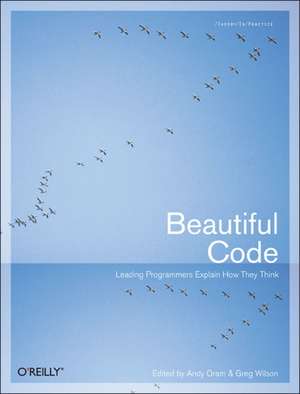
Beautiful Code: Theory in Practice (O'Reilly)
Autor Andy Oramen Limba Engleză Paperback – 31 iul 2007
Ceea ce diferențiază volumul Beautiful Code de documentația tehnică standard sau de manualele rigide de inginerie software este perspectiva sa introspectivă: nu ni se spune cum ar trebui să arate codul ideal, ci ni se arată cum a fost construit codul real, performant, în fața unor provocări tehnice masive. Subliniem valoarea celor 33 de studii de caz semnate de figuri legendare ale informaticii, precum Brian Kernighan sau Yukihiro Matsumoto, care își deschid „atelierul” pentru a ne explica logica din spatele unor soluții neconvenționale. Apreciem structura capitolelor care funcționează ca o sesiune de „think aloud”. Autorii nu se feresc să discute despre compromisurile necesare în arhitectură sau despre situațiile în care bunele practici teoretice au fost abandonate în favoarea eficienței practice. Complementar volumului Beautiful Architecture, care se concentrează pe structurile macro și robustețea sistemelor, Beautiful Code coboară în detaliile de implementare, oferind o claritate microscopică asupra eleganței algoritmice. Totodată, spre deosebire de abordarea didactică și normativă din The Practice of Programming, această lucrare pune accentul pe latura creativă și subiectivă a programării văzute ca artă. În contextul operei editoriale a lui Andy Oram, lucrarea continuă misiunea începută cu Making Software, aceea de a separa miturile de realitatea muncii de dezvoltare. Dacă în Peer-To-Peer Oram explora impactul social al tehnologiei, aici se concentrează pe estetica internă a sistemelor. Rezultatul este un volum dens, de 600 de pagini, care nu doar documentează soluții, ci educă instinctul tehnic al cititorului prin expunerea la modele de gândire de nivel înalt.
Preț: 238.89 lei
Preț vechi: 298.62 lei
-20%
Carte disponibilă
Livrare economică 05-19 noiembrie
Livrare express 21-27 octombrie pentru 56.21 lei
Specificații
ISBN-10: 0596510047
Pagini: 600
Ilustrații: Illustrations
Dimensiuni: 180 x 236 x 42 mm
Greutate: 1 kg
Editura: O'Reilly
Colecția Theory in Practice (O'Reilly)
Seria Theory in Practice (O'Reilly)
V-ar putea interesa
-
 Smalltalk Best Practice PatternsKent Beck-20%Preț: 408.65 lei510.81 lei
 -
 We, ProgrammersRobert Martin-20%Preț: 241.94 lei302.42 lei
 -
 Clean Code: A Handbook of Agile Software CraftsmanshipRobert Martin-20%Preț: 365.09 lei456.37 lei
 -
 -20%Preț: 304.38 lei380.49 lei
 -
 -20%Preț: 641.11 lei801.39 lei
 -
 -20%Preț: 226.70 lei283.37 lei
 -
 The Practice of ProgrammingBrian Kernighan-20%Preț: 304.10 lei380.12 lei
 -
 -20%Preț: 370.60 lei463.25 lei
 -
 Software Design DecodedAndre van der Hoek-20%Preț: 85.23 lei106.54 lei
 -
 Computer Architecture: A Quantitative ApproachJohn L. Hennessy-39%Preț: 536.81 lei884.58 lei
 -
 Source CodeBill GatesPreț: 189.29 lei
 -
 Code Complete: A practical handbook of software constructionSteve McConnell-20%Preț: 285.38 lei356.73 lei
 -
 Coding For Dummies, All New EditionPaul McFedries-20%Preț: 116.94 lei146.18 lei
 -
 Preț: 123.51 lei
 -
 CodersClive Thompson-47%Preț: 53.51 lei100.38 lei
 -
 Hacking: The Art of Exploitation, 2nd EditionJon Erickson-35%Preț: 256.17 lei394.85 lei
 -
 Street CoderSedat Kapanoglu-20%Preț: 277.22 lei346.53 lei
 -
 Good Code, Bad CodeTom Long-20%Preț: 365.68 lei457.10 lei
 -
 .NET 10 RevealedKajetan Duszy¿ski-20%Preț: 240.60 lei300.75 lei
De ce să citești această carte
Recomandăm această carte programatorilor care vor să depășească etapa de simpli executanți și să înțeleagă filosofia din spatele unui cod elegant. Veți câștiga o perspectivă unică asupra modului în care experți de top rezolvă probleme complexe, învățând când să respectați regulile și, mai important, când să le încălcați argumentat. Este o lectură esențială pentru rafinarea gândirii arhitecturale și a stilului de programare.
Despre autor
Andy Oram este un editor veteran în cadrul O'Reilly & Associates, având o expertiză consolidată în domeniul sistemelor Linux și al programării. Cariera sa este marcată de coordonarea unor antologii tehnice de referință care explorează intersecția dintre tehnologie și practicile de lucru reale. Printre proiectele sale notabile se numără Peer-To-Peer, o lucrare ce analizează rețelele descentralizate, și Beautiful Security, unde aplică aceeași metodă a studiilor de caz pentru a demonta ipotezele greșite despre securitatea informatică. Prin munca sa, Oram facilitează dialogul dintre cercetarea academică și nevoile pragmatice ale comunității de dezvoltatori.
Notă biografică
Descriere scurtă
This is not simply another design patterns book, or another software engineering treatise on the right and wrong way to do things. The authors think aloud as they work through their project's architecture, the tradeoffs made in its construction, and when it was important to break rules.
This book contains 33 chapters contributed by Brian Kernighan, KarlFogel, Jon Bentley, Tim Bray, Elliotte Rusty Harold, Michael Feathers,Alberto Savoia, Charles Petzold, Douglas Crockford, Henry S. Warren,Jr., Ashish Gulhati, Lincoln Stein, Jim Kent, Jack Dongarra and PiotrLuszczek, Adam Kolawa, Greg Kroah-Hartman, Diomidis Spinellis, AndrewKuchling, Travis E. Oliphant, Ronald Mak, Rogerio Atem de Carvalho andRafael Monnerat, Bryan Cantrill, Jeff Dean and Sanjay Ghemawat, SimonPeyton Jones, Kent Dybvig, William Otte and Douglas C. Schmidt, AndrewPatzer, Andreas Zeller, Yukihiro Matsumoto, Arun Mehta, TV Raman,Laura Wingerd and Christopher Seiwald, and Brian Hayes.
Beautiful Code is an opportunity for master coders to tell their story. All author royalties will be donated to Amnesty International.
Cuprins
- Dedication
- Foreword
- Preface
- Chapter 1: A Regular Expression Matcher
- Chapter 2: Subversion's Delta Editor: Interface As Ontology
- Chapter 3: The Most Beautiful Code I Never Wrote
- Chapter 4: Finding Things
- Chapter 5: Correct, Beautiful, Fast (in That Order): Lessons from Designing XML Verifiers
- Chapter 6: Framework for Integrated Test: Beauty Through Fragility
- Chapter 7: Beautiful Tests
- Chapter 8: On-the-Fly Code Generation for Image Processing
- Chapter 9: Top Down Operator Precedence
- Chapter 10: The Quest for an Accelerated Population Count
- Chapter 11: Secure Communication: The Technology Of Freedom
- Chapter 12: Growing Beautiful Code in BioPerl
- Chapter 13: The Design of the Gene Sorte
- Chapter 14: How Elegant Code Evolves with Hardware The Case of Gaussian Elimination
- Chapter 15: The Long-Term Benefits of Beautiful Design
- Chapter 16: The Linux Kernel Driver Model: The Benefits of Working Together
- Chapter 17: Another Level of Indirection
- Chapter 18: Python's Dictionary Implementation: Being All Things to All People
- Chapter 19: Multidimensional Iterators in NumPy
- Chapter 20: A Highly Reliable Enterprise System for NASA's Mars Rover Mission
- Chapter 21: ERP5: Designing for Maximum Adaptability
- Chapter 22: A Spoonful of Sewage
- Chapter 23: Distributed Programming with MapReduce
- Chapter 24: Beautiful Concurrency
- Chapter 25: Syntactic Abstraction: The syntax-case Expander
- Chapter 26: Labor-Saving Architecture: An Object-Oriented Framework for Networked Software
- Chapter 27: Integrating Business Partners the RESTful Way
- Chapter 28: Beautiful Debugging
- Chapter 29: Treating Code As an Essay
- Chapter 30: When a Button Is All That Connects You to the World
- Chapter 31: Emacspeak: The Complete Audio Desktop
- Chapter 32: Code in Motion
- Chapter 33: Writing Programs for "The Book"
- Afterword
- Contributors
- Colophon