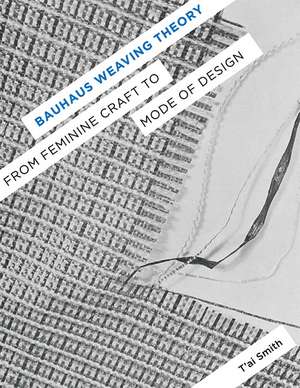
Bauhaus Weaving Theory: From Feminine Craft to Mode of Design
Autor T’ai Smithen Limba Engleză Paperback – 9 noi 2014
În cele 272 de pagini, Bauhaus Weaving Theory propune o analiză riguroasă a scrierilor teoretice produse în cadrul atelierului de țesătorie, demontând mitul conform căruia această disciplină era strict artizanală. T’ai Smith investighează textele lăsate de figuri emblematice precum Anni Albers sau Gunta Stölzl, demonstrând cum acestea au împrumutat vocabularul picturii și arhitecturii pentru a-și legitima practica în contextul modernismului. Ne-a atras atenția modul în care autoarea urmărește evoluția de la tapiseria de artă la inovații tehnice remarcabile, precum materialele reflectorizante sau fonoizolante, integrând aceste obiecte într-un discurs intelectual complex. Subliniem faptul că lucrarea nu se rezumă la o istorie vizuală, ci funcționează ca o examinare critică a modului în care s-au stabilit valorile în lumea artei secolului XX. Suntem de părere că această perspectivă reîncadrează atelierul de țesătorie ca un nucleu de gîndire teoretică central școlii Bauhaus. Ca alternativă la Weaving at Black Mountain College de Michael Beggs, care se concentrează pe pedagogia americană post-Bauhaus, volumul lui T’ai Smith oferă avantajul unei analize aprofundate a surselor scrise originale din perioada germană, fiind esențial pentru înțelegerea fundamentelor teoretice ale designului textil modern.
Preț: 160.64 lei
Carte disponibilă
Livrare economică 06-20 noiembrie
Livrare express 23-29 octombrie pentru 108.73 lei
Specificații
ISBN-10: 0816687242
Pagini: 272
Ilustrații: 41
Dimensiuni: 152 x 203 x 20 mm
Greutate: 0.39 kg
Ediția:1
Editura: University of Minnesota Press
Colecția Univ Of Minnesota Press
V-ar putea interesa
-
 RoadsworthBethany Gibson-10%Preț: 166.08 lei184.15 lei
 -
 A More Abundant LifeJacqueline HoeferPreț: 303.56 lei
 -
 Ekpahak: Where the Tide Ends/Où la Marée AboutitTerry Graff-10%Preț: 139.90 lei154.94 lei
 -
 -14%Preț: 197.40 lei228.44 lei
 -
 Preț: 157.51 lei
 -
 Preț: 76.62 lei
 -
 The State of Art - Representational & Abstract #2Chris HodsonPreț: 404.00 lei
 -
 Preț: 380.46 lei
 -
 Was Bilder erzählenHeinrich KraussPreț: 231.92 lei
 -
 Preț: 512.12 lei
 -
 Preț: 274.44 lei
 -
 Preț: 328.32 lei
 -
 Preț: 275.50 lei
 -
 Preț: 213.72 lei
 -
 Das Topische ModellBardo LeiboldPreț: 345.04 lei
 -
 -19%Preț: 654.90 lei808.52 lei
 -
 Die Plastik der ÄgypterHedwig FechheimerPreț: 404.31 lei
 -
 -23%Preț: 751.69 lei976.22 lei
De ce să citești această carte
Recomandăm această carte cercetătorilor și pasionaților de design care doresc să înțeleagă dimensiunea intelectuală a textilelor. Cititorul va descoperi cum femeile de la Bauhaus au folosit teoria pentru a depăși barierele de gen și ierarhiile artistice, transformând un meșteșug considerat „feminin” într-un pilon al designului modern. Este o resursă academică valoroasă care oferă o nouă perspectivă asupra istoriei modernismului prin prisma scrierilor teoretice ale artistelor.
Despre autor
T’ai Smith este o specialistă recunoscută în istoria artei și a designului, cu un interes particular pentru mediul textil și teoria mediilor. În lucrarea Bauhaus Weaving Theory, ea aduce la lumină contribuțiile intelectuale adesea ignorate ale femeilor din cadrul faimoasei școli germane. Abordarea sa interdisciplinară îmbină analiza istorică cu teoria critică, explorând intersecția dintre artă, industrie și filosofie. Expertiza sa este reflectată în modul meticulos în care interpretează textele de arhivă, oferind o voce teoretică artistelor care au modelat estetica funcționalistă a secolului trecut.
Descriere scurtă
From colorful, expressionist tapestries to the invention of soundproofing and light-reflective fabric, the workshop’s innovative creations influenced a modernist theory of weaving. In the first careful examination of the writings of Bauhaus weavers, including Anni Albers, Gunta Stözl, and Otti Berger, Smith details how these women challenged assumptions about the feminine nature of their craft. As they harnessed the vocabulary of other disciplines like painting, architecture, and photography, Smith argues, the weavers resisted modernist thinking about distinct media. In parsing texts about tapestries and functional textiles, the vital role these women played in debates about medium in the twentieth century and a nuanced history of the Bauhaus comes to light.
Bauhaus Weaving Theory deftly reframes the Bauhaus weaving workshop as central to theoretical inquiry at the school. Putting questions of how value and legitimacy are established in the art world into dialogue with the limits of modernism, Smith confronts the belief that the crafts are manual and technical but never intellectual arts.
Notă biografică
Recenzii
"This is the first scholarly analysis of the theoretical writing by the women weavers of the Bauhaus and as such fills a huge gap in the literature about the work of women artists at the school and the role and evolution of a feminized craft within the institution’s history. This book functions as not only a history of the weaving workshop, but also a nuanced history of the Bauhaus through the lens of creative practice." —Elissa Auther, University of Colorado, Colorado Springs
"Smith’s account yields important insights for the history of modernism as well as the art world’s current fascination with textiles and fiber art. A welcome resource for any scholar of modernism and a crucial lens on contemporary textile art."—Art Papers
"This book of theoretical essays uncovers a rarely spotlighted yet deeply significant creative process within the Bauhaus movement."—Metropolis
"An edifying and overdue investigation of the weavers’ far-reaching contributions."—American Craft
"A fascinating book that should interest professionals and amateurs alike."—CHOICE
"Compelling research."—Crafts Magazine
"An important schoalarly work for anyone interested in the history of fiber art, weaving, and the discourse about art vs. medium-specific craft."—Shuttle Spindle Dyepot
"Bauhaus Weaving Theory proves to be foundational in rethinking weaving; it is a remarkable work of scholarship, pellucid and engaging."—Journal of Modern Craft
"T'ai Smith's excellent book demonstrates the historical importance of the workshop and its significant place in contemporary deliberations on arts and crafts."—Widewalls