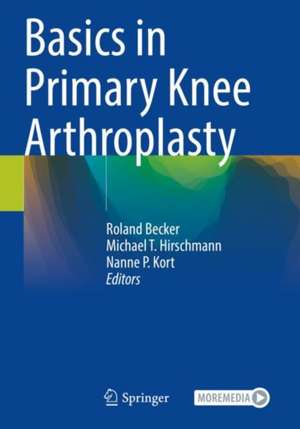
Basics in Primary Knee Arthroplasty
Editat de Roland Becker, Michael T. Hirschmann, Nanne P. Korten Limba Engleză Paperback – 8 apr 2023
Bazându-ne pe cele mai recente ghiduri de medicină bazată pe dovezi (EBM) și analize clinice ale cinematicii articulare, Basics in Primary Knee Arthroplasty se constituie într-o resursă fundamentală pentru ortopedul aflat la începutul curbei de învățare. Remarcăm modul riguros în care editorii Roland Becker, Michael T. Hirschmann și Nanne P. Kort au structurat materialul, pornind de la baze anatomice și antropometrice pentru a justifica deciziile clinice complexe. Putem afirma că volumul nu este doar un manual de tehnică, ci un tratat de biomecanică aplicată, explorând încărcarea articulației și designul componentelor protetice. Structura logică a celor 18 capitole facilitează o progresie naturală: de la înțelegerea genunchiului nativ la criteriile de selecție pentru artroplastia unicompartimentală sau patelofemurală. Un element distinctiv îl reprezintă integrarea resurselor video și a detaliilor practice („tips and tricks”), esențiale pentru gestionarea situațiilor intraoperatorii neprevăzute. Clinicienii care folosesc Total Knee Arthroplasty de E. Carlos Rodrìguez-Merchán ca referință vor găsi aici o completare necesară prin accentul pus pe planificarea 2D și pe gestionarea comorbidităților cardiovasculare la pacienții programați pentru intervenție. Această lucrare consolidează expertiza editorilor în domeniu, raportându-se direct la temele abordate în lucrări anterioare precum Infection in Knee Replacement sau The Unhappy Total Knee Replacement. Dacă acele volume se concentrau pe complicații și eșecuri, Basics in Primary Knee Arthroplasty revine la fundamente, asigurând premisele unei intervenții primare reușite. Este o lectură clinică precisă, care echilibrează rigoarea științifică a designului de implant cu realitatea pragmatică a sălii de operație.
Preț: 1258.27 lei
Preț vechi: 1324.50 lei
-5%
Carte disponibilă
Livrare economică 11-25 noiembrie
Livrare express 28 octombrie-03 noiembrie pentru 85.60 lei
Specificații
ISBN-10: 3030581802
Pagini: 728
Ilustrații: XIV, 711 p. 397 illus., 350 illus. in color.
Dimensiuni: 178 x 254 x 37 mm
Greutate: 1.51 kg
Ediția:1st ed. 2022
Editura: Springer
Locul publicării:Cham, Switzerland
V-ar putea interesa
-
 -26%Preț: 2032.60 lei2761.32 lei
 -
 -29%Preț: 1089.08 lei1528.20 lei
 -
 The Technique of Total Knee ArthroplastyWilliam M. Mihalko-28%Preț: 1102.07 lei1540.69 lei
 -
 -24%Preț: 1518.98 lei2001.77 lei
 -
 -29%Preț: 1000.74 lei1399.64 lei
 -
 Complications in Orthopaedics: Adult ReconstructionPaul Maxwell Courtney-20%Preț: 1246.53 lei1557.55 lei
 -
 Surgery of the Hip: Expert Consult - Online and PrintDaniel J. Berry-29%Preț: 1599.34 lei2247.55 lei
 -
 Evaluation and Management of Hip and Knee Arthritis in WomenClaudette M. Lajam-28%Preț: 1372.03 lei1916.16 lei
 -
 Osteotomies Around the Knee, An Issue of Clinics in Sports MedicineMichael J. Alaia-5%Preț: 843.29 lei887.67 lei
 -
 -24%Preț: 1770.85 lei2325.88 lei
 -
 Techniques in Revision Hip and Knee ArthroplastyGiles R Scuderi-33%Preț: 1041.89 lei1555.03 lei
 -
 Knee ArthroscopyBrian McKeon-5%Preț: 725.54 lei763.72 lei
 -
 Joint Replacement Arthroplasty: Basic Science, Hip, Knee, and AnkleBernard F. Morrey MD-25%Preț: 2041.27 lei2706.55 lei
 -
 Surgery of the KneePhilippe Neyret-5%Preț: 879.59 lei925.88 lei
 -
 Advances in Orthopedic Surgery of the KneeE. Carlos Rodrìguez-Merchán-5%Preț: 619.82 lei652.45 lei
 -
 Total Ankle ReplacementBeat Hintermann-5%Preț: 904.25 lei951.85 lei
 -
 Knee ArthroplastyThomas P. Sculco-5%Preț: 755.24 lei794.99 lei
 -
 Partial Knee ArthroplastyJean-Noël A. Argenson-5%Preț: 680.75 lei716.58 lei
 -
 Knee ArthroplastyMrinal Sharma-5%Preț: 1345.93 lei1416.77 lei
 -
 Advances in Total Hip ArthroplastyYasuharu Nakashima-5%Preț: 1381.16 lei1453.86 lei
De ce să citești această carte
Recomandăm această lucrare tinerilor chirurgi ortopezi și rezidenților care se pregătesc pentru primele intervenții de protezare a genunchiului. Cititorul câștigă o înțelegere profundă a filosofiilor de aliniament mecanic și echilibrare ligamentară. Motivul concret pentru achiziție este accesul la materialele video de înaltă calitate și la ghidurile de selecție a pacienților, care transformă teoria biomecanică în succes clinic predictibil.
Despre autor
Roland Becker, Michael T. Hirschmann și Nanne P. Kort sunt figuri proeminente în ortopedia europeană, cu o activitate editorială vastă sub egida unor organizații precum ESSKA. Michael T. Hirschmann este recunoscut pentru cercetările sale privind eșecurile artroplastiei de genunchi, publicând lucrări de referință despre managementul infecțiilor și evaluarea pacienților cu rezultate postoperatorii nesatisfăcătoare. Expertiza lor colectivă acoperă întregul spectru al patologiei genunchiului, de la biomecanică și design de implant până la tehnici chirurgicale avansate și revizii complexe, poziționându-i ca lideri de opinie în chirurgia reconstructivă a membrului inferior.
Cuprins
Notă biografică
He has been Deputy Editor in Chief of Knee Arthroscopy Sports Traumatology and Knee Surgery (KSSTA) from 2012 to 2019 after being an Associated Editor from 2009. Prof. Becker has given over 400 presentations and published over 150 peer reviewed articles, mainly about knee. He was Editor and author of one of the most successful books about revision in total knee arthroplasty “The unhappy total knee arthroplasty”. He also wrote a book about Basics in Knee arthroscopy and contributed to numerous other book projects.
Prof. Hirschmann has published over 250 articles in peer-reviewed international medical journals and has led numerous books in knee surgery as editor. His research focuses on all aspects of knee surgery, but in particular on knee arthroplasty and "unhappy patients after total knee arthroplasty". His book "The unhappy total knee replacement" accounts to the one of most successful books in the field of expertise. Prof. Hirschmann is the chairman of the European Knee Associates (EKA), a section of ESSKA. He also serves as a board member of the German Knee Society (DKG). In addition, Prof. Hirschmann serves as the deputy editor in chief of Knee Surgery, Sports Traumatology, Arthroscopy (KSSTA). He is also member of the editorial boards of various journals such as Muscle Ligaments and Tendons Journal, World Journal of Orthopedics and AP SMART Journal.
Caracteristici
Descriere
This book supplies all the information that the young orthopaedic surgeon needs to know when preparing to perform total or partial knee replacement for the first time and also provides more experienced surgeons with a comprehensive general update on the basics.
After an opening section on anatomy and kinematics of the knee, patient management during the pre-, peri-, and postoperative phases is covered in detail with the aid of numerous illustrations. The final section considers postoperative patient evaluation, outcome measurements, and the value of registries.
Readers will gain a sound understanding of the scientific basis underlying management decisions, of component design philosophies, and of the rationale for preferences such as mechanical alignment and ligament balancing. The pros and cons of a variety of management choices are explained, and guidance provided on patient selection. Surgical techniques are presented on high-quality videos and many tips and tricks are highlighted to help the inexperienced to cope with challenging situations.