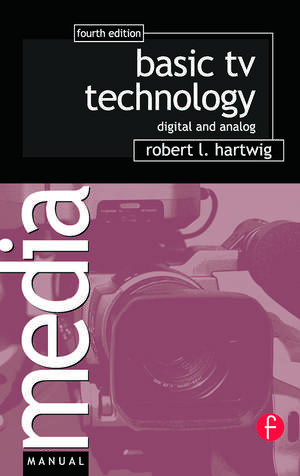
Basic TV Technology: Digital and Analog
Autor Robert L. Hartwigen Limba Engleză Paperback – 21 mar 2005
The fourth edition of Basic TV Technology has been updated to reflect the industry shift to digital video and includes new information on compression, television standards, LCD displays, HD, and equipment.
This book features the accessible Media Manual format, in which every topic is covered in two pages: one of explanatory text and one of figures.
Need more information on TV technologies, go to: http://www.insightmedia.info/newsletters.php
Preț: 448.53 lei
Puncte Express: 673
Carte tipărită la comandă
Livrare economică 24 noiembrie-08 decembrie
Livrare prin curier în România Termenul estimat este afișat lângă disponibilitate.
Transport gratuit pentru acest produs Plată online sau ramburs, în funcție de opțiunile comenzii.
Retur gratuit în 14 zile Comandă securizată și suport în română.
Specificații
ISBN-13: 9780240807171
ISBN-10: 0240807170
Pagini: 204
Ilustrații: Approx. 150 illustrations
Dimensiuni: 138 x 216 x 14 mm
Greutate: 0.25 kg
Ediția:Revised
Editura: Taylor & Francis
Colecția Routledge
Locul publicării:Oxford, United Kingdom
ISBN-10: 0240807170
Pagini: 204
Ilustrații: Approx. 150 illustrations
Dimensiuni: 138 x 216 x 14 mm
Greutate: 0.25 kg
Ediția:Revised
Editura: Taylor & Francis
Colecția Routledge
Locul publicării:Oxford, United Kingdom
V-ar putea interesa
-
 Tragically I Was an Only TwinPeter CookPreț: 121.78 leiNou
 -
 Production Management for TV and Film: The professional's guideLinda Stradling-14%Preț: 233.61 lei272.56 lei
 -
 -15%Preț: 290.74 lei340.99 lei
 -
 -5%Preț: 236.49 lei249.54 lei
 -
 ShowrunnersTara Bennett-17%Preț: 77.56 lei93.84 lei
 -
 The Art and Making of the FlashAbbie Bernstein-17%Preț: 121.49 lei145.68 lei
 -
 Producing with PassionDorothy Fadiman-17%Preț: 73.12 lei87.86 lei
Public țintă
Professional Practice & DevelopmentCuprins
The Atom & Electricity; Basic Circuits; Units of Measurement; Fields (Induction) and Noise; Abbreviations; Cathode Ray Tubes (CRTs); Need for interlace scanning; Blanking; Waveform Display; Charge Coupled Devices; An Introduction to Digital; Analog and Digital; Color System; How the Eye Sees Light; Digital Encoding Ratios; CODECs; Composite Encoding; Color CRTs; Plasma Display Screens; LCD Screens; Analog Sync Generators; Vectorscope; PAL; Combining Sync and Camera Flow Diagrams; Video Switchers; Switcher Applications; Production Switcher Flow Diagram; Switcher Transitions and Special Effects; Special Effects Keys--Luminance Keys, Chroma Keys; Composite Versus Component Video; Color Difference Component Video; Digital Special Effects; Digital Interpolation; Analog Videotape Recording Technology; Analog Video Recording Standards & Formats; Other Tracks and Lockup; Time Base Error and Correction; Larger Analog Sync Problems & Solutions; Other Advantages of TBCs & Frame Synchronizers; Digital Videotape Recorders; Digital Video Servers; Disc Based Recorders; Editing Analog Videotape; The Editing Process; Types of Edits; Editing Methods-Manual editing and Control track counters; SMPTE Time Code Editing; Off/On Line Editing; Editing by Computers; Problems of Traditional Editing; Non Linear Editing; Video, Spatial, Temporal Compression; MPEG Compression Standard; Computer Graphics for Video; Character Generators; Creating Imagery & Effects; The Digital Studio; Open Architecture vs. Dedicated Equipment; Drawbacks of Open Architecture Equipment; HD TV; ATSC HD Broadcast Standard; SDTV; Audio for Video; Surround Sound; Professional and Consumer Audio; Combining Audio Components; Microphones, Mixers, and Loudspeakers; Sound Recording for Video; Digital Audio Workstations; Further Reading; Glossary
Recenzii
"I read this book to refresh my basic grasp of television technology concepts, and for that purpose it worked perfectly. Organized into small sections which build slowly from simple ideas (electricity basics) to complex tools (video servers). The book also includes a useful list of further reading material and a reference glossary." -- An Amazon Reviewer
Notă biografică
Robert Lee Hartwig was born and raised in a small northern California farming town. At the age of 13, his parents bought an 8mm movie camera. He spent the next couple of years fooling around with animation and teaching himself simple film editing. He spent his teenage summers on the family farm. He attended Chico State University where, quite by accident, he got involved in the college radio station. While involved in college radio, he served as Business Manager of the station and was appointed to be the student manager of the station. At the same time, the school was developing a Mass Communications Degree program, which he transferred to as soon as the program opened. While in school, he worked at both AM and FM radio stations as an on-air announcer. He still worked summers on the farm because the 80 - 100 hour weeks made a lot more money for him. He was a member of the first graduating class in Mass Communications from Chico State where the faculty awarded him the Leadership Merit Award upon graduation.
He went to San Diego State University for his Master's Degree in Radio and Television. Coming from a rural background, living in a city the size of San Diego drove him nuts. The culture shock was the greatest challenge to completing the MA. While working on the MA, he also worked for the San Diego Area Instructional Television Authority, was a Television Specialist for the Adult Division of the San Diego Community College District, worked as a photographer on a special project for the San Diego Community College Association, and taught a night class in TV Production for the Adult Division of the San Diego Community College District. This teaching experience gave him the teaching bug. He was granted his MA in December of 1973.
He moved back to northern California and got a part-time teaching job in the Mass Communications Department at Butte Community College in Oroville, CA. While at Butte he also produced and directed video programs for t
He went to San Diego State University for his Master's Degree in Radio and Television. Coming from a rural background, living in a city the size of San Diego drove him nuts. The culture shock was the greatest challenge to completing the MA. While working on the MA, he also worked for the San Diego Area Instructional Television Authority, was a Television Specialist for the Adult Division of the San Diego Community College District, worked as a photographer on a special project for the San Diego Community College Association, and taught a night class in TV Production for the Adult Division of the San Diego Community College District. This teaching experience gave him the teaching bug. He was granted his MA in December of 1973.
He moved back to northern California and got a part-time teaching job in the Mass Communications Department at Butte Community College in Oroville, CA. While at Butte he also produced and directed video programs for t
Descriere
Understand the fundamentals of television and video technology without a math or science background!