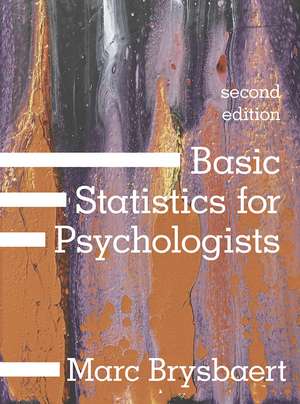
Basic Statistics for Psychologists
Autor Marc Brysbaerten Limba Engleză Paperback – 30 oct 2019
Considerăm că a doua ediție a volumului Basic Statistics for Psychologists reprezintă o resursă fundamentală pentru studenții de licență care navighează prin complexitatea metodologiei cercetării. Marc Brysbaert, cu o vastă experiență pedagogică la Universitatea din Ghent și Royal Holloway, reușește să transforme un subiect adesea intimidant într-un instrument de lucru accesibil. Notăm cu interes includerea analizei Bayesiene (Capitolul 8) și a regresiei multiple, elemente care aliniază manualul la standardele contemporane de raportare a datelor în psihologie.
Structura cărții este riguros organizată în 15 capitole, pornind de la conceptele elementare de tendință centrală și variabilitate, până la tehnici avansate precum analiza varianței pentru designuri cu mai multe variabile independente. Ceea ce diferențiază acest titlu de alte manuale este integrarea software-ului modern; dincolo de clasicul SPSS, autorul oferă ghidaj pas cu pas pentru jamovi și JASP, pachete statistice open-source tot mai utilizate în mediul academic. Cititorii familiarizați cu Jamovi for Psychologists de Paul Richardson vor aprecia aici contextul teoretic mai larg și fundamentarea matematică a formulelor, în timp ce abordarea prietenoasă amintește de stilul regăsit în Understanding and Using Statistics in Psychology de Jeremy Miles.
În contextul operei sale, această lucrare completează expertiza autorului din Fundamentals of Cognition, oferind suportul tehnic necesar pentru a investiga procesele cognitive descrise în lucrările sale anterioare. Brysbaert nu se limitează la teorie, ci ancorează fiecare test statistic în exemple reale din cercetarea psihologică, facilitând o înțelegere intuitivă a modului în care cifrele se traduc în comportament uman.
Preț: 339.13 lei
Preț vechi: 411.65 lei
-18%
Carte disponibilă
Livrare economică 16-30 noiembrie
Livrare express 30 octombrie-05 noiembrie pentru 131.94 lei
Specificații
ISBN-10: 1137607467
Pagini: 560
Ilustrații: 15 bw illus
Dimensiuni: 192 x 258 x 38 mm
Greutate: 0.88 kg
Ediția:2nd ed. 2020
Editura: Bloomsbury Publishing
Colecția Bloomsbury Academic
Locul publicării:London, United Kingdom
De ce să citești această carte
Recomandăm această carte oricărui student la psihologie care dorește să depășească bariera fricii de statistică. Veți câștiga o bază solidă nu doar în calculul manual al formulelor, ci și în utilizarea celor mai noi instrumente digitale precum JASP și jamovi. Este un ghid practic, esențial pentru cursul de metode de cercetare, care transformă analiza de date într-o competență clară și aplicabilă.
Descriere
Featuring new chapters on Bayesian and multiple regression analysis, this book gives students a working understanding of how to conduct reliable and methodical research using statistics. Brysbaert illustrates the key concepts using examples from psychological research, with clear formulas and explanations for calculations. With helpful chapter-by-chapter guidance for carrying out tests using SPSS, as well as coverage of jamovi and JASP software, this book aims to develop students' confidence in statistical analysis, and to take the fear out of the topic. It offers an easily navigable layout filled with features that help learners to avoid common pitfalls and check their understanding along the way.
This engaging and informative guide is essential reading for undergraduate psychology students taking courses in research methods and statistics.
New to this Edition:
- Chapters on Bayesian analysis, mixed-effects models, and multiple regression analysis
- Coverage of jamovi and JASP, two free statistical packages
Cuprins
2. Summarising data using the frequency distribution
3. Summarising data using measures of central tendency
4. Summarising data using measures of variability
5. Standardised scores, normal distribution and probability
6. Using the t-test to measure the difference between independent groups
7. Interpreting the results of a statistical test: The traditional approach
8. Interpreting the results of a statistical test: The Bayesian approach
9. Non-parametric tests of difference between independent groups
10. Using the t-test to measure change in related samples
11. Non-parametric tests to measure changes in related samples
12. Improving predictions through the Pearson correlation coefficient
13. Improving predictions through non-parametric tests
14. Using analysis of variance as an extension of t-tests
15. Using analysis of variance for designs with more than one independent variable
16. More than one predictor in correlational studies: Multiple regression
17. More than one observation per condition per participant: Mixed-effects analysis.