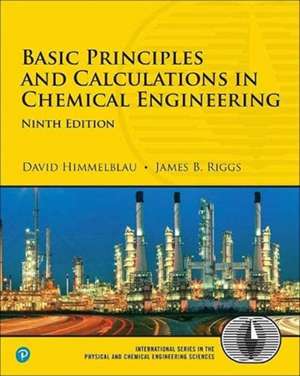
Basic Principles and Calculations in Chemical Engineering
Autor David Himmelblau, David M. Himmelblau, James B. Riggsen Limba Engleză Paperback – 29 iul 2022
Observăm în această a noua ediție a Basic Principles and Calculations in Chemical Engineering o structură progresivă riguroasă, concepută să ghideze cititorul de la fundamentele teoretice la implementarea tehnică modernă. Lucrarea debutează cu o introducere în contextul industrial și etic, trecând rapid către rigoarea conversiilor de unități și a variabilelor de proces, pentru a culmina cu analiza detaliată a bilanțurilor de masă și energie. Găsim aici o abordare echilibrată între metodele clasice de calcul și instrumentele digitale actuale, autorii introducând probleme specifice rezolvate în MATLAB și Python, esențiale pentru eficiența inginerului contemporan. Pe linia practică a volumului Principles of Chemical Engineering Processes de Nayef Ghasem, această lucrare își păstrează relevanța prin focusul pe aplicații de ultimă oră în biotehnologie și nanotehnologie, domenii care au transformat curricula de specialitate. Spre deosebire de alte manuale care rămân la nivelul sistemelor statice, David Himmelblau și James B. Riggs aduc în prim-plan capitole noi dedicate bilanțurilor dinamice, oferind o perspectivă fluidă asupra proceselor industriale. Această ediție consolidează temele prezente în varianta Basic Principles and Calculations in Chemical Engineering, Global Edition, dar optimizează conținutul pentru o parcurgere mai rapidă, eliminând redundanțele. Structura logică — împărțită în Introducere, Concepte Introductive și Bilanțuri de Masă — asigură o tranziție lină de la verificarea rezultatelor la utilizarea matricelor și vectorilor în rezolvarea ecuațiilor liniare. Este un instrument tehnic care nu doar prezintă formule, ci formează o metodologie de lucru consecventă pentru orice inginer chimist.
Preț: 962.63 lei
Preț vechi: 1173.94 lei
-18%
Carte tipărită la comandă
Livrare economică 23-30 noiembrie
Specificații
ISBN-10: 013732717X
Pagini: 960
Dimensiuni: 203 x 254 x 51 mm
Greutate: 2.0099999999999998 kg
Ediția:9. Auflage
Editura: Pearson
V-ar putea interesa
-
 -18%Preț: 1081.21 lei1318.55 lei
 -
 -9%Preț: 548.51 lei602.75 lei
 -
 EIS: Fault Finding and DiagnosisJohn Hooper-21%Preț: 141.45 lei180.01 lei
 -
 Chemical Sensors: Simulation and Modeling - Volume 4: Optical SensorsGhenadii Korotcenkov-39%Preț: 955.69 lei1567.51 lei
 -
 Verfahrenstechnik der ThermoplastextrusionAndreas Limper-13%Preț: 778.88 lei895.26 lei
 -
 FluidverfahrenstechnikRalf Goedecke-13%Preț: 733.97 lei843.63 lei
 -
 Regenerativer ErdölersatzRolf Bayerbach-8%Preț: 398.82 lei433.50 lei
 -
 Catalytic Oxidation Of Gas OilSyed Mumtaz Danish Naqvi-8%Preț: 464.56 lei504.95 lei
 -
 Preț: 374.31 lei
 -
 Transferencia de oxígeno en fluidos modelo y caldos de fermentaciónRosa Isela Carbajal De Nova-8%Preț: 406.90 lei442.29 lei
 -
 Stoichiometry and Materials ScienceAlessio Innocenti-23%Preț: 951.57 lei1235.81 lei
 -
 New Features on Magnesium AlloysWaldemar Alfredo Monteiro-23%Preț: 808.85 lei1050.45 lei
 -
 MetallurgyYogiraj Pardhi-23%Preț: 808.85 lei1050.45 lei
 -
 Metal FormingMohsen Kazeminezhad-23%Preț: 811.49 lei1053.88 lei
 -
 -23%Preț: 811.79 lei1054.27 lei
 -
 Aluminium AlloysZaki Ahmad-23%Preț: 944.99 lei1227.25 lei
De ce să citești această carte
Această carte este indispensabilă studenților și profesioniștilor care doresc să stăpânească bazele ingineriei chimice prin aplicații moderne. Cititorul câștigă o înțelegere profundă a bilanțurilor de masă și energie, beneficiind de exemple concrete din Python și MATLAB. Este recomandată celor care vizează industrii de vârf, oferind un avantaj competitiv prin integrarea conceptelor de sustenabilitate și biotehnologie într-un cadru tehnic riguros.
Despre autor
David Himmelblau a fost un profesor emerit la University of Texas la Austin, recunoscut la nivel mondial pentru contribuțiile sale fundamentale în educația ingineriei chimice. Alături de James B. Riggs, acesta a dezvoltat manuale care au devenit standarde academice, axându-se pe aplicabilitatea practică a calculelor și pe adaptarea constantă a materialului didactic la noile tehnologii. Experiența lor vastă se reflectă în claritatea cu care sunt explicate procesele complexe de rafinare, bioinginerie și microelectronică.
Descriere scurtă
Like previous editions, Basic Principles and Calculations in Chemical Engineering, 9th Edition offers a strong foundation of skills and knowledge for successful study and practice, guiding students through formulating and solving material and energy balance problems, as well as describing gases, liquids, and vapors. Throughout, it introduces efficient, consistent, student-friendly methods for solving problems, analyzing data, and gaining a conceptual, application-based understanding of modern chemical engineering processes.
Coverage in previous editions has been condensed and streamlined to serve today's students and faculty more effectively. Two entirely new chapters have been added, presenting complete introductions to dynamic material and energy balances, and to Psychrometric Charts.
Cuprins
How to Use This Book xvii
Acknowledgments xxi
About the Authors xxiii
Part I: Introduction 1
Chapter 1: Introduction to Chemical Engineering 3
1.1 A Brief History of Chemical Engineering 3
1.2 Types of Jobs Chemical Engineers Perform 6
1.3 Industries in Which Chemical Engineers Work 8
1.4 Sustainability 10
1.5 Ethics 24
Chapter 2: Introductory Concepts 29
2.1 Units of Measure 29
2.2 Unit Conversions 35
2.3 Equations and Units 41
2.4 Measurement Errors and Significant Figures 47
2.5 Validation of Results 53
2.6 Mass, Moles, and Density 55
2.7 Process Variables 75
Part II: Material Balances 125
Chapter 3: Material Balances 127
3.1 The Connection between a Process and Its Schematic 129
3.2 Introduction to Material Balances 134
3.3 A General Strategy for Solving Material Balance Problems 145
3.4 Material Balances for Single Unit Systems 164
3.5 Vectors and Matrices 188
3.6 Solving Systems of Linear Equations with MATLAB 190
3.7 Solving Systems of Linear Equations with Python 196
Chapter 4: Material Balances with Chemical Reaction 225
4.1 Stoichiometry 226
4.2 Terminology for Reaction Systems 235
4.3 Species Mole Balances 248
4.4 Element Material Balances 268
4.5 Material Balances for Combustion Systems 276
Chapter 5: Material Balances for Multiunit Processes 313
5.1 Preliminary Concepts 314
5.2 Sequential Multiunit Systems 317
5.3 Recycle Systems 340
5.4 Bypass and Purge 357
5.5 The Industrial Application of Material Balances 367
Part III: Gases, Vapors, and Liquids 401
Chapter 6: Ideal and Real Gases 403
6.1 Ideal Gases 405
6.2 Real Gases: Equations of State 422
6.3 Real Gases: Compressibility Charts 436
6.4 Real Gas Mixtures 444
Chapter 7: Multiphase Equilibrium 473
7.1 Introduction 473
7.2 Phase Diagrams and the Phase Rule 475
7.3 Single-Component Two-Phase Systems (Vapor Pressure) 487
7.4 Two-Component Gas/Single-Component Liquid Systems 504
7.5 Two-Component Gas/Two-Component Liquid Systems 523
7.6 Multicomponent Vapor-Liquid Equilibrium 536
Part IV: Energy Balances 559
Chapter 8: Energy Balances without Reaction 561
8.1 Terminology Associated with Energy Balances 564
8.2 Overview of Types of Energy and Energy Balances 569
8.3 Energy Balances for Closed, Unsteady-State Systems 574
8.4 Energy Balances for Open, Steady-State Systems 597
8.5 Mechanical Energy Balances 627
8.6 Energy Balances for Special Cases 640
Chapter 9: Energy Balances with Reaction 681
9.1 The Standard Heat (Enthalpy) of Formation 682
9.2 The Heat (Enthalpy) of Reaction 688
9.3 Integration of Heat of Formation and Sensible Heat 700
9.4 The Heat (Enthalpy) of Combustion 726
Part V: Combined Material and Energy Balances 747
Chapter 10: Humidity (Psychrometric) Charts 749
10.1 Terminology 751
10.2 The Humidity (Psychrometric) Chart 755
10.3 Applications of the Humidity Chart 765
Chapter 11: Unsteady-State Material and Energy Balances 781
11.1 Unsteady-State Balances 783
11.2 Numerical Integration of ODEs 790
11.3 Examples 799
Supplemental online materials:
Chapter 12: Heats of Solution and Mixing 825
Chapter 13: Liquids and Gases in Equilibrium with Solids 845
Chapter 14: Solving Material and Energy Balances Using Process Simulators (Flowsheeting Codes) 857
Part VI: Supplementary Material--Appendixes 889
Appendix A: Atomic Weights and Numbers 893
Appendix B: Tables of the Pitzer Z^0 and Z^1 Factors 894
Appendix C: Heats of Formation and Combustion 899
Appendix D: Answers to Selected Problems 903
Supplemental online materials:
Appendix E: Physical Properties of Various Organic and Inorganic Substances 908
Appendix F: Heat Capacity Equations 920
Appendix G: Vapor Pressures 924
Appendix H: Heats of Solution and Dilution 925
Appendix I: Enthalpy-Concentration Data 926
Appendix J: Thermodynamic Charts 933
Appendix K: Physical Properties of Petroleum Fractions 940
Appendix L: Solution of Sets of Equations 949
Appendix M: Fitting Functions to Data 971
Index 975
Notă biografică
James B. Riggs was a university professor for thirty years. Twenty-five of those years were spent at Texas Tech University, where he founded and directed the Texas Tech Process Control and Optimization Consortium. He authored several popular textbooks, including Computational Methods for Engineers with MATLAB Applications, Thirteenth Edition; Programming with MATLAB for Engineers, Fourteenth Edition; and Chemical and Bio-Process Control, Fifth Edition.