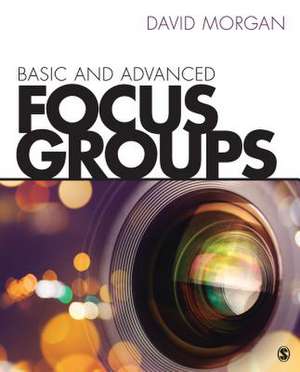
Basic and Advanced Focus Groups
Autor David L. Morganen Limba Engleză Electronic book text – 26 iul 2018
Preț: 269.02 lei
Puncte Express: 404
Preț estimativ în valută:
43.62€ • 51.31$ • 38.07£
43.62€ • 51.31$ • 38.07£
Indisponibil temporar
Doresc să fiu notificat când acest titlu va fi disponibil:
Se trimite...
Specificații
ISBN-13: 9781506327105
ISBN-10: 1506327109
Pagini: 216
Dimensiuni: 187 x 232 mm
Ediția:1
Editura: SAGE Publications
Colecția Sage Publications, Inc
Locul publicării:Thousand Oaks, United States
ISBN-10: 1506327109
Pagini: 216
Dimensiuni: 187 x 232 mm
Ediția:1
Editura: SAGE Publications
Colecția Sage Publications, Inc
Locul publicării:Thousand Oaks, United States
V-ar putea interesa
-
 Focus Groups as Qualitative ResearchDavid L. MorganPreț: 308.41 lei
 -
 Planning Focus GroupsDavid L. Morgan-15%Preț: 645.90 lei759.88 lei
 -
 The Focus Group GuidebookDavid L. Morgan-15%Preț: 641.81 lei755.08 lei
 -
 -9%Preț: 633.06 lei695.66 lei
 -
 Successful Focus GroupsDavid Morgan-18%Preț: 973.35 lei1187.01 lei
 -
 A New Era in Focus Group Research: Challenges, Innovation and PracticeRosaline S. Barbour-18%Preț: 969.12 lei1181.85 lei
 -
 -23%Preț: 652.42 lei847.31 lei
 -
 Advanced Qualitative Research: A Guide to Using TheoryMichelle O'ReillyPreț: 417.58 lei
 -
 Doing International Research: Global and Local MethodsChristopher WilliamsPreț: 355.73 lei
 -
 Preț: 422.50 lei
 -
 Preț: 352.97 lei
 -
 Researching Social LifeNigel GilbertPreț: 481.71 lei
 -
 -23%Preț: 582.85 lei756.95 lei
 -
 Monitoring and Evaluation Training: A Systematic ApproachScott G. (Graham) Chaplowe-23%Preț: 577.09 lei749.47 lei
 -
 Statistics without MathematicsDavid J. BartholomewPreț: 331.17 lei
 -
 Preț: 503.84 lei
 -
 The Business of People: The significance of social science over the next decadeCampaign for Social SciencePreț: 138.58 lei
 -
 -27%Preț: 825.53 lei1130.87 lei
 -
 Implementation Monitoring and Process EvaluationRuth P. Saunders-15%Preț: 654.07 lei769.50 lei
 -
 There's a Stat for That!: What to Do & When to Do itBruce B. FreyPreț: 338.33 lei
 -
 -23%Preț: 584.85 lei759.54 lei
 -
 Dealing With Complexity in Development Evaluation: A Practical ApproachJ. Michael Bamberger-23%Preț: 585.31 lei760.15 lei
 -
 Data Visualization & Presentation With Microsoft OfficeValerie M. Sue-9%Preț: 551.63 lei606.18 lei
Recenzii
“This
is
great
tool
for
their
students
or
themselves
if
they
want
to
use
focus
groups
as
a
research
approach.
There
is
a
lot
of
value
for
the
price
of
this
text.”
“This introductory text provides students with a solid understanding of principles, methods, and contributions of focus group methodology. It provides good coverage of the topic and essential components for consideration in using focus groups. Morgan is among the most well-known experts on focus group research; this current volume reflects how his insight and own research have evolved over the years to show how the field has changed.”
“This book provides accessible, practical information that is targeted toward an audience unfamiliar with the logistics of conducting focus groups.”
“The chapters contain enough depth for the text to serve as a one-stop shop for designing and using a focus group methodology.”
“Overall, the book is written in a language that is easy to understand (despite the topics the book is covering) for undergraduate students who may not be interested in research methods and have taken it as a required course in their curriculum.”
“I was pleasantly surprised at how useful the appendices are. Each of them provides information that will help a researcher. Including transcribed text is good because new researchers may not have been exposed to this type of data. In addition, the interview guides are useful tools and can be used in other forms of research as well.”
“This introductory text provides students with a solid understanding of principles, methods, and contributions of focus group methodology. It provides good coverage of the topic and essential components for consideration in using focus groups. Morgan is among the most well-known experts on focus group research; this current volume reflects how his insight and own research have evolved over the years to show how the field has changed.”
“This book provides accessible, practical information that is targeted toward an audience unfamiliar with the logistics of conducting focus groups.”
“The chapters contain enough depth for the text to serve as a one-stop shop for designing and using a focus group methodology.”
“Overall, the book is written in a language that is easy to understand (despite the topics the book is covering) for undergraduate students who may not be interested in research methods and have taken it as a required course in their curriculum.”
“I was pleasantly surprised at how useful the appendices are. Each of them provides information that will help a researcher. Including transcribed text is good because new researchers may not have been exposed to this type of data. In addition, the interview guides are useful tools and can be used in other forms of research as well.”
Cuprins
Preface
About the Author
PART I. BASIC ISSUES
Chapter 1. Introducing Focus Groups
Basic Issues
Advanced Topics
Chapter 2. Uses for Focus Groups
Basic Issues
Advanced Topics
Chapter 3. The Importance of Interaction
Basic Issues
Advanced Topics
PART II. DESIGNING FOCUS GROUPS
Chapter 4. Research Design for Focus Groups
Basic Issues
Advanced Topics
Chapter 5. Group Composition, Group Size, and Number of Groups
Basic Issues
Advanced Topics
Chapter 6. Asking Questions in Focus Groups
Basic Issues
Advanced Topics
Chapter 7. Moderating the Discussion
Basic Issues
Advanced Topics
Chapter 8. Analyzing Focus Groups
Basic Issues
Advanced Topics
PART III. ADVANCED TOPICS AND CONCLUSIONS
Chapter 9. Working Cross-Culturally
Basic Issues
Chapter 10. Specialized Age Groups
Basic Issues
Chapter 11. Online Focus Groups
Basic Issues
Chapter 12. Conclusions: Future Directions for Focus Groups
Basic Issues
APPENDICES
Appendix 1
Statement of Informed Consent
Appendix 2
Generic Focus Group Introduction
Appendix 3
Three Examples of Interview Guides
Appendix 4
Experiences as Graduate Students
Glossary
References
Index
About the Author
PART I. BASIC ISSUES
Chapter 1. Introducing Focus Groups
Basic Issues
Advanced Topics
Chapter 2. Uses for Focus Groups
Basic Issues
Advanced Topics
Chapter 3. The Importance of Interaction
Basic Issues
Advanced Topics
PART II. DESIGNING FOCUS GROUPS
Chapter 4. Research Design for Focus Groups
Basic Issues
Advanced Topics
Chapter 5. Group Composition, Group Size, and Number of Groups
Basic Issues
Advanced Topics
Chapter 6. Asking Questions in Focus Groups
Basic Issues
Advanced Topics
Chapter 7. Moderating the Discussion
Basic Issues
Advanced Topics
Chapter 8. Analyzing Focus Groups
Basic Issues
Advanced Topics
PART III. ADVANCED TOPICS AND CONCLUSIONS
Chapter 9. Working Cross-Culturally
Basic Issues
Chapter 10. Specialized Age Groups
Basic Issues
Chapter 11. Online Focus Groups
Basic Issues
Chapter 12. Conclusions: Future Directions for Focus Groups
Basic Issues
APPENDICES
Appendix 1
Statement of Informed Consent
Appendix 2
Generic Focus Group Introduction
Appendix 3
Three Examples of Interview Guides
Appendix 4
Experiences as Graduate Students
Glossary
References
Index
Descriere
Taking
a
“bi-level”
approach,
this
book
gives
readers
a
complete
picture
of
focus
groups
with
coverage
of
both
the
“how-to”
and
the
why,
and
argues
against
there
being
any
one
right
way
to
do
the
research.