Cantitate/Preț
Produs

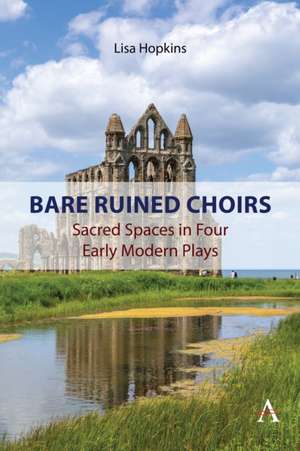
Bare Ruined Choirs: Bare Ruined Choirs, cartea 1

Autor Lisa Hopkins
en Limba Engleză Paperback – iul 2025
The book argues that these plays show us a society haunted by the unquiet burials of Anglo-Saxon saints and kings and the destruction of shrines and churches during the English Reformation, and peopled by crossover figures who inhabit both the spiritual and the secular realms. It begins with an introduction which sets out the distinction between spiritual and temporal overlordship of lands, glances at the ways in which sacred and secular spheres of influence could be brought into conflict in plays from the late-sixteenth and early seventeenth centuries, and explains that the book is interested not only in the extent to which those spheres of influence map onto actual territory but also in the ways in which land is perceived as retaining memories of uses to which it has been previously put. This was particularly the case when royal or saintly bodies had been buried in it, even if the actual burials had been disturbed or lost completely, but other kinds of spaces and places could also carry with them a sense of an ineradicable past (often a specifically pre-Reformation past). When plays claim to represent such richly suggestive sites as holy wells, abbeys built before the Norman Conquest, or places where martyrdoms or miracles have occurred, they simultaneously suggest the power and appeal of such memories and yet also acknowledge their loss and inaccessibility, not least because what the audience sees is not the place represented but bare boards of the stage standing in for it. Four chapters then follow. The first is on the anonymous Thorney Abbey, which offers an origin story for the Anglo-Saxon foundation which preceded the Norman Westminster Abbey during the reign of an unnamed king of England who has a brother (and heir) called Edmund. The Anglo-Saxon St Edmund was well remembered in the early modern period and was particularly important to English Catholic exiles; the unnamed brother can be identified as Athelstan, grandson of Alfred the Great, who was king of England from 925 to 939 but never married (probably because he was illegitimate), making Thorney Abbey part of a group of early modern plays which found Athelstan a flexible, suggestive and culturally resonant figure who could be used to discuss a range of important issues, including succession, the status of the monarch, and the benefits and logic of celibacy. Thorney Abbey presents the foundation of the abbey as a neat and simple process, but the subsequent history of Westminster Abbey was not in fact quite so trouble-free and that leaches into the play, which also has strong similarities to Macbeth in ways which put pressure on Shakespeare's play, particularly on its use of Edward the Confessor, helping us to see that Macbeth treads a nervous line between implying the superiority of a king who collapses the distinction between spiritual and temporal and refusing to actually show him. The second chapter is on another anonymous play, A Knack to Know a Knave, which features Edgar, king of Mercia and Northumbria (c. 944-975), and Saint Dunstan, two figures who carried considerable cultural heft. Dunstan was a complex and controversial figure whose association with miracles that savoured of trickery meant that to early Reformers, he was even more suspect than most saints. Edgar's main achievement was the revival of Benedictine monasticism, which he funded by large grants of land and by enforcing the payment of the ecclesiastical tax known as Peter's Pence, making him almost the perfect test case for considering the relationship between temporal and spiritual power. The third chapter focuses on William Rowley's A Shoemaker a Gentleman, which tells the story of the shoemaker saint Crispin and his brother Crispian and the early English and Welsh martyrs St Hugh, St Winifred, St Alban and St Amphiabel in ways which evoke the long and difficult history of debates about the extent of British Catholics' allegiance to the Pope. Last comes a chapter on Anthony Brewer's
Citește tot Restrânge

Preț: 16748 lei

Puncte Express: 251

Carte disponibilă

Livrare economică 16-30 septembrie
Livrare express 02-08 septembrie pentru 1551 lei

Livrare prin curier în România Termenul estimat este afișat lângă disponibilitate.
Transport gratuit de la 40000 lei Plată online sau ramburs, în funcție de opțiunile comenzii.
Retur gratuit în 14 zile Comandă securizată și suport în română.

Specificații

ISBN-13: 9781839995118
ISBN-10: 1839995114
Pagini: 72
Dimensiuni: 152 x 229 x 4 mm
Greutate: 0.12 kg
Ediția:Text mare
Editura: Wimbledon Publishing
Colecția Bare Ruined Choirs
Seria Bare Ruined Choirs


Notă biografică

Lisa Hopkins is Professor Emerita of English at Sheffield Hallam University. She is a co-editor of Journal of Marlowe Studies and of Shakespeare, the journal of the British Shakespeare Association, and a series editor of Arden Critical Readers and Arden Studies in Early Modern Drama.


Cuprins

Acknowledgements; Introduction; 1 Thorney Abbey; 2 A Knack to Know a Knave; 3 A Shoemaker a Gentleman; 4 The Lovesick King; Coda; Index


Descriere

The book discusses the demarcation of secular and sacred territory in early modern English drama. It focuses primarily on four plays, Thorney Abbey, A Knack to Know a Knave, A Shoemaker a Gentleman and The Lovesick King, but puts these in dialogue with Hamlet, Macbeth, King Lear and Doctor Faustus.