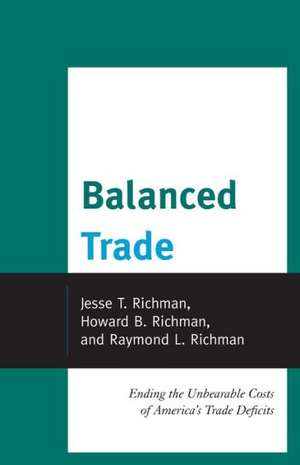
Balanced Trade: Ending the Unbearable Costs of America’s Trade Deficits
Autor Jesse Richman, Howard Richman, Raymond Richmanen Limba Engleză Hardback – 24 apr 2014
Although trade deficits provide short-term gains in consumption, these are combined with long-term losses in consumption, innovation, investment, employment and power. Furthermore, market mechanisms do not correct trade imbalances that result from mercantilism, nor do they compensate for the long term shift in production and consumption towards the mercantilist. Balancing trade can make important short run and long run contributions to economic stability and prosperity.
In America today, despite the growing evidence that imbalanced free trade is not working, many American economists remain adamant in their promotion of free trade. They are also quick to label actions taken to balance trade as protectionism. The political system has also failed to effectively address the problem of imbalanced trade, and the Federal Reserve has often exacerbated rather than addressed the challenge. We show that the classical economic arguments against mercantilism do not justify doing nothing.
Effectively responding to imbalanced trade and mercantilism requires careful selection of strategy in order to achieve multiple objectives: balancing trade while maintaining the benefits of international trade, avoiding unnecessary inefficiencies, and maintaining compliance with international law.
One of the best options is the Scaled Tariff. By targeting countries with which the United States has a large current account deficit, the Scaled Tariff would efficiently, legally, and effectively balance trade. It would be applied to all imported goods from trade surplus countries that have had a sizable trade surplus with the United States over the most recent four economic quarters.The tariff rate would be designed to take in a portion (e.g. 50%) of the bilateral trade deficit (goods plus services) as revenue. No particular product is protected; the scaled tariff simply changes the terms of trade between the two countries, much as currency devaluation would change the terms of trade with all countries.
Preț: 501.23 lei
Preț vechi: 789.88 lei
-37%
Puncte Express: 752
Carte tipărită la comandă
Livrare economică 02-16 decembrie
Livrare prin curier în România Termenul estimat este afișat lângă disponibilitate.
Transport gratuit pentru acest produs Plată online sau ramburs, în funcție de opțiunile comenzii.
Retur gratuit în 14 zile Comandă securizată și suport în română.
Specificații
ISBN-13: 9780739188804
ISBN-10: 0739188801
Pagini: 133
Ilustrații: 19 BW Illustrations, 1 Table, 18 Graphs
Dimensiuni: 154 x 232 x 14 mm
Greutate: 0.36 kg
Editura: Bloomsbury Publishing
Colecția Lexington Books
Locul publicării:New York, United States
ISBN-10: 0739188801
Pagini: 133
Ilustrații: 19 BW Illustrations, 1 Table, 18 Graphs
Dimensiuni: 154 x 232 x 14 mm
Greutate: 0.36 kg
Editura: Bloomsbury Publishing
Colecția Lexington Books
Locul publicării:New York, United States
Cuprins
Table of Contents
Dedication
Acknowledgements
Introduction
Part I - The Problems
1. The Problem of Mercantilism
2. The Problem of Private Savings Flows
3. The Problem of Trade Deficits
Part II - The Failures
4. The Failure of the Economists
5. The Failure of the Political System
6. The Failure of the Federal Reserve
Part III - The Solutions
7. Reciprocity: Principles for Balanced Trade
8. Methods for Balancing Trade
9. The Scaled Tariff
10. Balanced Trade Economics
Notes
References
Dedication
Acknowledgements
Introduction
Part I - The Problems
1. The Problem of Mercantilism
2. The Problem of Private Savings Flows
3. The Problem of Trade Deficits
Part II - The Failures
4. The Failure of the Economists
5. The Failure of the Political System
6. The Failure of the Federal Reserve
Part III - The Solutions
7. Reciprocity: Principles for Balanced Trade
8. Methods for Balancing Trade
9. The Scaled Tariff
10. Balanced Trade Economics
Notes
References
Recenzii
Balanced Trade: Ending the Unbearable Costs of America's Trade Deficits addresses the problems caused by this country's unbalanced trade in a straightforward and hard-hitting way. The book describes the significant negative impact of unbalanced trade on the U.S. economy and the many possible steps that can be taken to move the country back to a productive trade regime.