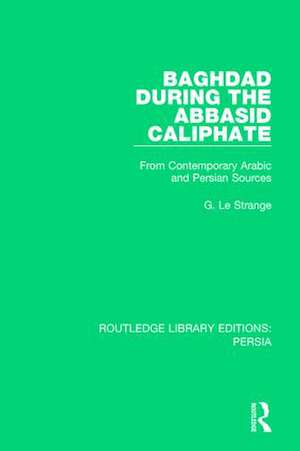
Baghdad During the Abbasid Caliphate: From Contemporary Arabic and Persian Sources: Routledge Library Editions: Persia
Autor G. Le Strangeen Limba Engleză Paperback – 12 mar 2019




Preț: 357.83 lei
Puncte Express: 537
Carte tipărită la comandă
Livrare economică 07-21 decembrie
Livrare prin curier în România Termenul estimat este afișat lângă disponibilitate.
Transport gratuit de la 400.00 lei Plată online sau ramburs, în funcție de opțiunile comenzii.
Retur gratuit în 14 zile Comandă securizată și suport în română.
Specificații
ISBN-13: 9781138080324
ISBN-10: 1138080322
Pagini: 416
Dimensiuni: 156 x 234 x 23 mm
Greutate: 0.61 kg
Ediția:1
Editura: Taylor & Francis
Colecția Routledge
Seria Routledge Library Editions: Persia
Locul publicării:Oxford, United Kingdom
ISBN-10: 1138080322
Pagini: 416
Dimensiuni: 156 x 234 x 23 mm
Greutate: 0.61 kg
Ediția:1
Editura: Taylor & Francis
Colecția Routledge
Seria Routledge Library Editions: Persia
Locul publicării:Oxford, United Kingdom
Cuprins
1. The Foundation of Baghdad 2. The City of Mansur 3. The City of Mansur (continued) 4. The Canals of Western Baghdad 5. The Kufah Highroad and the Karkh Suburb 6. The Canals of Karkh 7. The Quarters of the Lower Harbour 8. The Quarter of the Basrah Gate 9. The Shari Quarter and the Trench of Tahir 10. The Harbiyah Quarter 11. The Quarters of the Muhawwal Gate 12. Baratha, Muhawwal and the Kazimayn 13. Eastern Baghdad in General 14. Rusafah 15. The Shammasiyah Quarter 16. The Mukharrim Quarter 17. The Buyid Palaces 18. The Palaces of the Caliphs 19. The Palace Gates and Adjoining Quarters 20. The Quarters North of the Palaces 21. The Quarters East and South of the Palaces 22. Recapitulation and Authorities: Early Period 23. Recapitulation and Authorities: Middle Period 24. Recapitulation and Authorities: Final Period
Descriere
The history of Baghdad as a metropolis coincides with the history of the rise and fall of the Abbasid Caliphs. In this volume, first published in 1900 and written by a recognized authority in the field, the history of the city and of the Abbasid dynasty are closely interwoven so that, from a scholarly blending of contemporary records and discursive narrative, an accurate picture emerges of the state and society within the capital of the Muslim world during the period from the eighth to the thirteenth centuries.