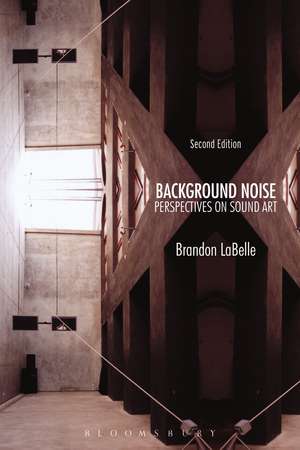
Background Noise, Second Edition: Perspectives on Sound Art
Autor Brandon LaBelleen Limba Engleză Paperback – 26 mar 2015
At its center the book presupposes an intrinsic relation between sound and its location, galvanizing acoustics, sound phenomena, and the environmental with the tensions inherent in what LaBelle identifies as sound's relational dynamic. For the author, this is embedded within sound's tendency to become public expressed in its ability to travel distances, foster cultural expression, and define spaces while being radically flexible.
This second expanded edition includes a new chapter on the non-human and subnatural tendencies in sound art, revisions to the text as well as a new preface by the author. Intersecting material analysis with theoretical frameworks spanning art and architectural theory, performance studies and media theory, Background Noise makes the case that sound and sound art are central to understandings of contemporary culture.
Preț: 252.59 lei
Preț vechi: 325.01 lei
-22%
Puncte Express: 379
Carte disponibilă
Livrare economică 16-30 noiembrie
Livrare express 31 octombrie-06 noiembrie pentru 115.02 lei
Livrare prin curier în România Termenul estimat este afișat lângă disponibilitate.
Transport gratuit de la 400.00 lei Plată online sau ramburs, în funcție de opțiunile comenzii.
Retur gratuit în 14 zile Comandă securizată și suport în română.
Specificații
ISBN-13: 9781628923520
ISBN-10: 1628923520
Pagini: 376
Ilustrații: 30 bw images
Dimensiuni: 152 x 228 x 28 mm
Greutate: 0.54 kg
Ediția:2nd Revised edition
Editura: Bloomsbury Publishing
Colecția Bloomsbury Academic
Locul publicării:New York, United States
ISBN-10: 1628923520
Pagini: 376
Ilustrații: 30 bw images
Dimensiuni: 152 x 228 x 28 mm
Greutate: 0.54 kg
Ediția:2nd Revised edition
Editura: Bloomsbury Publishing
Colecția Bloomsbury Academic
Locul publicării:New York, United States
V-ar putea interesa
-
 Nothin' to LoseKen SharpPreț: 89.97 lei
 -
 Nick Drake: The BiographyPatrick Humphries-27%Preț: 78.16 lei107.13 lei
 -
 -33%Preț: 90.71 lei135.59 lei
 -
 Decca Studios and Klooks KleekDick WeindlingPreț: 73.15 lei
 -
 My Bloody Valentine's LovelessMike McGonigal-32%Preț: 52.20 lei76.27 lei
 -
 The Ramones' RamonesNicholas Rombes-32%Preț: 51.95 lei76.09 lei
 -
 The Rolling Stones' Exile on Main StreetBill Janovitz-31%Preț: 53.19 lei76.86 lei
 -
 DJ Shadow's EndtroducingEliot Wilder-32%Preț: 51.55 lei75.86 lei
 -
 -25%Preț: 1003.92 lei1346.97 lei
 -
 Starting At Zero: His Own StoryJimi Hendrix-28%Preț: 77.11 lei106.39 lei
 -
 Mr Mojo: A Biography of Jim MorrisonDylan Jones-27%Preț: 66.70 lei91.46 lei
 -
 -26%Preț: 211.84 lei287.30 lei
Cuprins
Acknowledgements
Preface to the Second Edition
Introduction: Auditory Relations
Fade In
Part 1: 4'33": Sound and Points of Origin
Introduction to Part 1
Chapter 1 Sociality of Sound: John Cage and Musical Concepts
Chapter 2 Exposing the Sound Object:Musique Concrète's Sonic Research
Chapter 3 Automatic Music: Group Ongaku's Performative Labors
Part 2: Box with the Sound of Its Own Making: From Gags to Sculptural Form
Introduction to Part 2
Chapter 4 Rhythms of Chaos: Happenings, Environments, and Fluxus
Chapter 5 Minimalist Treatments: La Monte Young and Robert Morris
Chapter 6 Conceptualizations:Michael Asher and the Subject of Space
Part 3: I Am Sitting in a Room: Vocal Intensities
Introduction to Part 3
Chapter 7 Performing Desire/ Performing Fear: Vito Acconci and the Power Plays of Voice
Chapter 8 Finding Oneself: Alvin Lucier and the Phenomenal Voice
Chapter 9 Word of Mouth: Christof Migone's Little Manias
Part 4: Public Supply: Buildings, Constructions, and Locational Listening
Introduction to Part 4
Chapter 10 Tuning Space:Max Neuhaus and Site-Specific Sound
Chapter 11 Other Architectures:Michael Brewster, Maryanne Amacher, and Bernhard Leitner
Chapter 12 Composing Intensities: Iannis Xenakis's Multimedia Architectures
Part 5: Soundmarks: Environments and Aural Geography
Introduction to Part 5
Chapter 13 Seeking Ursound: Hildegard Westerkamp, Steve Peters, and the Soundscape
Chapter 14 Language Games: Yasunao Tone and the Mechanics of Information
Chapter 15 Complicating Place: Bill Fontana and Networking the Soundscape
Part 6: Global Strings: Interpersonal and Network Space
Introduction to Part 6
Chapter 16 Interactions: Achim Wollscheid's Production of the Local
Chapter 17 Global Events: Atau Tanaka and Network as Instrument
Chapter 18 Live Streams: Apo33 and Multiplying Place
Fade Out
Conclusion: Auditive Pivot
Appendix: Peripheries - subnature, phantom memory, and dirty listening
List of Works Cited
Index
Preface to the Second Edition
Introduction: Auditory Relations
Fade In
Part 1: 4'33": Sound and Points of Origin
Introduction to Part 1
Chapter 1 Sociality of Sound: John Cage and Musical Concepts
Chapter 2 Exposing the Sound Object:Musique Concrète's Sonic Research
Chapter 3 Automatic Music: Group Ongaku's Performative Labors
Part 2: Box with the Sound of Its Own Making: From Gags to Sculptural Form
Introduction to Part 2
Chapter 4 Rhythms of Chaos: Happenings, Environments, and Fluxus
Chapter 5 Minimalist Treatments: La Monte Young and Robert Morris
Chapter 6 Conceptualizations:Michael Asher and the Subject of Space
Part 3: I Am Sitting in a Room: Vocal Intensities
Introduction to Part 3
Chapter 7 Performing Desire/ Performing Fear: Vito Acconci and the Power Plays of Voice
Chapter 8 Finding Oneself: Alvin Lucier and the Phenomenal Voice
Chapter 9 Word of Mouth: Christof Migone's Little Manias
Part 4: Public Supply: Buildings, Constructions, and Locational Listening
Introduction to Part 4
Chapter 10 Tuning Space:Max Neuhaus and Site-Specific Sound
Chapter 11 Other Architectures:Michael Brewster, Maryanne Amacher, and Bernhard Leitner
Chapter 12 Composing Intensities: Iannis Xenakis's Multimedia Architectures
Part 5: Soundmarks: Environments and Aural Geography
Introduction to Part 5
Chapter 13 Seeking Ursound: Hildegard Westerkamp, Steve Peters, and the Soundscape
Chapter 14 Language Games: Yasunao Tone and the Mechanics of Information
Chapter 15 Complicating Place: Bill Fontana and Networking the Soundscape
Part 6: Global Strings: Interpersonal and Network Space
Introduction to Part 6
Chapter 16 Interactions: Achim Wollscheid's Production of the Local
Chapter 17 Global Events: Atau Tanaka and Network as Instrument
Chapter 18 Live Streams: Apo33 and Multiplying Place
Fade Out
Conclusion: Auditive Pivot
Appendix: Peripheries - subnature, phantom memory, and dirty listening
List of Works Cited
Index
Recenzii
The rise of a prominent auditory culture, as seen in the recent plethora of art exhibitions on sound art, in conjunction with academic programs dedicated to "aural culture", sonic art, and auditory issues now emerging, reveals the degree to which sound art is lending definition to the 21st Century. And yet sound art still lacks related literature to compliment, and expand, the realm of practice. Written by The Wire's contributor Brandon Labelle, Background Noise sets out an historical overview, while at the same time shaping that history according to what sound art reveals-the dynamics of art to operate spatially, through media of reproduction and broadcast, and in relation to the intensities of communication and its contextual framework.
Background Noise follows the development of sound as an artistic medium and illustrates how sound is put to use within modes of composition, installation, and performance. While chronological in its structure, Brandon LaBelle's book is informed by spatial thinking - weaving architecture, environments, and the specifics of location into the work of sound, with the aim of formulating an expansive history and understanding of sound art.
Reading Background Noise for the first time introduced me to the world of sound art, to its rich history, its incredible variety of concrete works, its overview of artists working in the field, and its discourses. It taught me how to think about sound in relation to space instead of time. Now, some seven years later, Background Noise is still one of my most important sources. It is a must-read for anyone interested in auditory culture and sound art.
There are stones here. Stones gathered with great shrewdness by Brandon LaBelle from the broad shore of relational artistic practice; each carries the weight of its own historical significance; each is perfectly shaped to deliver its conceptual impact; each is thrown outwards in just the right sequence and with just the right trajectory to set the ripples running, producing patterns that continue to inspire the reader long, long after the momentum of the book has come to rest. Background Noise is the very best of books: as reverberant as the phenomena it so beautifully articulates.
Background Noise follows the development of sound as an artistic medium and illustrates how sound is put to use within modes of composition, installation, and performance. While chronological in its structure, Brandon LaBelle's book is informed by spatial thinking - weaving architecture, environments, and the specifics of location into the work of sound, with the aim of formulating an expansive history and understanding of sound art.
Reading Background Noise for the first time introduced me to the world of sound art, to its rich history, its incredible variety of concrete works, its overview of artists working in the field, and its discourses. It taught me how to think about sound in relation to space instead of time. Now, some seven years later, Background Noise is still one of my most important sources. It is a must-read for anyone interested in auditory culture and sound art.
There are stones here. Stones gathered with great shrewdness by Brandon LaBelle from the broad shore of relational artistic practice; each carries the weight of its own historical significance; each is perfectly shaped to deliver its conceptual impact; each is thrown outwards in just the right sequence and with just the right trajectory to set the ripples running, producing patterns that continue to inspire the reader long, long after the momentum of the book has come to rest. Background Noise is the very best of books: as reverberant as the phenomena it so beautifully articulates.