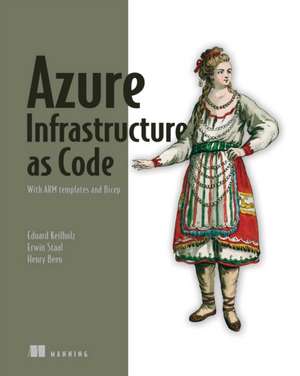
Azure Infrastructure as Code
Autor Eduard Keilholz, Erwin Staal, Henry Beenen Limba Engleză Paperback – 19 sep 2022
Descoperim aici un ghid tehnic riguros care se distanțează de documentația oficială Microsoft prin accentul pus pe fluxul de lucru real și pe bunele practici de inginerie software aplicate infrastructurii. În timp ce documentația listează parametrii, Azure Infrastructure as Code explică modul în care aceștia sunt utilizați pentru a garanta rezultate repetabile în medii complexe. Subliniem tranziția fluidă pe care autorii o realizează de la sintaxa clasică ARM (Azure Resource Manager) la noul limbaj Bicep, oferind cititorului instrumentele necesare pentru a scrie cod mai curat și mai ușor de întreținut. Notăm cu interes capitolele dedicate testării șabloanelor și orchestrării prin Azure Pipelines și GitHub Actions, elemente esențiale pentru orice arhitectură modernă de cloud. Volumul nu se rezumă la simpla provizionare, ci analizează în profunzime gestionarea ciclului de viață al resurselor, inclusiv utilizarea Deployment Stacks pentru pre-configurarea mediilor destinate altor echipe. Complementar lui Building Applications with Azure Resource Manager (ARM), care se concentrează pe fundamentele provizionării, acest titlu publicat de Manning Publications acoperă zona avansată de guvernanță și conformitate prin Azure Policy, oferind o perspectivă aplicată asupra modului în care se pot impune standarde la nivel de enterprise. Spre deosebire de Deep-Dive Terraform on Azure, care explorează un instrument agnostic de cloud, această lucrare maximizează avantajele ecosistemului nativ Microsoft, asigurând o integrare profundă cu serviciile specifice Azure.
Preț: 372.32 lei
Preț vechi: 465.40 lei
-20%
Carte disponibilă
Livrare economică 09-23 noiembrie
Livrare express 23-29 octombrie pentru 42.21 lei
Specificații
ISBN-10: 1617299421
Pagini: 300
Dimensiuni: 185 x 232 x 20 mm
Greutate: 0.67 kg
Editura: Manning Publications
De ce să citești această carte
Recomandăm această carte inginerilor DevOps și arhitecților de sistem care doresc să stăpânească automatizarea nativă în Azure. Veți câștiga expertiză practică în scrierea de scripturi Bicep și configurarea conductelor de CI/CD pentru infrastructură. Este un instrument esențial pentru a elimina erorile umane și pentru a asigura o scalabilitate predictibilă a resurselor cloud, trecând de la configurarea manuală la o abordare „infrastructure as code” profesionistă.
Despre autor
Eduard Keilholz, Erwin Staal și Henry Been sunt experți recunoscuți în ecosistemul Microsoft Azure, deținând frecvent titlul de Microsoft MVP (Most Valuable Professional). Cu o vastă experiență în consultanță și inginerie software, aceștia s-au specializat în automatizarea infrastructurii și metodologii DevOps. Contribuțiile lor în comunitatea tech se concentrează pe eficientizarea livrării de software prin utilizarea inteligentă a uneltelor native de cloud, expertiză care se reflectă în abordarea pragmatică a acestui volum.
Notă biografică
Descriere scurtă
In Azure Infrastructure as Code you will learn how to:
Create reusable infrastructure templates using advanced features of the ARM (Azure Resource Manager) syntax
Write templates with the Azure Bicep domain-specific language (DSL)
Test ARM and Bicep templates
Deploy templates using deployment pipelines
Guarantee repeated outcomes when you reuse templates to replicate infrastructure
Share templates between teams
Provision templates to provide standards and Azure Policy to enforce them
Orchestrate complex deployments using Azure DevOps and GitHub Actions
Pre-provision environments for other teams with deployment stacks
Azure Infrastructure as Code teaches you to use Azure’s native infrastructure as code (IaC) tools, like ARM and Bicep, to build, manage, and scale infrastructure with just a few lines of code. You’ll discover ARM templates, deployment stacks, and the powerful new language Bicep. See how easy they make it to create new environments, safely make infrastructure changes, govern your resources using Azure Policy, and prevent configuration drift. Loaded with in-depth coverage of syntax and lots of illustrative examples, this hands-on guide is a must-read for anyone looking to expand their knowledge of provisioning.
About the technology
Automating tasks like provisioning servers, operating systems, and storage, saves time and radically increases consistency. The Infrastructure as Code (IaC) approach brings the tools and practices of application deployment, such as Github Actions, automated testing, and pipeline-driven deployments, to infrastructure components. With Azure’s native IaC tools, you can create whole new infrastructures with just a few lines of code using declarative specifications and an intuitive domain-specific language.
About the book
Azure Infrastructure as Code shows you how to manage and automate your infrastructure using Azure’s IaC tools. In this practical guide, you’ll discover how to set up Azure Resource Manager (ARM) templates and to script infrastructure creation using the Bicep DSL. You’ll also explore advanced topics such as testing, reusing templates, and defining policies as code. You’ll even build a complete CI/CD pipeline that can orchestrate a complex infrastructure deployment across multiple regions.
What's inside
Create reusable infrastructure templates
Write templates with the Azure Bicep domain-specific language
Deploy templates using deployment pipelines
Share templates between teams
About the reader
For operations, infrastructure, or software engineers with some Azure experience.
About the author
Henry Been is a freelance DevOps and Azure architect and consultant. Erwin Staal is an Azure architect and DevOps consultant. Eduard Keilholz is a cloud solution architect.
Table of Contents
PART 1 INTRODUCTION
1 Infrastructure as Code
2 Writing your first ARM template
PART 2 TAKING IT UP A NOTCH
3 Writing ARM templates
4 Deploying ARM templates
5 Writing advanced ARM templates
6 Simplifying ARM templates using the Bicep DSL
7 Complex deployments using Azure DevOps
8 Complex deployments using GitHub Actions
9 Testing ARM templates
PART 3 ADVANCED TOPICS
10 Template specs and Bicep registries: Building a repository of templates
11 Using deployment stacks for grouping resources
12 Governing your subscriptions using Azure Policy
13 Case studies