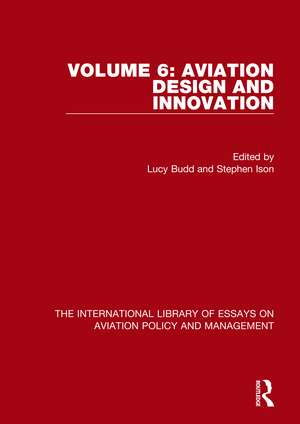
Aviation Design and Innovation: The International Library of Essays on Aviation Policy and Management
Autor Lucy Budd, Stephen Isonen Limba Engleză Hardback – 23 oct 2019
Observăm în sectorul aeronautic o presiune constantă asupra infrastructurii la sol, unde erorile de planificare în capacitatea terminalelor devin extrem de costisitoare și greu de remediat. Găsim în acest volum, Aviation Design and Innovation, o analiză tehnică a modului în care aeroporturile trebuie să faciliteze schimbul eficient de pasageri și mărfuri, adaptându-se de la primele jeturi din anii '50 până la cerințele specifice ale gigantului A380. Notăm cu interes modul în care autorii, Lucy Budd și Stephen Ison, structurează lucrarea în două secțiuni critice: designul și sustenabilitatea aeroporturilor, respectiv proiectarea și fabricarea aeronavelor.
Cartea detaliază tranziția de la producția centralizată la lanțurile de aprovizionare globale și explorează integrarea noilor tehnologii, precum travelatoarele și podurile de îmbarcare (airbridges), în contextul diversificării modelelor de business. Dacă Planning and Design of Airports, Fifth Edition de Robert Horonjeff v-a oferit cadrul teoretic și normativ al ingineriei aeroportuare, această lucrare oferă instrumentele practice pentru a înțelege cum inovația în designul aeronavelor dictează reconfigurarea spațiului fizic al terminalelor. În comparație cu Greening Airports de Milan Janić, care se axează strict pe monitorizarea nivelului de ecologizare, volumul de față extinde perspectiva către viabilitatea comercială a biocombustibililor și noile alianțe aeroport-companie aeriană.
Această lucrare completează portofoliul autorilor, care include și Air Transport Management, mutând focusul de la managementul operațional pur către ingineria și designul care susțin sustenabilitatea pe termen lung a transportului aerian. Structura de tip eseu academic permite o explorare aprofundată a riscurilor asociate designului flexibil, esențial pentru acomodarea operatorilor low-cost.
Preț: 1830.29 lei
Preț vechi: 2011.31 lei
-9%
Carte disponibilă
Livrare economică 18 mai-01 iunie
Livrare express 02-08 mai pentru 39.32 lei
Specificații
ISBN-10: 1472451600
Pagini: 292
Dimensiuni: 174 x 246 x 24 mm
Greutate: 0.64 kg
Ediția:1
Editura: Taylor & Francis
Colecția Routledge
Seria The International Library of Essays on Aviation Policy and Management
Locul publicării:Oxford, United Kingdom
V-ar putea interesa
-
 -8%Preț: 570.78 lei620.42 lei
 -
 Modelling and Managing Airport PerformanceKonstantinos Zografos-5%Preț: 530.25 lei558.15 lei
 -
 Preț: 331.12 lei
 -
 Straight and Level: Practical Airline EconomicsStephen HollowayPreț: 436.19 lei
 -
 Handling the Big JetsD. P. DaviesPreț: 342.88 lei
 -
 The Evolution of Airport DesignRobert Stewart-8%Preț: 545.59 lei593.03 lei
 -
 Aircraft PropulsionSaeed Farokhi-14%Preț: 702.27 lei816.60 lei
 -
 Flight Craft 23: Airbus A380Robert JacksonPreț: 118.66 lei
 -
 Aircraft Design: A Conceptual ApproachDaniel Raymer-8%Preț: 479.88 lei521.60 lei
 -
 -5%Preț: 541.67 lei570.17 lei
 -
 Aircraft: Design, Technology & SafetyCollin Parker-26%Preț: 978.50 lei1315.57 lei
 -
 Airline: Style at 30,000 FeetKeith Lovegrove-26%Preț: 78.14 lei104.99 lei
 -
 The Economics of AirlinesVolodymyr BilotkachPreț: 190.86 lei
 -
 Towards Sustainable AviationPaul UphamPreț: 356.39 lei
 -
 Shaking the SkiesGiovanni Bisignani-11%Preț: 124.19 lei139.87 lei
 -
 Preț: 441.56 lei
 -
 New Frontiers in Sustainable AviationT. Hikmet Karakoc-18%Preț: 1072.86 lei1308.37 lei
 -
 Progress in Sustainable AviationT. Hikmet Karakoc-24%Preț: 733.91 lei965.68 lei
 -
 The Future of Electric Aviation and Artificial IntelligenceT. Hikmet Karakoc-18%Preț: 1227.64 lei1497.12 lei
De ce să citești această carte
Această carte este esențială pentru inginerii aeroportuari și planificatorii de transport care se confruntă cu provocarea de a adapta infrastructura existentă la noile generații de aeronave. Cititorul câștigă o înțelegere clară a relației dintre designul tehnic al avioanelor și eficiența operațională la sol, primind soluții concrete pentru gestionarea fluxurilor de pasageri și implementarea combustibililor alternativi într-un mediu comercial competitiv.
Despre autor
Lucy Budd și Stephen Ison sunt experți recunoscuți în politici de transport, cu o activitate academică bogată sub egida editurii Routledge. Lucy Budd a contribuit semnificativ la lucrări de referință precum The Routledge Handbook of Sustainable Urban Transport, axându-se pe impactul tehnologiilor asupra mediului. Stephen Ison deține o experiență vastă în managementul logistic și aeroportuar, fiind co-autor al Air Transport Management. Împreună, aceștia integrează perspectivele de design tehnic cu realitățile economice și politice ale aviației moderne, oferind o viziune multidisciplinară asupra viitorului mobilității aeriene globale.
Descriere scurtă
Of course, the design of passenger terminal buildings is influenced not only by levels of demand, the commercial requirements of airlines and tenant companies, the availability of investment funds and political influence but also by the aircraft that will be using the facility both now and in the future. Indeed, the introduction of the first generation of passenger jets in the 1950s and higher-capacity wide-bodied aircraft in the late 1960s required not only the expansion of gate areas and passenger processing facilities but also the introduction of new technologies such as the travelator, the baggage reclaim carousel and the airbridge. The introduction of the A380 ‘Super Jumbo’ into revenue passenger service in 2007 similarly demanded a reconfiguration of the airports it serves and practitioners need to be cognisant of the options for accommodating a new generation of large aircraft.
While large aircraft generally require a lengthy turn around period between flights and the extensive provision of expensive fixed ground support infrastructure, low cost carriers pursue a business model based on very short turnarounds and minimal use of airport infrastructure assets such as airbridges. One of the main challenges facing airport operators is how to accommodate the diverse and dynamic requirements of different operators and these issues are addressed in this Volume.
Traditionally, aircraft were made and manufactured by small companies within one country but as costs have increased and technology has become more sophisticated, a relatively small number of manufacturers, which are supported by international supply chains, have come to dominate the commercial aircraft market.
Originally, all aviation jet fuels were derived from crude oil. However, concerns about future oil supply and energy security combined with the need to improve aviation’s environmental performance and sustainability has driven the development of alternative fuel sources. However, the development and adoption of alternative aviation fuels is not straightforward and the Volume examines the opportunities and challenges of widespread biofuel adoption in terms of production capacity, emissions reductions, cost and commercial viability.
The final essays in this Volume address business model innovation in the airline and airport sector and include considerations of the future evolution of low cost carriers, the potential for airline-airport alliances and the development of multi-airport multinational operating companies.
Cuprins
Introduction
Part I Airport Design and Sustainability
- A. R. Odoni and R. de Neufville, ‘Passenger Terminal Design’, Transportation Research Part A, 26A , 1, 1992, 27-35.
- A. G. de Barros and S. C. Wirasinghe, ‘Optimal Terminal Configurations for New Large Aircraft Operations’, Transportation Research Part A, 37, 2003, 315-331.
- R. de Neufville, ‘Low-Cost Airports for Low-Cost Airlines: Flexible Design to Manage the Risks’, Transportation Planning and Technology, 31, 1, 2008, 35-68.
- P. Forsyth, ‘The Impacts of Emerging Aviation Trends on Airport Infrastructure’, Journal of Air Transport Management, 13, 2007, 45-52.Part II Aircraft Design and Manufacturing
- A. MacPherson and D. Pritchard, ‘The International Decentralisation of US Commercial Aircraft Production: Implications for US Employment and Trade’, Futures, 35, 2003, 221-238.
- J. Niosi and M. Zhengu, ‘Aerospace Clusters: Local or Global Knowledge Spillovers?’, Industry and Innovation, 12, 1, 2005, 5-29.
- J. M. C. King, ‘The Airbus 380 and Boeing 787: A Role in the Recovery of the Airline Transport Market’, Journal of Air Transport Management, 13, 2007, 16-22.
- A. Z. Ibsen, ‘The Politics of Airplane Production: The Emergence of Two Technological Frames in the Competition between Boeing and Airbus’, Technology in Society, 31, 2009, 342-349.Part III Alternative fuels
- E. Nygren, K. Aleklett and M. Höök, ‘Aviation Fuel and Future Oil Production Scenarios’, Energy Policy, 37, 2009, 4003-4010.
- P. Gegg, L. Budd and S. Ison, ‘The Market Development of Aviation Biofuel: Drivers and Constraints’, Journal of Air Transport Management, 39, 2014, 34-40.
- T. K. Hari, Z. Yaakob and N. N. Binitha, ‘Aviation Biofuel from Renewable Resources: Routes, Opportunities and Challenges’, Renewable and Sustainable Energy Reviews, 42, 2015, 1234-1244.
- N. Winchester, R. Malina, M. D. Staples and S. R. H. Barrett, ‘The Impact of Advanced Biofuels on Aviation Emissions and Operations in the U.S.’, Energy Economics, 49, 2015, 482-491.
- M. Kousoulidou and L. Lonza, ‘Biofuels in Aviation: Fuel Demand and CO2 Emissions Evolution in Europe Toward 2030’, Transportation Research Part D, 46, 2016, 166-181.Part IV Business Model Innovation
- G. Francis, I. Humphreys, S. Ison and M. Aicken, ‘Where Next for Low Cost Airlines? A Spatial and Temporal Comparative Study’, Journal of Transport Geography, 14, 2006, 83-94.
- D. Gillen and A. Gados, ‘Airlines Within Airlines: Assessing the Vulnerabilities of Mixing Business Models’, Research in Transportation Economics, 24, 2008, 25-35.
- R. Klophaus, R. Conrady and F. Fichert, ‘Low Cost Carriers Going Hybrid: Evidence from Europe’, Journal of Air Transport Management, 23, 2012, 54-58.
- S. Albers, B. Kock and C. Ruff, ‘Strategic Alliances Between Airlines and Airports – Theoretical Assessment and Practical Evidence’, Journal of Air Transport Management, 11, 2005, 49-58.
- P. Forsyth, H.-M. Niemeier and H. Wolf, ‘Airport Alliances and Mergers – Structural Change in the Airport Industry?’, Journal of Air Transport Management, 17, 2011, 49-56.
- D. McNeill, ‘The Airport Hotel as Business Space’, Geografiska Annaler. Series B, Human Geography, 91, 3, 2009, 219-228.
- M. C. Charles, P. Barnes, N. Ryan and J. Clayton, ‘Airport Futures: Towards a Critique of the Aerotropolis Model’, Futures, 39, 2007, 1009-1028.