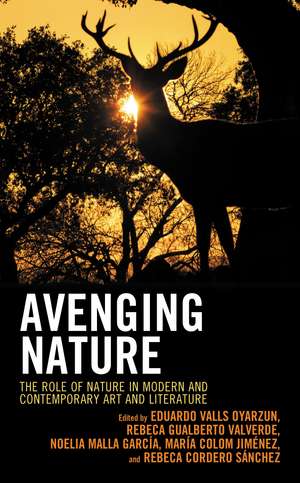
Avenging Nature: The Role of Nature in Modern and Contemporary Art and Literature: Ecocritical Theory and Practice
Editat de Eduardo Valls Oyarzun, Rebeca Gualberto Valverde, Noelia Malla Garcia, María Colom Jiménez, Rebeca Cordero Sánchez Contribuţii de Anastasia Cardone, Frank Izaguirre, Laura de la Parra, Jessica Roberts, Laura Sanz García, Hande Gürses, Pedro Miguel Carmona, Ryan Winet, Leonor Martínez, Patrycja Austin, Peter Melville, Carmen Méndez, Mónica Martín, Paula Barba Guerrero, Víctor Junco, Javier Martín Párragaen Limba Engleză Hardback – 28 sep 2020
Din seria Ecocritical Theory and Practice
- 32%
 Preț: 528.45 lei
 - 31%
 Preț: 531.25 lei
 - 33%
 Preț: 581.25 lei
 - 26%
 Preț: 293.65 lei
 - 23%
 Preț: 328.98 lei
 -
 Preț: 325.23 lei
 - 26%
 Preț: 286.85 lei
 - 31%
 Preț: 529.58 lei
 - 33%
 Preț: 582.81 lei
 - 27%
 Preț: 284.27 lei
 - 33%
 Preț: 550.43 lei
 - 36%
 Preț: 690.52 lei
 - 28%
 Preț: 353.14 lei
 - 25%
 Preț: 367.77 lei
 - 33%
 Preț: 640.50 lei
 - 33%
 Preț: 550.88 lei
 - 27%
 Preț: 352.24 lei
 - 33%
 Preț: 705.42 lei
 - 34%
 Preț: 569.73 lei
 - 26%
 Preț: 360.79 lei
 - 25%
 Preț: 571.04 lei
 - 36%
 Preț: 679.30 lei
 - 33%
 Preț: 549.31 lei
 - 33%
 Preț: 581.55 lei
 - 32%
 Preț: 616.15 lei
 - 36%
 Preț: 679.30 lei
 - 27%
 Preț: 362.06 lei
 - 29%
 Preț: 343.17 lei
 - 23%
 Preț: 320.61 lei
 - 27%
 Preț: 285.65 lei
 - 33%
 Preț: 614.26 lei
 - 35%
 Preț: 561.12 lei
 - 33%
 Preț: 582.62 lei
 - 34%
 Preț: 574.47 lei
 - 22%
 Preț: 326.87 lei
 - 34%
 Preț: 600.88 lei
 - 26%
 Preț: 286.85 lei
 - 34%
 Preț: 601.74 lei
 - 31%
 Preț: 529.87 lei
 - 28%
 Preț: 347.76 lei
 - 34%
 Preț: 575.01 lei
Preț: 615.34 lei
Preț vechi: 911.69 lei
-33%
Puncte Express: 923
Carte tipărită la comandă
Livrare economică 02-16 decembrie
Livrare prin curier în România Termenul estimat este afișat lângă disponibilitate.
Transport gratuit pentru acest produs Plată online sau ramburs, în funcție de opțiunile comenzii.
Retur gratuit în 14 zile Comandă securizată și suport în română.
Specificații
ISBN-13: 9781793621443
ISBN-10: 1793621446
Pagini: 280
Dimensiuni: 161 x 228 x 279 mm
Greutate: 0.55 kg
Editura: Bloomsbury Publishing
Colecția Lexington Books
Seria Ecocritical Theory and Practice
Locul publicării:New York, United States
ISBN-10: 1793621446
Pagini: 280
Dimensiuni: 161 x 228 x 279 mm
Greutate: 0.55 kg
Editura: Bloomsbury Publishing
Colecția Lexington Books
Seria Ecocritical Theory and Practice
Locul publicării:New York, United States
V-ar putea interesa
-
 Bird Census TechniquesColin J. Bibby-29%Preț: 468.31 lei664.11 lei
 -
 Field Guide to Freshwater Invertebrates of North AmericaJames H. ThorpPreț: 248.13 lei
 -
 The Political Ecology of Oil and Gas Activities in the Nigerian Aquatic EcosystemPrince Emeka Ndimele-24%Preț: 527.42 lei693.49 lei
 -
 Plant Reproductive Ecology: Patterns and StrategiesJon and Lesley Lovett-Doust-31%Preț: 1090.01 lei1586.83 lei
 -
 Juvenile Primates: Life History, Development, and BehaviorMichael E. Pereira-32%Preț: 719.52 lei1059.48 lei
 -
 Oxford Surveys in Evolutionary Biology: Volume 7: 1990Douglas Futuyma-30%Preț: 490.96 lei696.50 lei
 -
 Ecologies of the Heart: Emotion, Belief, and the EnvironmentE. N. Anderson-19%Preț: 333.09 lei409.85 lei
 -
 Extinction in Our Times: Global Amphibian DeclineJames P. Collins-20%Preț: 306.44 lei382.54 lei
 -
 The Ecology of Butterflies in BritainRoger L. H. Dennis-29%Preț: 411.32 lei576.49 lei
 -
 Infectious Diseases of Humans: Dynamics and ControlRoy M. Anderson-25%Preț: 682.02 lei912.03 lei
 -
 Aquatic Weeds: The Ecology and Management of Nuisance Aquatic VegetationArnold H. Pieterse-29%Preț: 417.56 lei585.79 lei
 -
 Ant-Plant InteractionsCamilla R. Huxley-32%Preț: 651.20 lei956.00 lei
 -
 Cannibalism: Ecology and Evolution among Diverse TaxaMark A. Elgar-33%Preț: 998.15 lei1487.80 lei
 -
 The Biology of MillipedesStephen P. Hopkin-33%Preț: 993.61 lei1479.53 lei
 -
 A Fabulous Kingdom: The Exploration of the ArcticCharles Officer-20%Preț: 133.28 lei167.38 lei
 -
 Environmental BiologyMike Calver-23%Preț: 812.68 lei1055.42 lei
 -
 Aquatic EcosystemsNicholas V. C. Polunin-14%Preț: 1084.83 lei1261.43 lei
 -
 Encyclopedia of Human GeographyBarney Warf-27%Preț: 1277.25 lei1749.67 lei
 -
 -11%Preț: 454.72 lei510.92 lei
 -
 Carbon and Its DomesticationA. M. Mannion-15%Preț: 623.43 lei733.45 lei
 -
 Preț: 374.54 lei
 -
 Preț: 411.39 lei
Cuprins
Introduction, Eduardo Valls Oyarzun
Part I
Towards a New Ecocritical Ethics: Cultural Perspectives
Chapter 1. Bringing Culture Back to Nature: A Biosemiotic Reading of Annie Dillard's Pilgrim at Tinker Creek, Anastasia Cardone
Chapter 2. "Have You Seen the Snow Leopard?": Animal Commodity Resistance in Peter Matthiessen's The Snow Leo, Frank Izaguirre
Chapter 3. "With One Arm I Supported Her: The Other Arm Was the Executioner's": An Ecofeminist Reading of Anna Kavan's Ice, Laura de la Parra
Chapter 4. "We Were Neither What We Had Been Nor What We Would Become": Frankensteinian Science and Liminal States in Jeff VanderMeer'sAnnihilation, Jessica Roberts
Chapter 5. Santiago Rusiñol's Abandoned Gardens: Between the Poetics of Ruin and the Defense of a Lost Identity, Laura Sanz García
Part II
Empowering Nature: Transcending Anthropocentrism in the Anthropocene
Chapter 6. Welcoming Cosmos: A Comparative Study of Narrative, Nature and Cosmopolitanism in The Wall and Pond, Hande Gurses
Chapter 7. A Few Sockeyes and Dying Embers in What Is Left of the Forest: Settler Culture and Changing Views of Nature in Gail Anderson Dargatz's Latest Novels, Pedro Miguel Carmona
Chapter 8. The Last Epigram: Christian Bök'sXenotext, Ryan Winet
Chapter 9. A Poetic Correspondence on Ecology and the Green World: Allan Cooper and Harry Thurston'sThe Deer Yard, Leonor Martínez
Chapter 10. Wonders and Threats of Symbiotic Relationships in the Anthropocene: Jeff VanderMeer's The Southern ReachTrilogy, Patrycja Austin
Part III
The Age of Dystopia: Nature against Culture in Contemporary Literature and Film
Chapter 11. Demonizing Nature: Ecocriticism and Popular Fantasy, Peter Melville
Chapter 12. Accepting the X: Uncanny Encounters with Nature and the Wilderness in Jeff Vandermeer'sThe Southern Reach Trilogy, Carmen Méndez
Chapter 13. Ecocritical Archaeologies of Global Ecocide in 21st-Century Post-Apocalyptic Films, Mónica Martí
Chapter 14. Biohazard, Eco-terror and the Rise of Post-Human Dystopia: Re (b) ordering Space to Promote Environmental Ethics in ZalBatmanglij'sThe East and Cormac McCarthy's The Road, Paula Barba Guerrero
Chapter 15. Another Inconvenient Truth: Hollywood, the Myth of GreenCapitalism, Víctor Junco
Chapter 16. De-Evolution, Dystopia and Apocalypse in American Postmodern Speculative Fiction, Javier Martín Párraga
Index
About the Editors
About the Contributors
Part I
Towards a New Ecocritical Ethics: Cultural Perspectives
Chapter 1. Bringing Culture Back to Nature: A Biosemiotic Reading of Annie Dillard's Pilgrim at Tinker Creek, Anastasia Cardone
Chapter 2. "Have You Seen the Snow Leopard?": Animal Commodity Resistance in Peter Matthiessen's The Snow Leo, Frank Izaguirre
Chapter 3. "With One Arm I Supported Her: The Other Arm Was the Executioner's": An Ecofeminist Reading of Anna Kavan's Ice, Laura de la Parra
Chapter 4. "We Were Neither What We Had Been Nor What We Would Become": Frankensteinian Science and Liminal States in Jeff VanderMeer'sAnnihilation, Jessica Roberts
Chapter 5. Santiago Rusiñol's Abandoned Gardens: Between the Poetics of Ruin and the Defense of a Lost Identity, Laura Sanz García
Part II
Empowering Nature: Transcending Anthropocentrism in the Anthropocene
Chapter 6. Welcoming Cosmos: A Comparative Study of Narrative, Nature and Cosmopolitanism in The Wall and Pond, Hande Gurses
Chapter 7. A Few Sockeyes and Dying Embers in What Is Left of the Forest: Settler Culture and Changing Views of Nature in Gail Anderson Dargatz's Latest Novels, Pedro Miguel Carmona
Chapter 8. The Last Epigram: Christian Bök'sXenotext, Ryan Winet
Chapter 9. A Poetic Correspondence on Ecology and the Green World: Allan Cooper and Harry Thurston'sThe Deer Yard, Leonor Martínez
Chapter 10. Wonders and Threats of Symbiotic Relationships in the Anthropocene: Jeff VanderMeer's The Southern ReachTrilogy, Patrycja Austin
Part III
The Age of Dystopia: Nature against Culture in Contemporary Literature and Film
Chapter 11. Demonizing Nature: Ecocriticism and Popular Fantasy, Peter Melville
Chapter 12. Accepting the X: Uncanny Encounters with Nature and the Wilderness in Jeff Vandermeer'sThe Southern Reach Trilogy, Carmen Méndez
Chapter 13. Ecocritical Archaeologies of Global Ecocide in 21st-Century Post-Apocalyptic Films, Mónica Martí
Chapter 14. Biohazard, Eco-terror and the Rise of Post-Human Dystopia: Re (b) ordering Space to Promote Environmental Ethics in ZalBatmanglij'sThe East and Cormac McCarthy's The Road, Paula Barba Guerrero
Chapter 15. Another Inconvenient Truth: Hollywood, the Myth of GreenCapitalism, Víctor Junco
Chapter 16. De-Evolution, Dystopia and Apocalypse in American Postmodern Speculative Fiction, Javier Martín Párraga
Index
About the Editors
About the Contributors
Recenzii
Avenging Nature comprises an exceptionally insightful collection of top-quality analyses of the portrayal of "insubordinate nature" in a carefully selected corpus of literature, art, and film from Europe and North America. Working from multiple theoretical focuses, contributors to this important volume reassess how cultural producers articulate nature's "striking back" and vengeance against longstanding anthropocentrism. This book is a major international contribution to ecocritical scholarship.
This topical and timely exploration of the fraught relationship between humanity and nature along three major axes-ecocritical ethics, empowering nature and dystopias-comprises sixteen finely honed contributions by an international array of scholars. Focusing predominantly on contemporary Anglophone literature, the individually-authored chapters analyse how cultural texts have engaged in various yet interrelated ways with the aforementioned relationship through approaches that scholars and students hitherto unfamiliar with the topic or with its literary and cultural inscriptions will find compelling.
Nature is certainly avenged through this book, Avenging Nature. The Role of Nature in Modern and Contemporary Art and Literature bears witness to the wealth of creative global responses to an endangered nature in the Anthropocene. Its chapters distill the ecological wisdom of literature, art, and cinema from the early twentieth-century production of Spanish symbolist poet and painter Santiago Rusiñol to the groundbreaking genetic writing of Christian Bök in The Xenotext. It highlights the disturbing message of dystopian narratives such as Jeff Vandermeer's The Southern Reach Trilogy or Zal Batmanglij's The East while reflecting anew on some classics of nature writing such as Annie Dillard's Pilgrim at Tinker Creek. This book deserves the attention of those seeking to understand how ecocritical thinking applied to manifold artistic expressions serves to unearth the voice of nature to make it heard loud and clear.
This topical and timely exploration of the fraught relationship between humanity and nature along three major axes-ecocritical ethics, empowering nature and dystopias-comprises sixteen finely honed contributions by an international array of scholars. Focusing predominantly on contemporary Anglophone literature, the individually-authored chapters analyse how cultural texts have engaged in various yet interrelated ways with the aforementioned relationship through approaches that scholars and students hitherto unfamiliar with the topic or with its literary and cultural inscriptions will find compelling.
Nature is certainly avenged through this book, Avenging Nature. The Role of Nature in Modern and Contemporary Art and Literature bears witness to the wealth of creative global responses to an endangered nature in the Anthropocene. Its chapters distill the ecological wisdom of literature, art, and cinema from the early twentieth-century production of Spanish symbolist poet and painter Santiago Rusiñol to the groundbreaking genetic writing of Christian Bök in The Xenotext. It highlights the disturbing message of dystopian narratives such as Jeff Vandermeer's The Southern Reach Trilogy or Zal Batmanglij's The East while reflecting anew on some classics of nature writing such as Annie Dillard's Pilgrim at Tinker Creek. This book deserves the attention of those seeking to understand how ecocritical thinking applied to manifold artistic expressions serves to unearth the voice of nature to make it heard loud and clear.