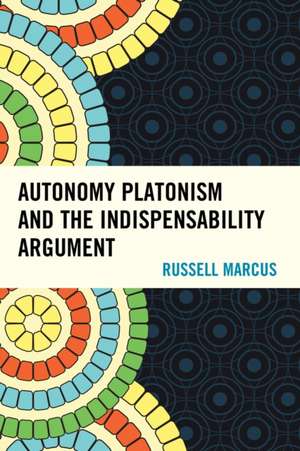
Autonomy Platonism and the Indispensability Argument
Autor Russell Marcusen Limba Engleză Hardback – 11 iun 2015
Preț: 633.31 lei
Preț vechi: 958.44 lei
-34%
Puncte Express: 950
Carte tipărită la comandă
Livrare economică 19 noiembrie-03 decembrie
Livrare prin curier în România Termenul estimat este afișat lângă disponibilitate.
Transport gratuit pentru acest produs Plată online sau ramburs, în funcție de opțiunile comenzii.
Retur gratuit în 14 zile Comandă securizată și suport în română.
Specificații
ISBN-13: 9780739173121
ISBN-10: 073917312X
Pagini: 260
Dimensiuni: 160 x 236 x 23 mm
Greutate: 0.5 kg
Editura: Bloomsbury Publishing
Colecția Lexington Books
Locul publicării:New York, United States
ISBN-10: 073917312X
Pagini: 260
Dimensiuni: 160 x 236 x 23 mm
Greutate: 0.5 kg
Editura: Bloomsbury Publishing
Colecția Lexington Books
Locul publicării:New York, United States
V-ar putea interesa
-
 Introduction to Formal Logic with Philosophical ApplicationsRussell Marcus-23%Preț: 596.60 lei774.81 lei
 -
 Game Theory - Analysis of Conflict (Paper) (OISC)Roger B. MyersonPreț: 344.83 lei
 -
 Game Theory for Applied EconomistsRobert S Gibbons-19%Preț: 459.12 lei566.81 lei
 -
 Games, Strategies, and Decision MakingJoseph Harrington-40%Preț: 535.43 lei890.43 lei
 -
 The Complete Polysecure BundleJessica FernPreț: 241.75 lei
Descriere
Mathematical platonism is the view that mathematical statements are true of real mathematical objects like numbers, shapes, and sets. One central problem with platonism is that numbers, shapes, sets, and the like are not perceivable by our senses. In contemporary philosophy, the most common defense of platonism uses what is known as the indispensability argument. According to the indispensabilist, we can know about mathematics because mathematics is essential to science.
Platonism is among the most persistent philosophical views. Our mathematical beliefs are among our most entrenched. They have survived the demise of millennia of failed scientific theories. Once established, mathematical theories are rarely rejected, and never for reasons of their inapplicability to empirical science.
Autonomy Platonism and the Indispensability Argument is a defense of an alternative to indispensability platonism. The autonomy platonist believes that mathematics is independent of empirical science: there is purely mathematical evidence for purely mathematical theories which are even more compelling to believe than empirical science.
Russell Marcus begins by contrasting autonomy platonism and indispensability platonism. He then argues against a variety of indispensability arguments in the first half of the book. In the latter half, he defends a new approach to a traditional platonistic view, one which includes appeals to a priori but fallible methods of belief acquisition, including mathematical intuition, and a natural adoption of ordinary mathematical methods. In the end, Marcus defends his intuition-based autonomy platonism against charges that the autonomy of mathematics is viciously circular. This book will be useful to researchers, graduate students, and advanced undergraduates with interests in the philosophy of mathematics or in the connection between science and mathematics.
Platonism is among the most persistent philosophical views. Our mathematical beliefs are among our most entrenched. They have survived the demise of millennia of failed scientific theories. Once established, mathematical theories are rarely rejected, and never for reasons of their inapplicability to empirical science.
Autonomy Platonism and the Indispensability Argument is a defense of an alternative to indispensability platonism. The autonomy platonist believes that mathematics is independent of empirical science: there is purely mathematical evidence for purely mathematical theories which are even more compelling to believe than empirical science.
Russell Marcus begins by contrasting autonomy platonism and indispensability platonism. He then argues against a variety of indispensability arguments in the first half of the book. In the latter half, he defends a new approach to a traditional platonistic view, one which includes appeals to a priori but fallible methods of belief acquisition, including mathematical intuition, and a natural adoption of ordinary mathematical methods. In the end, Marcus defends his intuition-based autonomy platonism against charges that the autonomy of mathematics is viciously circular. This book will be useful to researchers, graduate students, and advanced undergraduates with interests in the philosophy of mathematics or in the connection between science and mathematics.
Cuprins
Chapter One: Platonism: An Overview
Chapter Two: The Quinean Indispensability Argument
Chapter Three: Problems for QI
Chapter Four: The Weasel
Chapter Five: The Unfortunate Consequences
Chapter Six: The Putnamian Indispensability Argument
Chapter Seven: The Explanatory Indispensability Argument
Chapter Eight: Motivating Autonomy Platonism
Chapter Nine: Plenitudinous Platonism
Chapter Ten: Intuition-Based Autonomy Platonism
Chapter Eleven: Circles and Justification
Chapter Twelve: Conclusions
Chapter Two: The Quinean Indispensability Argument
Chapter Three: Problems for QI
Chapter Four: The Weasel
Chapter Five: The Unfortunate Consequences
Chapter Six: The Putnamian Indispensability Argument
Chapter Seven: The Explanatory Indispensability Argument
Chapter Eight: Motivating Autonomy Platonism
Chapter Nine: Plenitudinous Platonism
Chapter Ten: Intuition-Based Autonomy Platonism
Chapter Eleven: Circles and Justification
Chapter Twelve: Conclusions
Recenzii
[T]here is plenty of thought-provoking material to be found in this book, and it fills an important gap in the philosophy of mathematics literature. Marcus's writing style is clear and lively. (I liked his remark (p. 109) that 'philosophy should not be burden-of-proof volleyball'.) The book will be of interest both to those with a stake in the indispensability debates and to those looking to make progress developing more traditional defenses of platonism.
Autonomy Platonism and the Indispensability Argument contributes clarity and resourcefulness to a trenchant debate.
Russell Marcus has written a very good book. It is extremely clear and well-written, and it argues, rightly I think, for the important claim that traditional versions of platonism, which take mathematics to be justified independently of the empirical sciences, are superior to new-fangeled versions of platonism that take the ultimate justification for mathematics to be based on its usefulness in science.
Is mathematics justified through its empirical applications? Yes, say indispensabilist platonists, and no, say autonomy platonists. With skill and aplomb, Marcus argues for autonomy platonism and against indispensability platonism. This book is a significant contribution to the central debate in contemporary philosophy of mathematics and deserves a wide readership.
Autonomy Platonism and the Indispensability Argument contributes clarity and resourcefulness to a trenchant debate.
Russell Marcus has written a very good book. It is extremely clear and well-written, and it argues, rightly I think, for the important claim that traditional versions of platonism, which take mathematics to be justified independently of the empirical sciences, are superior to new-fangeled versions of platonism that take the ultimate justification for mathematics to be based on its usefulness in science.
Is mathematics justified through its empirical applications? Yes, say indispensabilist platonists, and no, say autonomy platonists. With skill and aplomb, Marcus argues for autonomy platonism and against indispensability platonism. This book is a significant contribution to the central debate in contemporary philosophy of mathematics and deserves a wide readership.