Cantitate/Preț
Produs

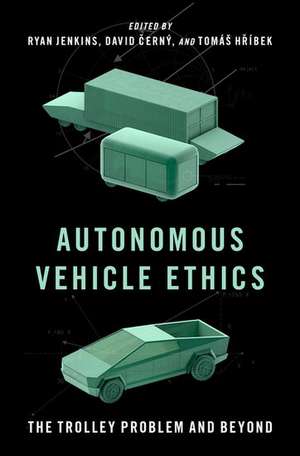
Autonomous Vehicle Ethics: The Trolley Problem and Beyond

Editat de Ryan Jenkins, David Cerný, Tomás Hríbek
en Limba Engleză Hardback – 14 noi 2022

Evoluția tehnologică a transportului automatizat a depășit rapid stadiul experimentelor mentale teoretice, impunând o reevaluare profundă a modului în care etica este integrată în algoritmi. Reținem că Autonomous Vehicle Ethics marchează un punct de cotitură în literatura de specialitate, propunând o depășire a celebrei „dileme a tramvaiului” pentru a aborda realitățile complexe ale implementării pe scară largă. Ne-a atras atenția rigoarea cu care editorii Ryan Jenkins, David Cerný și Tomás Hríbek au structurat cele 528 de pagini, refuzând soluțiile simpliste în favoarea unei analize multidisciplinare.

Apreciem în mod deosebit modul în care lucrarea tratează mediile de trafic „hibrid”, unde interacțiunea dintre inteligența artificială și comportamentul uman imprevizibil generează noi provocări pentru siguranța publică. Volumul este comparabil cu Test-Driving the Future de Diane P. Michelfelder în rigurozitate, dar actualizat pentru contextul securității cibernetice și al integrării în Internet of Things. În timp ce alte lucrări se concentrează pe scenarii de urgență, acest titlu explorează impactul sistemic asupra peisajului urban și distribuția beneficiilor tehnologice în societate.

Poziționată ca o continuare firească a preocupărilor explorate de Ryan Jenkins în Robot Ethics 2.0 și Who Should Die?, această nouă lucrare rafinează analiza responsabilității morale în era automatizării. Dacă în lucrările anterioare accentul cădea pe riscurile fizice și psihologice generale ale roboticii, aici editorii aplică aceleași standarde etice înalte unei industrii specifice, cea a transporturilor, transformând volumul într-un instrument esențial pentru înțelegerea guvernanței tehnologice actuale.

Citește tot Restrânge

Preț: 24553 lei

Preț vechi: 28019 lei
-12%

Puncte Express: 368

Carte disponibilă

Livrare economică 14-19 mai


Specificații

ISBN-13: 9780197639191
ISBN-10: 0197639194
Pagini: 528
Dimensiuni: 237 x 164 x 42 mm
Greutate: 0.84 kg
Editura: Oxford University Press
Colecția OUP USA
Locul publicării:New York, United States

De ce să citești această carte

Această lucrare este esențială pentru cercetătorii și profesioniștii din etica tehnologiei, oferind o perspectivă post-trolley problem asupra vehiculelor autonome. Cititorul câștigă o înțelegere clară a modului în care automatizarea va remodela orașele și normele juridice. Este recomandată celor care doresc să treacă de la dezbaterea filozofică abstractă la soluții practice de design etic și politici publice în transporturi.


Despre autor

Ryan Jenkins este un specialist recunoscut în etica tehnologiei, co-editor al volumului de referință Robot Ethics 2.0. Expertiza sa se concentrează pe intersecția dintre filozofia morală și tehnologiile emergente, de la inteligența artificială la sistemele militare autonome explorate în Who Should Die?. Alături de David Cerný și Tomás Hríbek, Jenkins coordonează acest volum publicat de Oxford University Press, aducând laolaltă perspective globale din inginerie, drept și științe sociale pentru a defini cadrul etic al viitorului mobilității.


Descriere

"A runaway trolley is speeding down a track" So begins what is perhaps the most fecund thought experiment of the past several decades since its invention by Philippa Foot. Since then, moral philosophers have applied the "trolley problem" as a thought experiment to study many different ethical conflicts - and chief among them is the programming of autonomous vehicles. Nowadays, however, very few philosophers accept that the trolley problem is a perfect analogy for driverless cars or that the situations autonomous vehicles face will resemble the forced choice of the unlucky bystander in the original thought experiment.This book represents a substantial and purposeful effort to move the academic discussion beyond the trolley problem to the broader ethical, legal, and social implications that autonomous vehicles present. There are still urgent questions waiting to be addressed, for example: how AVs might interact with human drivers in mixed or "hybrid" traffic environments; how AVs might reshape our urban landscapes; what unique security or privacy concerns are raised by AVs as connected devices in the "Internet of Things"; how the benefits and burdens of this new technology, including mobility, traffic congestion, and pollution, will be distributed throughout society; and more.An attempt to map the landscape of these next-generation questions and to suggest preliminary answers, this volume draws on the disciplines of philosophy, sociology, economics, urban planning and transportation engineering, business ethics and more, and represents a global range of perspectives.

Notă biografică

Dr. Ryan Jenkins is an Associate Professor of Philosophy, a Senior Fellow at the Ethics + Emerging Sciences Group at California Polytechnic State University in San Luis Obispo, and a former Co-Chair of the Robot Ethics Technical Committee of the IEEE. He studies the ethics of emerging technologies, especially artificial intelligence, autonomous weapons, and driverless cars. He has served on two NSF grants to study the ethical, legal, and social implications of autonomous vehicles. He has published extensively in academic journals and his work has appeared in public fora including the Washington Post, Slate, and Forbes.Dr. David Cerný is a research fellow at the Institute of State and Law of the Czech Academy of Sciences and the Institute of Computer Science of the Czech Academy of Sciences. He is a founding member of the Karel Capek Center for Values in Science and Technology. His research interests range from normative to applied ethics, primarily focusing on artificial intelligence, robotics, and medical ethics. He has served on two Technology Agency of the Czech Republic grants to investigate the ethical implications of autonomous vehicles and end-of-life decisions. He also served as an expert at the European Commission. Czech media often interview him on issues related to applied ethics, and his work has appeared in public fora.Dr. Tomás Hríbek is a research fellow at the Institute of Philosophy of the Czech Academy of Sciences. Together with David Cerný, he is the founder of the Karel Capek Center for Values in Science and Technology. He has published on topics ranging from philosophy of mind and science, to ethics (particularly bioethics, and more recently the ethics of emerging technologies) and aesthetics. He also teaches at several colleges, including Charles University and Anglo-American University, in his hometown of Prague.