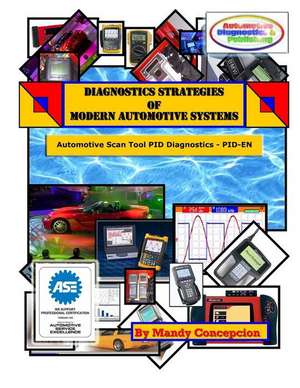
Automotive Scan Tool Pid Diagnostics
Autor Mandy Concepcionen Limba Engleză Paperback
Ecosistemul diagnosticării auto moderne gravitează în jurul interfețelor OBD I și OBD II, iar Automotive Scan Tool Pid Diagnostics explorează metodologiile de interpretare a fluxurilor de date PID pentru o localizare rapidă a defectelor. Remarcăm o abordare axată pe eficiență, unde conceptul de „driver seat diagnostics” devine pilonul central: utilizarea scanerului pentru a elimina presupunerile înainte de a trece la testele manuale invazive. Credem că valoarea acestui manual constă în structurarea clară a parametrilor motorului, de la timpii de injecție și sarcina motorului (Engine LOAD), până la comportamentul complex al senzorilor MAF, MAP și TPS.
Autorul Mandy Concepcion organizează materialul în nouă teste practice, fiecare vizând un sistem critic. Reținem analiza detaliată a strategiilor de detectare a raturilor de aprindere (Misfire) și importanța resetării valorilor Fuel Trims după reparații. Cititorul care a aplicat deja studiile de caz din Automotive Repair Case Studies va găsi aici fundamentul tehnic necesar pentru a înțelege „de ce” și „cum” interpretează computerul de bord (ECM) datele senzorilor. Față de lucrările sale anterioare, precum Automotive Electronic Diagnostics (Course-1), care se concentrau pe scheme electrice, acest volum prioritizează fluxul de date în timp real.
Stilul este tehnic și aplicat, eliminând teoria redundantă în favoarea unor corelații directe: de exemplu, modul în care un senzor de temperatură a aerului (IAT) defect influențează livrarea de combustibil. Este o resursă esențială pentru rafinarea abilităților de diagnosticare logică, transformând scanerul dintr-un simplu cititor de coduri într-un instrument analitic de precizie.
Preț: 178.35 lei
Carte disponibilă
Livrare economică 20 octombrie-03 noiembrie
Specificații
ISBN-10: 1466386959
Pagini: 64
Dimensiuni: 216 x 279 x 3 mm
Greutate: 0.17 kg
Editura: CREATESPACE
V-ar putea interesa
-
 Marine Diesel EnginesNigel Calder-16%Preț: 174.03 lei207.07 lei
 -
 How to Repair Briggs and Stratton Engines, 4th Ed.Paul Dempsey-29%Preț: 140.91 lei198.80 lei
 -
 Ace The Technical Pilot Interview 2/EGary Bristow-33%Preț: 167.30 lei250.78 lei
 -
 Oh's Intensive Care ManualJonathan M. Handy-29%Preț: 675.87 lei958.41 leiRecomandat
 -
 Kern's Cardiac Catheterization HandbookPaul Sorajja-28%Preț: 386.82 lei536.03 leiRecomandat
 -
 Anesthesia SecretsBrian M. Keech-26%Preț: 326.83 lei438.93 leiRecomandat
 -
 McGee's Evidence-Based Physical DiagnosisSteven McGee-28%Preț: 425.25 lei587.36 lei
 -
 -18%Preț: 129.39 lei158.34 lei
 -
 How to Use Automotive Diagnostic ScannersTracy MartinPreț: 171.74 lei
 -
 Bosch Fuel Injection & Engine ManagementC. ProbstPreț: 340.06 lei
 -
 Preț: 317.45 lei
 -
 Haynes Manual Of Engine ManagementHaynes PublishingPreț: 277.07 lei
 -
 -31%Preț: 205.47 lei296.79 lei
 -
 AUTOMOTIVE ENGINES 8/ETim Gilles-17%Preț: 614.76 lei741.29 lei
 -
 Automotive Code-To-Flowchart Repair (Ford)Mandy ConcepcionPreț: 189.06 lei
 -
 Preț: 309.49 lei
 -
 OBD-I & OBD-IIGreg Banish-21%Preț: 204.42 lei260.30 lei
 -
 Reciprocating Engine Combustion DiagnosticsRakesh Kumar MauryaPreț: 463.87 lei
 -
 Automotive Air ConditioningQuansheng Zhang-9%Preț: 680.02 lei747.27 lei
 -
 Advanced Engine DiagnosticsAvinash Kumar Agarwal-18%Preț: 864.97 lei1054.83 lei
De ce să citești această carte
Această carte este indispensabilă mecanicilor care doresc să reducă timpul de diagnosticare prin stăpânirea parametrilor PID. Veți învăța să interpretați corect datele de „Fuel Trim” și să identificați rapid defecțiuni complexe, precum catalizatoarele înfundate sau scurgerile de vacuum, fără demontări inutile. Este un ghid practic ce transformă diagnoza electronică dintr-o ghicitoare într-un proces matematic precis.