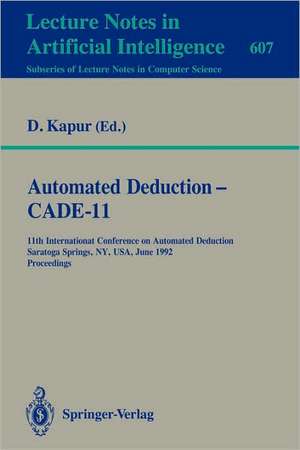
Automated Deduction - CADE-11
Editat de Deepak Kapuren Limba Engleză Paperback – 27 mai 1992
Preț: 650.30 lei
Preț vechi: 812.89 lei
-20%
Puncte Express: 975
Carte tipărită la comandă
Livrare economică 05-19 decembrie
Livrare prin curier în România Termenul estimat este afișat lângă disponibilitate.
Transport gratuit pentru acest produs Plată online sau ramburs, în funcție de opțiunile comenzii.
Retur gratuit în 14 zile Comandă securizată și suport în română.
Specificații
ISBN-13: 9783540556022
ISBN-10: 3540556028
Pagini: 816
Ilustrații: XVI, 800 p.
Dimensiuni: 155 x 235 x 44 mm
Greutate: 1.21 kg
Ediția:1992
Editura: Springer
Locul publicării:Berlin, Heidelberg, Germany
ISBN-10: 3540556028
Pagini: 816
Ilustrații: XVI, 800 p.
Dimensiuni: 155 x 235 x 44 mm
Greutate: 1.21 kg
Ediția:1992
Editura: Springer
Locul publicării:Berlin, Heidelberg, Germany
V-ar putea interesa
-
 -19%Preț: 92.35 lei114.22 lei
 -
 Modelling and Reasoning with Vague ConceptsJonathan Lawry-20%Preț: 654.06 lei817.57 lei
 -
 Artificial Intelligence in Economics and ManagmentPhillip Ein-Dor-20%Preț: 671.27 lei839.09 lei
 -
 Computer VisionSimon J. D. Prince-20%Preț: 582.72 lei728.39 lei
 -
 Machine LearningPeter Flach-20%Preț: 386.84 lei483.55 lei
 -
 Multi-Agent Machine LearningH M Schwartz-20%Preț: 675.81 lei844.77 lei
 -
 Wavelet Neural NetworksAntonios K Alexandridis-20%Preț: 634.18 lei792.72 lei
 -
 Practical Introduction to CompDawson-Howe-20%Preț: 518.21 lei647.76 lei
 -
 Machine Learning: An Algorithmic Perspective, Second EditionStephen Marsland-20%Preț: 625.22 lei781.53 lei
 -
 Natural Language Processing and Computational LinguisticsMohamed Zakaria Kurdi-9%Preț: 1021.06 lei1122.04 lei
 -
 Biometric SystemsJames L. Wayman-20%Preț: 732.37 lei915.46 lei
 -
 Automated ReasoningStéphane Demri-20%Preț: 335.26 lei419.08 lei
 -
 -20%Preț: 324.41 lei405.51 lei
 -
 -20%Preț: 653.96 lei817.45 lei
 -
 Program Development in Computational LogicMaurice Bruynooghe-20%Preț: 335.32 lei419.15 lei
 -
 Nonlinear Speech Modeling and ApplicationsGerard Chollet-20%Preț: 343.12 lei428.90 lei
 -
 -20%Preț: 652.70 lei815.88 lei
 -
 -20%Preț: 983.69 lei1229.61 lei
 -
 -20%Preț: 620.33 lei775.42 lei
 -
 Believable BotsPhilip Hingston-20%Preț: 676.70 lei845.88 lei
Public țintă
ResearchCuprins
The impossibility of the automation of logical reasoning.- Automatic proofs in mathematical logic and analysis.- Proving geometry statements of constructive type.- The central variable strategy of str?ve.- Unification in the union of disjoint equational theories: Combining decision procedures.- Reduction and unification in Lambda calculi with subtypes.- A combinatory logic approach to higher-order E-unification (extended abstract).- Cycle unification.- A parallel completion procedure for term rewriting systems.- Grammar rewriting.- Polynomial interpretations and the complexity of algorithms.- Uniform traversal combinators: Definition, use and properties.- Sorted unification using set constraints.- An abstract view of sorted unification.- Unification in order-sorted algebras with overloading.- Puzzles and paradoxes.- Experiments in automated deduction with condensed detachment.- Caching and lemmaizing in model elimination theorem provers.- LIM+ challenge problems by RUE hyper-resolution.- Computing prime implicates incrementally.- Linear-input subset analysis.- Theoretical study of symmetries in propositional calculus and applications.- Difference matching.- Using middle-out reasoning to control the synthesis of tail-recursive programs.- The use of proof plans to sum series.- Disproving conjectures.- An interval-based temporal logic in a multivalued setting.- A normal form for first-order temporal formulae.- Semantic entailment in non classical logics based on proofs found in classical logic.- Embedding negation as failure into a model generation theorem prover.- Automated correctness proofs of machine code programs for a commercial microprocessor.- Proving the Chinese remainder theorem by the cover set induction.- Automatic program optimization through prooftransformation.- Proof search theory and practice in the (former) USSR (Tentative).- Basic paramodulation and superposition.- Theorem proving with ordering constrained clauses.- The special-relation rules are incomplete.- An improved method for adding equality to free variable semantic tableaux.- Proof search in the intuitionistic sequent calculus.- Implementing the meta-theory of deductive systems.- Tactic-based theorem proving and knowledge-based forward chaining: An experiment with Nuprl and Ontic.- Little theories.- Some termination criteria for narrowing and E-narrowing.- Decidable matching for convergent systems.- Free sequentially in orthogonal order-sorted rewriting systems with constructors.- Programming with equations: A framework for lazy parallel evaluation.- A many sorted logic with possibly empty sorts.- Theorem proving in non-standard logics based on the inverse method.- One more logic with uncertainty and resolution principle for it.- A natural deduction automated theorem proving system.- Isabelle-91.- The semantically guided linear deduction system.- The Shunyata system.- A geometry theorem prover for macintoshes.- FRI: Failure-resistant induction in RRL.- Herky: High performance rewriting in RRL.- IMPS: System description.- Proving equality theorems with hyper-linking.- Xpnet: A graphical interface to proof nets with an efficient proof checker.- &: Automated natural deduction.- An overview of Frapps 2.0: A framework for resolution-based automated proof procedure systems.- The GAZER theorem prover.- ROO: A parallel theorem prover.- RVF: An automated formal verification system.- KPROP — An AND-parallel theorem prover for propositional logic implemented in KL1 system abstract.- A report on ICL HOL.- PVS: A prototype verification system.- The KIVsystem: Systematic construction of verified software.- The tableau-based theorem prover 3 T A P for multiple-valued logics.- Analytica — A theorem prover in mathematica.- The FAUST — prover.- Eves system description.- MGTP: A parallel theorem prover based on lazy model generation.- Benchmark problems in which equality plays the major role.- Computing transitivity tables: A challenge for automated theorem provers.