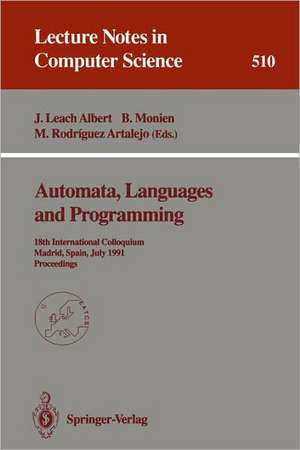
Automata, Languages and Programming
Editat de Javier Leach Albert, Burkhard Monien, Mario Rodriguez Artalejoen Limba Engleză Paperback – 20 iun 1991
Preț: 674.51 lei
Preț vechi: 843.14 lei
-20%
Puncte Express: 1012
Carte tipărită la comandă
Livrare economică 27 noiembrie-11 decembrie
Livrare prin curier în România Termenul estimat este afișat lângă disponibilitate.
Transport gratuit pentru acest produs Plată online sau ramburs, în funcție de opțiunile comenzii.
Retur gratuit în 14 zile Comandă securizată și suport în română.
Specificații
ISBN-13: 9783540542339
ISBN-10: 3540542337
Pagini: 780
Ilustrații: XII, 768 p.
Dimensiuni: 155 x 235 x 42 mm
Greutate: 1.16 kg
Ediția:1991
Editura: Springer
Locul publicării:Berlin, Heidelberg, Germany
ISBN-10: 3540542337
Pagini: 780
Ilustrații: XII, 768 p.
Dimensiuni: 155 x 235 x 42 mm
Greutate: 1.16 kg
Ediția:1991
Editura: Springer
Locul publicării:Berlin, Heidelberg, Germany
V-ar putea interesa
-
 Computer VisionSimon J. D. Prince-20%Preț: 582.72 lei728.39 lei
 -
 Enterprise Content and Search Management for Building Digital PlatformsShailesh Kumar Shivakumar-20%Preț: 528.34 lei660.43 lei
 -
 Spock: Up and RunningRob Fletcher-20%Preț: 351.55 lei439.44 lei
 -
 Tragic DesignJonathan Shariat-20%Preț: 192.19 lei240.24 lei
 -
 Thoughtful Machine Learning with PythonMatthew Kirk-20%Preț: 258.34 lei322.92 lei
 -
 This is Service Design DoingMarc Stickdorn-20%Preț: 264.28 lei330.35 lei
 -
 Karau, H: High Performance SparkHolden Karau-20%Preț: 242.50 lei303.13 lei
 -
 Practical TableauRyan Sleeper-20%Preț: 319.04 lei398.80 lei
 -
 Course in Mathematical CryptographyGilbert Baumslag-20%Preț: 343.49 lei429.36 lei
 -
 Data Structures and Efficient AlgorithmsBurkhard Monien-20%Preț: 340.57 lei425.71 lei
 -
 Parallel Architectures and Their Efficient UseFriedhelm Meyer Auf Der Heide-20%Preț: 332.26 lei415.32 lei
 -
 Algebraic and Logic ProgrammingGiorgio Levi-20%Preț: 323.39 lei404.23 lei
 -
 Automata, Languages and ProgrammingFriedhelm Meyer Auf Der Heide-20%Preț: 670.25 lei837.82 lei
 -
 Algebraic and Logic ProgrammingMichael Hanus-20%Preț: 338.24 lei422.80 lei
 -
 Computer Science LogicJörg Flum-20%Preț: 337.51 lei421.89 lei
 -
 Die Doktorarbeit: Vom Start zum ZielBarbara Messing-20%Preț: 270.64 lei338.29 lei
 -
 Multicore:Thomas Rauber-20%Preț: 161.18 lei201.48 lei
 -
 -20%Preț: 335.29 lei419.11 lei
 -
 Algebraic InformaticsFranz Winkler-20%Preț: 333.53 lei416.92 lei
 -
 -20%Preț: 313.10 lei391.37 lei
 -
 -20%Preț: 325.79 lei407.24 lei
 -
 -20%Preț: 319.75 lei399.68 lei
Public țintă
ResearchCuprins
On the semantics of logic programs.- Logic programming with recurrence domains.- Extensional embedding of a strongly stable model of PCF.- Uniform ideals and strictness analysis.- Logical and computational aspects of programming with sets/bags/lists.- Safety for branching time semantics.- Program composition and modular verification.- Model-checking for probabilistic real-time systems.- Computing behavioural relations, logically.- The power of reconfiguration.- General resolution of tseitin formulas is hard.- Program checkers for probability generation.- Running time to recognize nonregular languages by 2-way probabilistic automata.- Statistics on random trees.- The expressive power of implicit specifications.- CCS + time = an interleaving model for real time systems.- On confluent semi-commutations — Decidability and complexity results.- Lazard's factorizations of free partially commutative monoids.- A Kleene theorem for infinite trace languages.- Canonical sets of horn clauses.- A specialized completion procedure for monadic string-rewriting systems presenting groups.- A confluent reduction for the ?-calculus with surjective pairing and terminal object.- Provably recursive programs and program extraction.- Efficient algorithms for path problems with general cost criteria.- Computing shortest paths and distances in planar graphs.- Maintaining biconnected components of dynamic planar graphs.- Efficient maximal cubic graph cuts.- Structural parallel algorithmics.- Improving known solutions is hard.- Collapsing degrees via strong computation.- Fast parallel generation of random permutations.- A parallel algorithm for two processors precedence constraint scheduling.- An efficient NC algorithm for finding Hamiltonian cycles in dense directed graphs.- On logics, tilings,and automata.- Satisfiability of systems of ordinal notations with the subterm property is decidable.- Complete axiomatizations of some quotient term algebras.- The meaning of negative premises in transition system specifications.- Deciding history preserving bisimilarity.- Adding action refinement to a finite process algebra.- Improved parallel computations with matrices and polynomials.- Finding minimal forbidden minors using a finite congruence.- Better algorithms for the pathwidth and treewidth of graphs.- Two P-complete problems in the theory of the reals.- L morphisms: Bounded delay and regularity of ambiguity.- Degree and decomposability of variable-length codes.- An EILENBERG theorem for ?-languages.- Balancing order and chaos in image generation.- Average case complexity.- Minimal NFA problems are hard.- Algorithms for determining the smallest number of nonterminals (states) sufficient for generating (accepting) a regular language.- Computing shortest transversals.- Ray shooting in polygons using geodesic triangulations.- The expected extremes in a delaunay triangulation.- Computational geometry for the gourmet old fare and new dishes.- On the power of multiple reads in a chip.- On linear decision trees computing Boolean functions.- An almost linear-time algorithm for the dense subset-sum problem.- On-line algorithms for weighted bipartite matching and stable marriages.- String matching with preprocessing of text and pattern.- Ordering problems approximated: single-processor scheduling and interval graph completion.