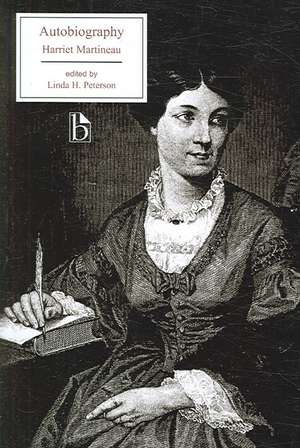
Autobiography
Autor Harriet Martineau Editat de Linda Petersonen Limba Engleză Paperback – 21 dec 2006
This edition of her Autobiography reproduces the original 1877 text, which Martineau composed in 1855 and had printed in anticipation of her death. It includes illustrations of the author and her homes; excerpts from the “Memorials,” added by her editor Maria Chapman; and reviews that praise and critique Martineau’s method as an autobiographer and achievement as a Victorian woman of letters.
Preț: 243.17 lei
Preț vechi: 307.36 lei
-21%
Puncte Express: 365
Carte disponibilă
Livrare economică 05-19 noiembrie
Livrare express 22-28 octombrie pentru 117.16 lei
Livrare prin curier în România Termenul estimat este afișat lângă disponibilitate.
Transport gratuit de la 400.00 lei Plată online sau ramburs, în funcție de opțiunile comenzii.
Retur gratuit în 14 zile Comandă securizată și suport în română.
Specificații
ISBN-13: 9781551115559
ISBN-10: 1551115557
Pagini: 744
Dimensiuni: 140 x 216 x 35 mm
Greutate: 0.76 kg
Ediția:Revised
Editura: BROADVIEW PR
Colecția Broadview Press
Locul publicării:Peterborough, Canada
ISBN-10: 1551115557
Pagini: 744
Dimensiuni: 140 x 216 x 35 mm
Greutate: 0.76 kg
Ediția:Revised
Editura: BROADVIEW PR
Colecția Broadview Press
Locul publicării:Peterborough, Canada
V-ar putea interesa
-
 Autobiography Of A GeishaSayo MasudaPreț: 114.55 lei
 -
 -28%Preț: 425.13 lei593.41 lei
 -
 Women's Fiction and the Great WarSuzanne Raitt-21%Preț: 294.76 lei371.02 lei
 -
 English Feminism, 1780-1980Barbara Caine-28%Preț: 406.19 lei566.49 lei
 -
 -31%Preț: 555.78 lei801.92 lei
 -
 Woman Defamed and Woman Defended: An Anthology of Medieval TextsAlcuin Blamires-28%Preț: 398.71 lei556.68 lei
 -
 Gender and Human RightsKaren Knop-28%Preț: 424.75 lei593.67 lei
 -
 Women at Work: An Economic PerspectiveTito Boeri-28%Preț: 379.48 lei529.11 lei
 -
 Preț: 104.40 lei
 -
 A Suitable Job for a WomanVal McDermidPreț: 94.52 lei
Recenzii
Harriet Martineau lived an extraordinary literary life. She became a reviewer and journalist in the 1820s when her family’s fortune collapsed; published a best-selling series, Illustrations of Political Economy (1832-34), that made her fame and fortune by the age of thirty; overcame a hearing disability to become a “literary lion” in London society; toured the United States and wrote two founding texts of sociology based on her experiences; explored north Africa and the Middle East to observe non-European societies; wrote “leaders” (editorials) on slavery for the London Daily News during the American Civil War; and commented publicly on matters of politics, history, and religion in an era when women supposedly maintained their place in the sphere of domesticity.
This edition of her Autobiography reproduces the original 1877 text, which Martineau composed in 1855 and had printed in anticipation of her death. It includes illustrations of the author and her homes; excerpts from the “Memorials,” added by her editor Maria Chapman; and reviews that praise and critique Martineau’s method as an autobiographer and achievement as a Victorian woman of letters.
“Words like ‘extraordinary’ and ‘remarkable’ are not misplaced in describing Harriet Martineau’s Autobiography. Controversial throughout her life, she is, in Linda Peterson’s words, ‘a superb storyteller,’ recounting all that happened to her with outspoken directness. In a field dominated by male practitioners, Martineau's uncompromising account of her life, relationships, travels, and illnesses deserves much wider recognition. In this first comprehensively annotated edition of the text since it was originally published in 1877, readers can fully appreciate what made Martineau a compelling teller of her own tale.” — Valerie R. Sanders, University of Hull
“Harriet Martineau’s Autobiography is something much more complex than a conventional autobiography. Martineau’s long and elaborate work was self-consciously written in a hybrid form to offer advice and support for many areas of Victorian women’s experience. It considers the spiritual life, illness, education and, most powerfully of all, professional journalism as a way of life. It is an important book, less well known than it should be. This attractive and scrupulously, but unobtrusively, annotated edition by a leading scholar of Victorian women’s life writing brings a major text within reach of all those interested in Victorian women and their public and private lives.” — Brian Maidment, University of Salford
This edition of her Autobiography reproduces the original 1877 text, which Martineau composed in 1855 and had printed in anticipation of her death. It includes illustrations of the author and her homes; excerpts from the “Memorials,” added by her editor Maria Chapman; and reviews that praise and critique Martineau’s method as an autobiographer and achievement as a Victorian woman of letters.
“Words like ‘extraordinary’ and ‘remarkable’ are not misplaced in describing Harriet Martineau’s Autobiography. Controversial throughout her life, she is, in Linda Peterson’s words, ‘a superb storyteller,’ recounting all that happened to her with outspoken directness. In a field dominated by male practitioners, Martineau's uncompromising account of her life, relationships, travels, and illnesses deserves much wider recognition. In this first comprehensively annotated edition of the text since it was originally published in 1877, readers can fully appreciate what made Martineau a compelling teller of her own tale.” — Valerie R. Sanders, University of Hull
“Harriet Martineau’s Autobiography is something much more complex than a conventional autobiography. Martineau’s long and elaborate work was self-consciously written in a hybrid form to offer advice and support for many areas of Victorian women’s experience. It considers the spiritual life, illness, education and, most powerfully of all, professional journalism as a way of life. It is an important book, less well known than it should be. This attractive and scrupulously, but unobtrusively, annotated edition by a leading scholar of Victorian women’s life writing brings a major text within reach of all those interested in Victorian women and their public and private lives.” — Brian Maidment, University of Salford
Cuprins
Acknowledgements
Introduction
Harriet Martineau: A Brief Chronology
A Note on the Text
Autobiography
Appendix A: Illustrations from the Autobiography (1877)
Appendix B: Selections from the Memorials (1877)
Introduction
Harriet Martineau: A Brief Chronology
A Note on the Text
Autobiography
Appendix A: Illustrations from the Autobiography (1877)
Appendix B: Selections from the Memorials (1877)
- Private Memorandum (June 1829)
- Letter from Harriet Martineau to her Mother(22 January 1830)
- Letter to the Editor of “Men of the Time”(22 March 1856)
- Obituary, London Daily News (29 June 1876)
- Margaret Oliphant, Blackwood’s Edinburgh Magazine (April 1877)
- John Morley, Macmillan’s Magazine (May 1877)
- W.R. Greg, The Nineteenth Century (August 1877)