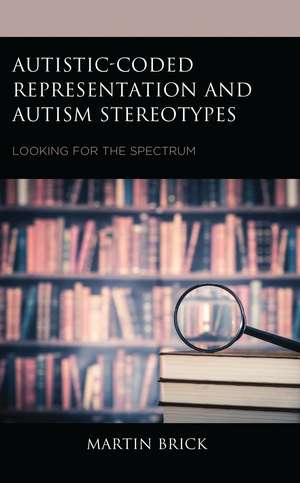
Autistic-Coded Representation and Autism Stereotypes: Looking for the Spectrum
Autor Martin Bricken Limba Engleză Hardback – apr 2024
Preț: 516.34 lei
Preț vechi: 767.98 lei
-33%
Puncte Express: 775
Carte tipărită la comandă
Livrare economică 30 noiembrie-14 decembrie
Livrare prin curier în România Termenul estimat este afișat lângă disponibilitate.
Transport gratuit pentru acest produs Plată online sau ramburs, în funcție de opțiunile comenzii.
Retur gratuit în 14 zile Comandă securizată și suport în română.
Specificații
ISBN-13: 9781666910001
ISBN-10: 1666910007
Pagini: 160
Ilustrații: 10 Tables
Dimensiuni: 159 x 237 x 19 mm
Greutate: 0.41 kg
Editura: Bloomsbury Publishing
Colecția Lexington Books
Locul publicării:New York, United States
ISBN-10: 1666910007
Pagini: 160
Ilustrații: 10 Tables
Dimensiuni: 159 x 237 x 19 mm
Greutate: 0.41 kg
Editura: Bloomsbury Publishing
Colecția Lexington Books
Locul publicării:New York, United States
Descriere
Autistic-Coded Representation and Autism Stereotypes: Looking for the Spectrum takes a fresh approach to examining autism representation in literature, film, and television by looking particularly at characters who are not directly identified as falling on the Autism Spectrum. As autism becomes an increasingly popular topic to explore in literature and visual media, it is important that representations present people with autism as real humans with complex interior lives. Too often autistic characters fall into broad stereotypes - victims, villains, fools, or heroes - and autism emerges as the defining aspect of their personality. This book looks at autistic-coded characters, both classic and contemporary, to examine the benefits of looking for the spectrum in characters not explicitly labeled. Autistic audiences see a diverse and fully fleshed representation of themselves and neurotypical audiences gain a greater understanding of ASD though exposure to characters who defy stereotypes.
Cuprins
Acknowledgments
Introduction
Part One: Autism Stereotypes
Chapter One: The Victim
Chapter Two: The Villain
Chapter Three: The Fool
Chapter Four: The Hero
Part One Conclusion: Autism Stereotypes
Part Two: Coded Representations of Autism
Chapter Five: Fan Favorites
Chapter Six: Classics
Chapter Seven: Narrative Voice in and Autism in David Foster Wallace
Chapter Eight: Autism and Humor in Visual Narratives
Conclusion
Bibliography
About the Author
Introduction
Part One: Autism Stereotypes
Chapter One: The Victim
Chapter Two: The Villain
Chapter Three: The Fool
Chapter Four: The Hero
Part One Conclusion: Autism Stereotypes
Part Two: Coded Representations of Autism
Chapter Five: Fan Favorites
Chapter Six: Classics
Chapter Seven: Narrative Voice in and Autism in David Foster Wallace
Chapter Eight: Autism and Humor in Visual Narratives
Conclusion
Bibliography
About the Author