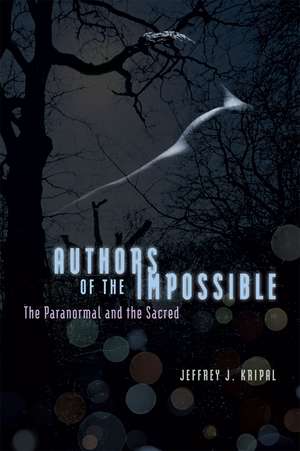
Authors of the Impossible: The Paranormal and the Sacred
Autor Jeffrey J. Kripalen Limba Engleză Paperback – 30 noi 2011
Kripal grounds his study in the work of four major figures in the history of paranormal research: psychical researcher Frederic Myers; writer and humorist Charles Fort; astronomer, computer scientist, and ufologist Jacques Vallee; and philosopher and sociologist Bertrand Méheust. Through incisive analyses of these thinkers, Kripal ushers the reader into a beguiling world somewhere between fact, fiction, and fraud. The cultural history of telepathy, teleportation, and UFOs; a ghostly love story; the occult dimensions of science fiction; cold war psychic espionage; galactic colonialism; and the intimate relationship between consciousness and culture all come together in Authors of the Impossible, a dazzling and profound look at how the paranormal bridges the sacred and the scientific.
Preț: 249.18 lei
Puncte Express: 374
Carte disponibilă
Livrare economică 27 octombrie-10 noiembrie
Livrare express 10-16 octombrie pentru 28.49 lei
Livrare prin curier în România Termenul estimat este afișat lângă disponibilitate.
Transport gratuit de la 400.00 lei Plată online sau ramburs, în funcție de opțiunile comenzii.
Retur gratuit în 14 zile Comandă securizată și suport în română.
Specificații
ISBN-13: 9780226453873
ISBN-10: 0226453871
Pagini: 352
Ilustrații: 1 color plate, 4 halftones
Dimensiuni: 152 x 229 x 25 mm
Greutate: 0.43 kg
Editura: University of Chicago Press
Colecția University of Chicago Press
ISBN-10: 0226453871
Pagini: 352
Ilustrații: 1 color plate, 4 halftones
Dimensiuni: 152 x 229 x 25 mm
Greutate: 0.43 kg
Editura: University of Chicago Press
Colecția University of Chicago Press
V-ar putea interesa
-
 The PropheciesNostradamus-19%Preț: 104.63 lei129.38 lei
 -
 -18%Preț: 198.47 lei242.89 lei
 -
 The Serpent's Gift: Gnostic Reflections on the Study of ReligionJeffrey J. KripalPreț: 330.23 lei
 -
 Magic, Mystery, and ScienceDan BurtonPreț: 223.53 lei
 -
 Preț: 420.66 lei
 -
 Preț: 479.60 lei
 -
 Witches and WitchcraftProfessor David Nash-40%Preț: 40.80 lei67.77 lei
 -
 Lucifer RisingGavin BaddeleyPreț: 112.27 lei
 -
 Techniques of Graeco-Egyptian MagicDr Stephen Skinner, Ph.D.-14%Preț: 285.51 lei333.33 lei
 -
 Esotericism and the AcademyWouter J. HanegraaffPreț: 260.98 lei
 -
 Portable Complete Golden Dawn System of MagicDr Israel Regardie-14%Preț: 709.05 lei824.47 lei
 -
 Aha!: The Sevenfold Mystery of the Ineffable LoveAleister Crowley-18%Preț: 168.88 lei206.30 lei
 -
 -19%Preț: 109.50 lei135.38 lei
 -
 WitchLisa ListerPreț: 75.42 lei
Notă biografică
Jeffrey J. Kripal holds the J. Newton Rayzor Chair in Philosophy and Religious Thought at Rice University. He is the author of several books, including, most recently, The Superhumanities: Historical Precedents, Moral Objections, New Realities, also published by the University of Chicago Press.
Cuprins
Acknowledgments
An Impossible Opening: The Magical Politics of Bobby Kennedy
Introduction: Off the Page
Definitions and Broken Lineages
Restoring a Lineage
Authors of the Impossible: The Paranormal as Meaning
The Fantastic Narrative of Western Occulture: The Paranormal as Story
1 The Book as Séance: Frederic Myers and the London Society for Psychical Research
After Life
Myers and the Founding of the S.P.R.
The Subliminal Gothic: The Human as Two
The Supernormal and Evolution: The World as Two
Telepathy: The Communications Technology of the Spirit
The Perfect Insect of the Imaginal
The Telepathic and the Erotic: Myers’s Platonic Speech
Dimensions
2 Scattering the Seeds of a Super-Story: Charles Fort and the Fantastic Narrative of Western Occulture
The Parable of the Peaches: Fort’s Mischievous Monistic Life
Collecting and Classifying the Data of the Damned: Fort’s Comparative Method
The Three Eras or Dominants: Fort’s Philosophy of History
The Philosophy of the Hyphen: Fort’s Dialectical Monism
Galactic Colonialism: Fort’s Science Mysticism and Dark Mythology
Evolution, Wild Talents, and the Poltergeist Girls: Fort’s Magical Anthropology
3 The Future Technology of Folklore: Jacques Vallee and the UFO Phenomenon
Forbidden Science (1957–69)
Passport to Magonia: From Folklore to Flying Saucers (1969)
The Invisible College (1975)
The Present Technology of Folklore: Computer Technology and
Remote Viewing in the Psychic Underground
The Alien Contact Trilogy and the Mature Multiverse Gnosis
Sub Rosa: The Three Secrets
The Hermeneutics of Light: The Cave Become Window
4 Returning the Human Sciences to Consciousness: Bertrand Méheust and the Sociology of the Impossible
A Double Premise
Méheust and the Master
Science Fiction and Flying Saucers
The Challenge of the Magnetic and the Shock of the Psychical
“If Only One of These Facts . . .”: The Impossible Case of Alexis Didier
The Collective Mind: Bateson, De Martino, Vallee, and Jung
Agent X: Projection Theory Turned Back on Itself
Conclusion: Back on the Page
The Eclipse of the Sacred and the Psyche in Modern Oblivion
Consciousness, Culture, and Cognition: The Fantastic Structure of the Mind-Brain
From Realization to Authorization: Toward a Hermeneutics of the Impossible
Dimensions
Impossible (Dis)Closings: Two Youthful Encounters
Required Reading (That Is Never Read ): A Select Annotated Bibliography
Some More Damned Anecnotes
Index
An Impossible Opening: The Magical Politics of Bobby Kennedy
Introduction: Off the Page
Definitions and Broken Lineages
Restoring a Lineage
Authors of the Impossible: The Paranormal as Meaning
The Fantastic Narrative of Western Occulture: The Paranormal as Story
1 The Book as Séance: Frederic Myers and the London Society for Psychical Research
After Life
Myers and the Founding of the S.P.R.
The Subliminal Gothic: The Human as Two
The Supernormal and Evolution: The World as Two
Telepathy: The Communications Technology of the Spirit
The Perfect Insect of the Imaginal
The Telepathic and the Erotic: Myers’s Platonic Speech
Dimensions
2 Scattering the Seeds of a Super-Story: Charles Fort and the Fantastic Narrative of Western Occulture
The Parable of the Peaches: Fort’s Mischievous Monistic Life
Collecting and Classifying the Data of the Damned: Fort’s Comparative Method
The Three Eras or Dominants: Fort’s Philosophy of History
The Philosophy of the Hyphen: Fort’s Dialectical Monism
Galactic Colonialism: Fort’s Science Mysticism and Dark Mythology
Evolution, Wild Talents, and the Poltergeist Girls: Fort’s Magical Anthropology
3 The Future Technology of Folklore: Jacques Vallee and the UFO Phenomenon
Forbidden Science (1957–69)
Passport to Magonia: From Folklore to Flying Saucers (1969)
The Invisible College (1975)
The Present Technology of Folklore: Computer Technology and
Remote Viewing in the Psychic Underground
The Alien Contact Trilogy and the Mature Multiverse Gnosis
Sub Rosa: The Three Secrets
The Hermeneutics of Light: The Cave Become Window
4 Returning the Human Sciences to Consciousness: Bertrand Méheust and the Sociology of the Impossible
A Double Premise
Méheust and the Master
Science Fiction and Flying Saucers
The Challenge of the Magnetic and the Shock of the Psychical
“If Only One of These Facts . . .”: The Impossible Case of Alexis Didier
The Collective Mind: Bateson, De Martino, Vallee, and Jung
Agent X: Projection Theory Turned Back on Itself
Conclusion: Back on the Page
The Eclipse of the Sacred and the Psyche in Modern Oblivion
Consciousness, Culture, and Cognition: The Fantastic Structure of the Mind-Brain
From Realization to Authorization: Toward a Hermeneutics of the Impossible
Dimensions
Impossible (Dis)Closings: Two Youthful Encounters
Required Reading (That Is Never Read ): A Select Annotated Bibliography
Some More Damned Anecnotes
Index
Recenzii
“This is an excellent book. As well as being carefully researched and theoretically interesting, it is also engaging, witty, and thoughtful. Writing in an easy, contemplative style, Kripal is never less than rigorous and wide-ranging; he doesn't get mired in statistics or parapsychological analysis, but instead, drawing on religious studies and cultural analysis, he explores key ideas and thinkers in their respective contexts. In the process, the reader is introduced to the largely rejected knowledge of the psychical, the sacred is resurrected in the paranormal, and lazy skepticism is challenged. Authors of the Impossible will contribute significantly to the intelligent, open-minded study of the sacred, while Kripal will, I suspect, become a key figure in the development of new trajectories in the study of religion.”
“Jeffrey Kripal’s new book represents a serious intellectual challenge to the epistemological assumptions that govern the work of scientists and religion scholars alike. He demands nothing short of a paradigm shift in order to make sense of the odd, the anomalous, and the inexplicable. All of this he calls the impossible—the paranormal situations in which thought forms are said to become physical realities and the future to morph into the present and past. Kripal is no fluffy believer; he argues incisively and in detail in ways that seek to shake our materialist and rational foundations at their base, so that our defensive walls come tumbling down.”
“This is a quietly earth-shattering project that constitutes a logical next step in the development of Kripal’s thinking over the course of his career and grows directly out of Esalen. In Kripal we have a classic Romantic thinker/writer who is formulating—in a conscious meld of the subjective and objective that is the hallmark of Romantic writing—his own distinctive and highly original Biographia Spiritualis.”
"This is another in a series of outstanding and almost certainly controversial contributions to the academic study of religion by Kripal. . . . Kripal has one of the most distinctive, interesting voices in the humanities today and has promise to revitalize and extend the reach of religious studies."
“Kripal’s erudite writing, interspersed with snippets of humour, moves along at an enthusiastic pace; it is evident that he finds this area of study exciting, both personally and academically. Rather than dismissing the paranormal as pseudo-science or belonging only to the rat-bag fringe, Kripal suggests instead that a more gainful approach is to investigate how the paranormal might bridge the sacred and the scientific. . . . This is an intriguing and daring book. . . . that greatly contributes to those discussions and suggests methodologies that can integrate the humanities and the sciences, the brain/mind distinctions, contemporary neuroscience, and psychical research.”
"There is much value to be gleaned from Kripal’s close reading of the four paranormal writers he examines. For scholars interested in giving paranormal belief its due, that reason alone is sufficient to ensure that Authors of the Impossible will remain an important yet controversial foray into the academic study of the so-called unexplained."