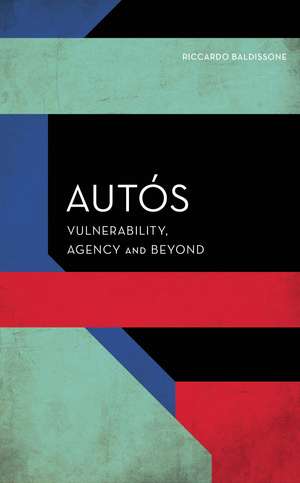
Autós: Individuation in the European Text: Experiments/On the Political
Autor Riccardo Baldissoneen Limba Engleză Hardback – 9 iul 2020






Preț: 698.40 lei
Preț vechi: 1005.67 lei
-31%
Puncte Express: 1048
Carte tipărită la comandă
Livrare economică 28 noiembrie-12 decembrie
Livrare prin curier în România Termenul estimat este afișat lângă disponibilitate.
Transport gratuit pentru acest produs Plată online sau ramburs, în funcție de opțiunile comenzii.
Retur gratuit în 14 zile Comandă securizată și suport în română.
Specificații
ISBN-13: 9781786606754
ISBN-10: 1786606755
Pagini: 224
Dimensiuni: 154 x 232 x 24 mm
Greutate: 0.6 kg
Editura: Bloomsbury Publishing
Colecția Rowman & Littlefield
Seria Experiments/On the Political
Locul publicării:New York, United States
ISBN-10: 1786606755
Pagini: 224
Dimensiuni: 154 x 232 x 24 mm
Greutate: 0.6 kg
Editura: Bloomsbury Publishing
Colecția Rowman & Littlefield
Seria Experiments/On the Political
Locul publicării:New York, United States
Descriere
Are we doomed to construct reality with the language of being and individuality? Autós shows a different perspective by reconsidering the European textual production of individuals. Its narration progresses in reverse chronological order to escape teleology: it goes from the modern atomized and self-sufficient subject to her immediate precursor, namely, the isolated faithful of Reformation theology, and to the amazing proliferation of medieval bodies, after the Late Antique narrow individuation of the Christian persona. Roman law mostly escapes the latter's definitional approach, which first appears in Greek speculation: here, the vocabulary of being and identity takes shape, as exemplified by the new Platonic deployment of the word autós, which has both the sense of 'same' and 'self.' The Homeric epic instead shows us a discursive regime that precedes the invention of body, mind, being, and self. Taking further old and new examples, the book seeks to provincialize the technologies of the self through a new vocabulary of incorporation, whose sphere of action is not the being of entities, but the performing of practices.
Cuprins
Acknowledgements
Introduction: A Reader's (Short) Guide to Autós
Chapter One: Of Wounds and Woundings: Damages to the Relational Body
Chapter Two: The Invention of the Modern Self between ?ayy and Robinson
Chapter Three: The Fundamentalist Reinvention of the Individual in the Age of Reformation and its Discontents
Chapter Four: Painted, Mirrored, and Mystical Bodies: A Medieval Proliferation
Chapter Five: A New Interiority in Christian Romania
Chapter Six: Roman Legal Actors: The Ordered Permutation of Personae
Chapter Seven: Keys to Greek Individuation: Oikeiosis, Ousia, Autos
Chapter Eight: Greek Early Theoretical Bottlenecks and their Homeric Horizon
Chapter Nine: Not Just Autos: The Reinvention of Abundance
Epilogue: Provincializing the Individual: The Perdividuation of Relational Bodiesas a Conclusion
Appendix: A Note on Paradigms (And Relational Bodies)
Bibliography
Index
Introduction: A Reader's (Short) Guide to Autós
Chapter One: Of Wounds and Woundings: Damages to the Relational Body
Chapter Two: The Invention of the Modern Self between ?ayy and Robinson
Chapter Three: The Fundamentalist Reinvention of the Individual in the Age of Reformation and its Discontents
Chapter Four: Painted, Mirrored, and Mystical Bodies: A Medieval Proliferation
Chapter Five: A New Interiority in Christian Romania
Chapter Six: Roman Legal Actors: The Ordered Permutation of Personae
Chapter Seven: Keys to Greek Individuation: Oikeiosis, Ousia, Autos
Chapter Eight: Greek Early Theoretical Bottlenecks and their Homeric Horizon
Chapter Nine: Not Just Autos: The Reinvention of Abundance
Epilogue: Provincializing the Individual: The Perdividuation of Relational Bodiesas a Conclusion
Appendix: A Note on Paradigms (And Relational Bodies)
Bibliography
Index
Recenzii
An ambitious, explosively erudite, vertiginously convincing, extremely important and indeed useful book. A maelstrom of a text, comprised of narration, literary analysis, history and philosophy, that offers an unexpected understanding of materiality as adumbrated within the textual. From Homeric gods to early Christian and Islamic ideas of commonwealth, and from Defoe's Robinson to Medieval female mystics, Baldissone offers a completely novel yet centuries-old path to bodies, objects, gods and humans.
Notă biografică
Riccardo Baldissone is a Fellow at the University of Westminster, School of Law. He has published a number of articles in Diaspora, Law and Literature, Literature and Human Rights and Labour History in the New Century. He has a forthcoming monograph "Farewell to Freedom: The Path of Liberty and Beyond" with University of Westminster Press.