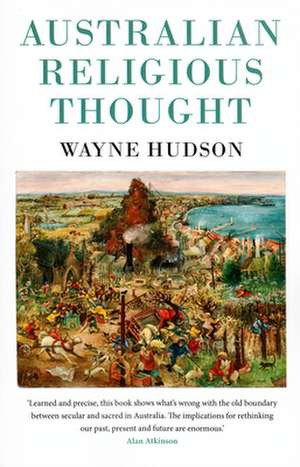
Australian Religious Thought
Autor Wayne Hudsonen Limba Engleză Paperback – mar 2016
Preț: 185.44 lei
Puncte Express: 278
Carte tipărită la comandă
Livrare economică 30 noiembrie-14 decembrie
Livrare prin curier în România Termenul estimat este afișat lângă disponibilitate.
Transport gratuit de la 400.00 lei Plată online sau ramburs, în funcție de opțiunile comenzii.
Retur gratuit în 14 zile Comandă securizată și suport în română.
Specificații
ISBN-13: 9781922235763
ISBN-10: 1922235768
Pagini: 352
Dimensiuni: 153 x 234 x 15 mm
Greutate: 0.66 kg
Editura: Monash University Publishing
Colecția Monash University Publishing
Locul publicării:Melbourne, Australia
ISBN-10: 1922235768
Pagini: 352
Dimensiuni: 153 x 234 x 15 mm
Greutate: 0.66 kg
Editura: Monash University Publishing
Colecția Monash University Publishing
Locul publicării:Melbourne, Australia
V-ar putea interesa
-
 The SearchWilliam WickhamPreț: 44.62 lei
 -
 -14%Preț: 715.95 lei832.50 lei
 -
 Asia, Modernity, and the Pursuit of the SacredJoel S. KahnPreț: 401.71 lei
 -
 -15%Preț: 420.47 lei494.67 lei
 -
 Light Within CobblestonesCecile Grace CharlesPreț: 398.78 lei
 -
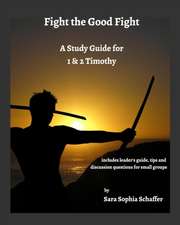 Fight the Good FightSara Sophia SchafferPreț: 100.28 lei
 -
 For His GloryBob AllenPreț: 59.67 lei
 -
 Anna of Asher: 28 Day Prayer JournalNicole ArbucklePreț: 95.43 lei
 -
 The HealerGinny MinkPreț: 98.41 lei
 -
 Straight, Not NarrowTad StrykerPreț: 126.76 lei
 -
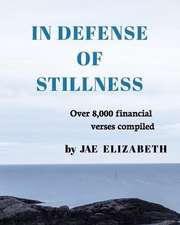 In Defense of StillnessJae ElizabethPreț: 219.06 lei
 -
 Daily Walk in FaithLatisha DawsonPreț: 36.59 lei
 -
 When Was Jesus Born?Andrew FreelandPreț: 60.02 lei
 -
 Surface ChristianMinister John MahoneyPreț: 150.24 lei
 -
 Der heilige BonifatiusJoseph Johann LauxPreț: 262.95 lei
 -
 Der germanische GötterhimmelVoenixPreț: 259.28 lei
Recenzii
Learned and precise, this book shows what’s wrong with the old boundary between secular and sacred in Australia. The implications for rethinking our past, present and future are enormous.
Here, for the first time, the history of Australian religious thought receives the kind of sophisticated treatment that it richly deserves, in the hands of an author of phenomenal learning and intellectual range. It will be much harder in the future for anyone blithely to call Australia a secular society and leave it at that. Wayne Hudson is steeped in the history and philosophy of the world’s religions and with assurance and zest, he tells the story of a previously underestimated religious dimension of Australian cultural and intellectual history.
[Stuart] MacIntyre challenged Hudson ‘to make better sense of how the patterns in Australia compared with those in other settler societies’. As a first step, Hudson has ‘brought together a substantial body of research and interpreted some of it in innovative ways’. For this, we contributors to Australian religious thought are in his debt, whether or not we count ourselves as religious.
Hudson’s book is a welcome and learned contribution on an important topic for the future of Australia.
Here, for the first time, the history of Australian religious thought receives the kind of sophisticated treatment that it richly deserves, in the hands of an author of phenomenal learning and intellectual range. It will be much harder in the future for anyone blithely to call Australia a secular society and leave it at that. Wayne Hudson is steeped in the history and philosophy of the world’s religions and with assurance and zest, he tells the story of a previously underestimated religious dimension of Australian cultural and intellectual history.
[Stuart] MacIntyre challenged Hudson ‘to make better sense of how the patterns in Australia compared with those in other settler societies’. As a first step, Hudson has ‘brought together a substantial body of research and interpreted some of it in innovative ways’. For this, we contributors to Australian religious thought are in his debt, whether or not we count ourselves as religious.
Hudson’s book is a welcome and learned contribution on an important topic for the future of Australia.