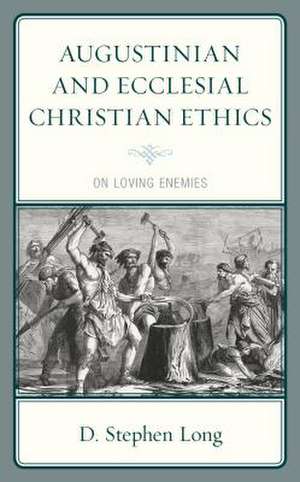
Augustinian and Ecclesial Christian Ethics: On Loving Enemies
Autor D. Stephen Longen Limba Engleză Hardback – 15 aug 2018
Preț: 682.59 lei
Preț vechi: 1060.15 lei
-36%
Puncte Express: 1024
Carte tipărită la comandă
Livrare economică 26 noiembrie-10 decembrie
Livrare prin curier în România Termenul estimat este afișat lângă disponibilitate.
Transport gratuit pentru acest produs Plată online sau ramburs, în funcție de opțiunile comenzii.
Retur gratuit în 14 zile Comandă securizată și suport în română.
Specificații
ISBN-13: 9781978702011
ISBN-10: 1978702019
Pagini: 350
Dimensiuni: 160 x 230 x 26 mm
Greutate: 0.76 kg
Editura: Bloomsbury Publishing
Colecția Fortress Academic
Locul publicării:New York, United States
ISBN-10: 1978702019
Pagini: 350
Dimensiuni: 160 x 230 x 26 mm
Greutate: 0.76 kg
Editura: Bloomsbury Publishing
Colecția Fortress Academic
Locul publicării:New York, United States
Cuprins
Chapter One: Origin and Development of the Augustinian Approach
Chapter Two: Origin and Development of the Ecclesial Approach
Chapter Three: Addressing the Critiques
Chapter Two: Origin and Development of the Ecclesial Approach
Chapter Three: Addressing the Critiques
Recenzii
This book, copious in detail and heavily footnoted, is an indispensable guide to scholars seeking to make their way through the thickets of these two approaches in Christian ethics. . . [it's] a wonderful resource, and should be required reading for those involved in sorting out the complex questions of what Christian participation in the life of the world looks like.
With mentors and peers in either approach to Christian ethics and political theology--the new Augustinians and the ecclesial project--I have felt like a chimera while attempting to sort through their respective strengths and weaknesses, points and counterpoints, subtleties and nuances. With this comprehensive and incisive text, D. Stephen Long judiciously and coherently advances this momentous interchange. I gratefully and enthusiastically recommend!
Managing to sustain a single well-construed argument throughout, D. Stephen Long defends an ecclesially-centered Augustinian politics against rival ways of appropriating Augustine for late modern political orders. The real benefit of this impressive work is the patience and charity (even friendship) that runs through it, embodying the politics it champions and giving us hope for how these conversations can go.
With mentors and peers in either approach to Christian ethics and political theology--the new Augustinians and the ecclesial project--I have felt like a chimera while attempting to sort through their respective strengths and weaknesses, points and counterpoints, subtleties and nuances. With this comprehensive and incisive text, D. Stephen Long judiciously and coherently advances this momentous interchange. I gratefully and enthusiastically recommend!
Managing to sustain a single well-construed argument throughout, D. Stephen Long defends an ecclesially-centered Augustinian politics against rival ways of appropriating Augustine for late modern political orders. The real benefit of this impressive work is the patience and charity (even friendship) that runs through it, embodying the politics it champions and giving us hope for how these conversations can go.