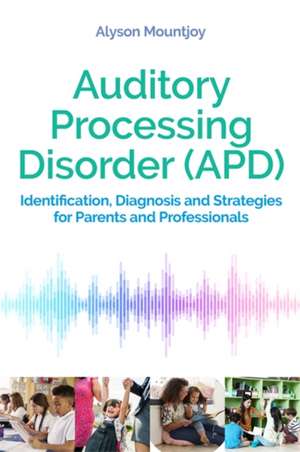
Auditory Processing Disorder (APD): Identification, Diagnosis and Strategies for Parents and Professionals
Autor Alyson Mountjoyen Limba Engleză Paperback – 18 mar 2021
This authoritative guide includes advice on how to identify, diagnose and support the condition in children, teenagers and adults. It provides everyday strategies based on 20 years of research to try at home, at school and at work. This book aims to help families, teachers and other professionals to understand and support those living with this complex invisible disability. Containing supportive case studies, the book addresses a range of prevalent issues, including relationships, self-esteem, confidence and mental health, making this a comprehensive guide for all things APD.
Preț: 164.78 lei
Preț vechi: 202.85 lei
-19%
Puncte Express: 247
Carte disponibilă
Livrare economică 17 noiembrie-01 decembrie
Livrare express 31 octombrie-06 noiembrie pentru 65.45 lei
Livrare prin curier în România Termenul estimat este afișat lângă disponibilitate.
Transport gratuit de la 400.00 lei Plată online sau ramburs, în funcție de opțiunile comenzii.
Retur gratuit în 14 zile Comandă securizată și suport în română.
Specificații
ISBN-13: 9781787752825
ISBN-10: 1787752828
Pagini: 256
Dimensiuni: 152 x 228 x 20 mm
Greutate: 0.37 kg
Editura: JESSICA KINGSLEY PUBLISHERS
Colecția Jessica Kingsley Publishers
Locul publicării:London, United Kingdom
ISBN-10: 1787752828
Pagini: 256
Dimensiuni: 152 x 228 x 20 mm
Greutate: 0.37 kg
Editura: JESSICA KINGSLEY PUBLISHERS
Colecția Jessica Kingsley Publishers
Locul publicării:London, United Kingdom
Recenzii
Shockingly, APD is an almost 'unheard' of condition, however it is very common and often exists with other conditions/disorders. If you are a parent or adult with any concerns about yours or your child's learning or other difficulties and the causes, this book is well worth reading.
I am one of the few professionals who has specialised in the area of psychosocial outcomes of conductive hearing loss and auditory processing problems, I have long become used to the profound absence of literature to inform families of children with APD. So what a delightful surprise it is to read this book. It is a bright star of information in an otherwise dark sky of ignorance. I believe it will become an essential resource to inform, guide and bolster resilience. Resilience that is, unfortunately, too often needed in the face of poorly informed professionals and community. As Alyson points out APD is more common but less identified than autism. As an unknown condition many ill-founded and damaging judgments are often made that do enormous harm. Children and adults are commonly seen as stupid, unmotivated or oppositional. These kinds of persistent judgements can easily be internalised promoting high anxiety, low self-esteem and self-protective but opportunity limiting avoidance. Identification and understanding is the antidote to these kinds of damaging judgements. This book can help prevent the unintentional harm so often done by such judgements. It is a book that will change many lives for the better. I commend it to you.
Auditory Processing Disorder (APD) contains a wealth of information on auditory processing disorders (APD) and provides a comprehensive overview of what it is like to have APD. The author has combined information from the scientific literature with parental and affected individuals' accounts and insights. She gives a clear and detailed account of what the patient and their family should expect from the time they are referred for a diagnostic evaluation to what should happen when they are provided with a management plan. The book includes some very useful advice and strategies for affected individuals and their families in order to manage their symptoms, and some information about other disorders that overlap with APD. The book is recommended reading for both those affected by APD and their families, as well as for interested professionals.
I am one of the few professionals who has specialised in the area of psychosocial outcomes of conductive hearing loss and auditory processing problems, I have long become used to the profound absence of literature to inform families of children with APD. So what a delightful surprise it is to read this book. It is a bright star of information in an otherwise dark sky of ignorance. I believe it will become an essential resource to inform, guide and bolster resilience. Resilience that is, unfortunately, too often needed in the face of poorly informed professionals and community. As Alyson points out APD is more common but less identified than autism. As an unknown condition many ill-founded and damaging judgments are often made that do enormous harm. Children and adults are commonly seen as stupid, unmotivated or oppositional. These kinds of persistent judgements can easily be internalised promoting high anxiety, low self-esteem and self-protective but opportunity limiting avoidance. Identification and understanding is the antidote to these kinds of damaging judgements. This book can help prevent the unintentional harm so often done by such judgements. It is a book that will change many lives for the better. I commend it to you.
Auditory Processing Disorder (APD) contains a wealth of information on auditory processing disorders (APD) and provides a comprehensive overview of what it is like to have APD. The author has combined information from the scientific literature with parental and affected individuals' accounts and insights. She gives a clear and detailed account of what the patient and their family should expect from the time they are referred for a diagnostic evaluation to what should happen when they are provided with a management plan. The book includes some very useful advice and strategies for affected individuals and their families in order to manage their symptoms, and some information about other disorders that overlap with APD. The book is recommended reading for both those affected by APD and their families, as well as for interested professionals.
Cuprins
Introduction; The "A Plan" Explained; The "A" Plan Topics; 1. Awareness: Identification; 2. Answers: Seeking Diagnosis; 3. Acceptance: The Process; 4. Additions: Co-Existing Conditions; 5. Action: Coping Strategies And Home Support; 6. Advocacy: Finding A Voice; 7. Adjustments: Education Support; 8. Alternatives: Flexible Education; 9. Adolescence: Teenage Years And Life Skills; 10. Adulthood: Problems And Possibilities; 11. Anxiety: Stress And Mental Health; Case Studies; Conclusion