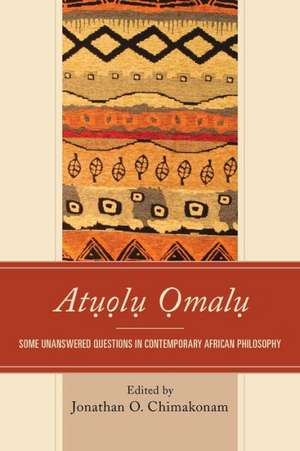
Atuolu Omalu: Some Unanswered Questions in Contemporary African Philosophy
Editat de Jonathan O. Chimakonamen Limba Engleză Paperback – 15 dec 2014
Preț: 331.56 lei
Preț vechi: 427.51 lei
-22%
Puncte Express: 497
Carte tipărită la comandă
Livrare economică 09-23 decembrie
Livrare prin curier în România Termenul estimat este afișat lângă disponibilitate.
Transport gratuit de la 400.00 lei Plată online sau ramburs, în funcție de opțiunile comenzii.
Retur gratuit în 14 zile Comandă securizată și suport în română.
Specificații
ISBN-13: 9780761864547
ISBN-10: 0761864547
Pagini: 334
Ilustrații: 5 b/w illustrations
Dimensiuni: 152 x 231 x 24 mm
Greutate: 0.45 kg
Editura: Bloomsbury Publishing
Colecția University Press of America
Locul publicării:New York, United States
ISBN-10: 0761864547
Pagini: 334
Ilustrații: 5 b/w illustrations
Dimensiuni: 152 x 231 x 24 mm
Greutate: 0.45 kg
Editura: Bloomsbury Publishing
Colecția University Press of America
Locul publicării:New York, United States
Cuprins
Foreword
Preface
Acknowledgments
Introduction
Chapter 1: Dating and Periodization Questions in African Philosophy
Jonathan O. Chimakonam
Chapter 2: The Question of Being in African Philosophy: A Case for Ibuanyidanda Ontology
Innocent I. Asouzu
Chapter 3: The Question of Moral Paradigm in African Philosophy: A Case for Communocentric Ethics
Mulumba I. Obiajulu
Chapter 4: The Knowledge Question in African Philosophy: A Case for Cogno-Normative (Complementary) Epistemology
Jonathan O. Chimakonam
Chapter 5: The Logic Question in African Philosophy: Between the Horns of Irredentism and Jingoism
Uduma O. Uduma
Chapter 6: The Criteria Question in African Philosophy
Jonathan O. Chimakonam
Chapter 7: The Ideology Question in African Philosophy: A Case for Tradition and the Quest for Democracy in Africa
Olusegun Oladipo
Chapter 8: African Philosophy: Some Basic Questions
Bruce B. Janz
Chapter 9: The Question of Cultural Imperialism in African Philosophy
Edwin Etieyibo
Chapter 10: The Transliteration Question in African Philosophy
Godfrey O. Ozumba
Chapter 11: The Question of Culture of Philosophy in Africa
Adebayo A. Aina and Olatunji A. Oyeshile
Chapter 12: The Question of Conceptual Decolonization in African Philosophy and the Problem of the Language of African Philosophy: A Critique of Kwasi Wiredu and a Proposal for Conceptual Mandelanization in the Africa We Know
Mesembe I. Edet
Chapter 13: The Question of the West and the Rest of Us in African Philosophy
Joseph N. Agbo
Chapter 14: The Future Question in African Philosophy
Ada Agada
Selected Bibliography
List of Contributors
Preface
Acknowledgments
Introduction
Chapter 1: Dating and Periodization Questions in African Philosophy
Jonathan O. Chimakonam
Chapter 2: The Question of Being in African Philosophy: A Case for Ibuanyidanda Ontology
Innocent I. Asouzu
Chapter 3: The Question of Moral Paradigm in African Philosophy: A Case for Communocentric Ethics
Mulumba I. Obiajulu
Chapter 4: The Knowledge Question in African Philosophy: A Case for Cogno-Normative (Complementary) Epistemology
Jonathan O. Chimakonam
Chapter 5: The Logic Question in African Philosophy: Between the Horns of Irredentism and Jingoism
Uduma O. Uduma
Chapter 6: The Criteria Question in African Philosophy
Jonathan O. Chimakonam
Chapter 7: The Ideology Question in African Philosophy: A Case for Tradition and the Quest for Democracy in Africa
Olusegun Oladipo
Chapter 8: African Philosophy: Some Basic Questions
Bruce B. Janz
Chapter 9: The Question of Cultural Imperialism in African Philosophy
Edwin Etieyibo
Chapter 10: The Transliteration Question in African Philosophy
Godfrey O. Ozumba
Chapter 11: The Question of Culture of Philosophy in Africa
Adebayo A. Aina and Olatunji A. Oyeshile
Chapter 12: The Question of Conceptual Decolonization in African Philosophy and the Problem of the Language of African Philosophy: A Critique of Kwasi Wiredu and a Proposal for Conceptual Mandelanization in the Africa We Know
Mesembe I. Edet
Chapter 13: The Question of the West and the Rest of Us in African Philosophy
Joseph N. Agbo
Chapter 14: The Future Question in African Philosophy
Ada Agada
Selected Bibliography
List of Contributors
Recenzii
The publication of philosophy from African scholars is always welcome, and this volume, edited by Chimakonam, is no exception. The title of this collection, which is derived from part of an Igbo proverb, might be loosely translated as 'explicating to the wise.' This volume features 14 essays-all but 3 published here for the first time-by 13 scholars representing the approach of the emerging Calabar School of Philosophy (http://africanphilcongress.com/), which focuses on a 'dialogical engagement' between tradition and modernity, universalism and particularism, and Western and African culture. The essays cover a wide range of topics, from logic to hermeneutics and ethics to transliteration. Many of the traditional themes of African philosophy appear, but usually with a new twist emphasizing the role of contemporary sociopolitical realities and seeking a functional synthesis of the 'useful'-both characteristic of the Calabar approach . . . The collection is nevertheless a very good introduction to a new generation of African philosophers.
By incorporating many sub-fields within philosophy overall the authors and editor are successful in compiling a complete book on contemporary written African philosophy. . . .[T]he volume's contributors lay out the previous debates fully in their chapters, and each has a nuanced take on how to organize the previous debates. This book implies the emergence of more books on these topics, and hopefully to be included in the future of the field is the incorporation of more sub-genres. The authors leave you excited by their methodology, and wanting for continued studies along this path.
This collection represents a radically new approach to African philosophy. Fresh ideas collide with fresh scholars to offer a much anticipated new direction.
This edited volume is a significant contribution to current questions on the 'how' and 'why' of African philosophy. Deeply influenced by the Calabar School of Philosophy (Nigeria), the contributors engage a series of critical questions about epistemology, ontology, and hermeneutics, as well as universalism/particularism, as they survey the current state of the field. Broadly comparative and marked by innovative thinking, these essays by mostly younger scholars demonstrate the vitality of the formal study of the 'love of wisdom' in Africa, and provide a useful historiography of contemporary African philosophy. This book will also be of special interest to anyone concerned with understanding African thought and culture in the era of globalization.
By incorporating many sub-fields within philosophy overall the authors and editor are successful in compiling a complete book on contemporary written African philosophy. . . .[T]he volume's contributors lay out the previous debates fully in their chapters, and each has a nuanced take on how to organize the previous debates. This book implies the emergence of more books on these topics, and hopefully to be included in the future of the field is the incorporation of more sub-genres. The authors leave you excited by their methodology, and wanting for continued studies along this path.
This collection represents a radically new approach to African philosophy. Fresh ideas collide with fresh scholars to offer a much anticipated new direction.
This edited volume is a significant contribution to current questions on the 'how' and 'why' of African philosophy. Deeply influenced by the Calabar School of Philosophy (Nigeria), the contributors engage a series of critical questions about epistemology, ontology, and hermeneutics, as well as universalism/particularism, as they survey the current state of the field. Broadly comparative and marked by innovative thinking, these essays by mostly younger scholars demonstrate the vitality of the formal study of the 'love of wisdom' in Africa, and provide a useful historiography of contemporary African philosophy. This book will also be of special interest to anyone concerned with understanding African thought and culture in the era of globalization.