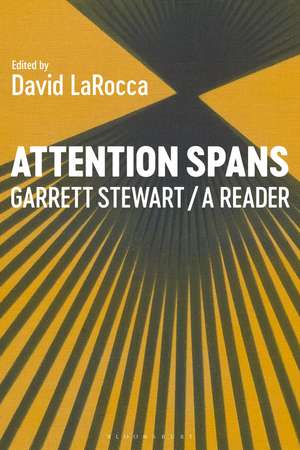
Attention Spans: Garrett Stewart, a Reader
Autor Professor or Dr. Garrett Stewart Editat de Dr. David LaRoccaen Limba Engleză Hardback – 22 feb 2024
| Toate formatele și edițiile | Preț | Express |
|---|---|---|
| Paperback (1) | 155.94 lei 3-5 săpt. | +0.00 lei 6-12 zile |
| Bloomsbury Publishing – 22 feb 2024 | 155.94 lei 3-5 săpt. | +0.00 lei 6-12 zile |
| Hardback (1) | 558.66 lei 6-8 săpt. | |
| Bloomsbury Publishing – 22 feb 2024 | 558.66 lei 6-8 săpt. |
Preț: 558.66 lei
Preț vechi: 800.84 lei
-30%
Puncte Express: 838
Preț estimativ în valută:
98.87€ • 115.55$ • 85.84£
98.87€ • 115.55$ • 85.84£
Carte tipărită la comandă
Livrare economică 19 februarie-05 martie
Preluare comenzi: 021 569.72.76
Specificații
ISBN-13: 9798765102237
Pagini: 376
Dimensiuni: 152 x 229 x 25 mm
Greutate: 0.67 kg
Editura: Bloomsbury Publishing
Colecția Bloomsbury Academic
Locul publicării:New York, United States
Pagini: 376
Dimensiuni: 152 x 229 x 25 mm
Greutate: 0.67 kg
Editura: Bloomsbury Publishing
Colecția Bloomsbury Academic
Locul publicării:New York, United States
Cuprins
An Introduction in Retrospect / David LaRocca
Inventory as Itinerary / Garrett Stewart
TexTcerpts / Garrett Stewart
I. Dickens as Prompt Text
1 / Trials - and Test Sites
Dickens and the Trials of Imagination (1974)
2 / Death Sentencing and Narrative Parole
Death Sentences: Styling of Dying in British Fiction (1984)
II. Reading In, Reading Out
3 / Literary Graphonics
Reading Voices: Literature and the Phonotext (1990)
4 / Re: Reading Under Address
Dear Reader: The Conscripted Audience in Nineteenth-Century British Fiction (1996)
III. Discipline Bridging
5 / From Imprint to Motion Picture
Between Film and Screen: Modernism's Photo Synthesis (1999)
6 / Pages Painted, Writing Withdrawn
The Look of Reading: Book, Painting, Text (2006)
7 / From Celluloid to Digitime
Framed Time: Toward a Postfilmic Cinema (2007)
IV. Convergences: Mediation Revisited
8 / Mapping the Narrative Substrate
Novel Violence: A Narratography of Victorian Fiction (2009)
9 / Reading Foreclosed/Text Reinvented
Bookwork: Medium to Object to Concept to Art (2011)
10 / The Narrative Optics of Surveillancinema
Closed Circuits: Screening Narrative Surveillance (2015)
V. Medium, Philosophy, Concept
11 / Textual Act as Contract
The Deed of Reading: Literature * Writing * Language * Philosophy (2015)
12 / Material Transference and Medial Merger
Transmedium: Conceptualism 2.0 and the New Object Art (2017)
VI. Reading Style/Styles of Reading
13 / Verbal Expenditures, Narrative Dividents
The Value of Style in Fiction (2018)
14 / The Dickens Page, In and Out Loud
The One, Other, and Only Dickens (2018)
15 / Bookhood in Evolution
Book, Text, Medium: Cross-Sectional Reading for a Digital Age (2020)
VII. Kinetic Textuality
16 / Cinemachination and the Legible Apparatus
Cinemachines: An Essay on Media and Method (2020)
17 / Museum Screens
Cinesthesia: Museum Cinema and the Curated Screen (2021)
18 / Toward a Cinematographic Sentence
The Ways of the Word: Episodes in Verbal Attention (2022)
VIII. Audiovisual Mirrors: Screening Text and Voice
19 / Reflex Reading
The Metanarrative Hall of Mirrors: Reflex Action in Fiction and Film (2022)
20 / The Legible Voice
Streisand: The Mirror of Difference (2023)
IX. Audioptics
X. Coverage
A Dialogue on Critical Conversation
Terms of Use: Coinagse Cashed Out - A Selective Glossary
Timelines: A Topographical Bibliography
Acknowledgments
Contributors
Inventory as Itinerary / Garrett Stewart
TexTcerpts / Garrett Stewart
I. Dickens as Prompt Text
1 / Trials - and Test Sites
Dickens and the Trials of Imagination (1974)
2 / Death Sentencing and Narrative Parole
Death Sentences: Styling of Dying in British Fiction (1984)
II. Reading In, Reading Out
3 / Literary Graphonics
Reading Voices: Literature and the Phonotext (1990)
4 / Re: Reading Under Address
Dear Reader: The Conscripted Audience in Nineteenth-Century British Fiction (1996)
III. Discipline Bridging
5 / From Imprint to Motion Picture
Between Film and Screen: Modernism's Photo Synthesis (1999)
6 / Pages Painted, Writing Withdrawn
The Look of Reading: Book, Painting, Text (2006)
7 / From Celluloid to Digitime
Framed Time: Toward a Postfilmic Cinema (2007)
IV. Convergences: Mediation Revisited
8 / Mapping the Narrative Substrate
Novel Violence: A Narratography of Victorian Fiction (2009)
9 / Reading Foreclosed/Text Reinvented
Bookwork: Medium to Object to Concept to Art (2011)
10 / The Narrative Optics of Surveillancinema
Closed Circuits: Screening Narrative Surveillance (2015)
V. Medium, Philosophy, Concept
11 / Textual Act as Contract
The Deed of Reading: Literature * Writing * Language * Philosophy (2015)
12 / Material Transference and Medial Merger
Transmedium: Conceptualism 2.0 and the New Object Art (2017)
VI. Reading Style/Styles of Reading
13 / Verbal Expenditures, Narrative Dividents
The Value of Style in Fiction (2018)
14 / The Dickens Page, In and Out Loud
The One, Other, and Only Dickens (2018)
15 / Bookhood in Evolution
Book, Text, Medium: Cross-Sectional Reading for a Digital Age (2020)
VII. Kinetic Textuality
16 / Cinemachination and the Legible Apparatus
Cinemachines: An Essay on Media and Method (2020)
17 / Museum Screens
Cinesthesia: Museum Cinema and the Curated Screen (2021)
18 / Toward a Cinematographic Sentence
The Ways of the Word: Episodes in Verbal Attention (2022)
VIII. Audiovisual Mirrors: Screening Text and Voice
19 / Reflex Reading
The Metanarrative Hall of Mirrors: Reflex Action in Fiction and Film (2022)
20 / The Legible Voice
Streisand: The Mirror of Difference (2023)
IX. Audioptics
X. Coverage
A Dialogue on Critical Conversation
Terms of Use: Coinagse Cashed Out - A Selective Glossary
Timelines: A Topographical Bibliography
Acknowledgments
Contributors
Recenzii
A critic of Garrett Stewart's brilliance and scope deserves a 'Reader,' but this fascinating book is far more than a collection of an author's most salient articles. A 'writing journal' of a teaching career that incorporates brief extracts of important books in the inspiring narrative of an immensely wide-ranging critical practice, Attention Spans engages the major developments of recent criticism. A tour de force.
Garrett Stewart is a multi-media close reader extraordinaire whose answerable style rewards close reading in turn. This selection of excerpts from each of his twenty books is interspersed with his own running commentary, stitching it all together and making his whole career's research and thinking-through seem as though it were all taking place in present time, while remaining full of scrupulous attention to the ways in which his work has evolved. After a dialogue with the editor, full of yet newer directions, this astonishing volume concludes with a glossary of Stewart's coinages.
As David LaRocca tells us early in this volume, J Hillis Miller described Garrett Stewart, on the jacket of his second book, as 'more or less sui generis.' This turned out to be a prophetic description of the most wide-ranging and least doctrinaire critic of his generation. It also aptly describes Attention Spans, a book like no other, and one that does not belong to any recognisable genre. In staging a critical rereading of his own work, Stewart offers us an exhilarating history of aesthetic theory since New Criticism, which is also a virtuosic display of fine readerly attention. Continually unsettled, continually restless, it is written in what Stewart himself calls a 'language not quite gelled into the print that transmits it.' To read it is to feel, again and again, the lifted joy of shared thinking.
Garrett Stewart is a multi-media close reader extraordinaire whose answerable style rewards close reading in turn. This selection of excerpts from each of his twenty books is interspersed with his own running commentary, stitching it all together and making his whole career's research and thinking-through seem as though it were all taking place in present time, while remaining full of scrupulous attention to the ways in which his work has evolved. After a dialogue with the editor, full of yet newer directions, this astonishing volume concludes with a glossary of Stewart's coinages.
As David LaRocca tells us early in this volume, J Hillis Miller described Garrett Stewart, on the jacket of his second book, as 'more or less sui generis.' This turned out to be a prophetic description of the most wide-ranging and least doctrinaire critic of his generation. It also aptly describes Attention Spans, a book like no other, and one that does not belong to any recognisable genre. In staging a critical rereading of his own work, Stewart offers us an exhilarating history of aesthetic theory since New Criticism, which is also a virtuosic display of fine readerly attention. Continually unsettled, continually restless, it is written in what Stewart himself calls a 'language not quite gelled into the print that transmits it.' To read it is to feel, again and again, the lifted joy of shared thinking.