Atong Texts
Autor Seino van Breugelen Limba Engleză Hardback – 20 iun 2019
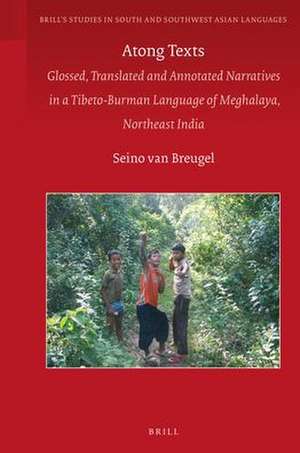
Each text is preceded by a systematic literary analysis. The photos in the appendix provide a visual impression of the environment in which the stories are told. This book is of great value to Tibeto-Burmanists, general linguists, discourse analysts and everyone interested in the languages, history and folklore of Northeast-India in general, and Meghalaya in particular.
Preț: 1673.89 lei
Preț vechi: 2173.88 lei
-23%
Puncte Express: 2511
Carte tipărită la comandă
Livrare economică 27 noiembrie-11 decembrie
Livrare prin curier în România Termenul estimat este afișat lângă disponibilitate.
Transport gratuit pentru acest produs Plată online sau ramburs, în funcție de opțiunile comenzii.
Retur gratuit în 14 zile Comandă securizată și suport în română.
Specificații
ISBN-13: 9789004371910
ISBN-10: 9004371915
Pagini: 582
Dimensiuni: 160 x 236 x 36 mm
Greutate: 0.89 kg
Ediția:Adnotată
Editura: Brill
ISBN-10: 9004371915
Pagini: 582
Dimensiuni: 160 x 236 x 36 mm
Greutate: 0.89 kg
Ediția:Adnotată
Editura: Brill
Cuprins
AcknowledgementsList of Tables, Maps and PhotosAbbreviations and Symbols
1 Introduction
2 Methodology of Text Collection
3 Atong Orthography in Relation to Its Phonology and Pronunciation3.1Some Important Remarks about the Use of Some Letters in the Orthography3.2Allohpony3.3The Pronunciation of Double Vowels and Double Consonants3.4Glottalisation3.5The Phonological Word and Its Stress
4 The Presentation of the Texts
5 Glossing
1 Dabatwari
2 Badri Rongdyng Ha•waimi Ortho
3 Ajot
4 Alsia Raja
5 Pheru aro Magachak
6 Joramigymyn
7 Singho aro Pheru
8 Garo Ha•byri
9 Boba aro Gore
10 Jada
11 Amak aro rukpek
12 Ha•ba
13 Ram nemcha
14 Khem
15 Wai khuruta
16 Phylgym aro Sa•gyrai
17 Nai•nokholthanggaba aro Kynokholthanggaba
18 Do•renggo Wa•dachong
19 Sijyw Durakhal
20 Mongma aro Taw•reksyrup
21 Naweng aro Kumiri
22 Haratgaba Bil
23 Ketketa Bura
24 Pheru aro Gorial
25 Paranggaba Sa•banthai
26 Ja•bek Rymna
27 Amak aro Pheru
28 Thengthonmynggymyn
29 Amakmu Saphaw
30 Kyrynggaba Matsa
31 Amak aro Khu•sum
32 Amak aro Chengchengmachok
33 Magachak aro Rukwak
34 Abu Chakkhen
35 Te•ew Re•enggaba Gawi
36 Nokchi Ang Dyngdang Mu•chiba
37 Bandimynggymyn
Appendix of PhotosReferencesIndex
1 Introduction
2 Methodology of Text Collection
3 Atong Orthography in Relation to Its Phonology and Pronunciation3.1Some Important Remarks about the Use of Some Letters in the Orthography3.2Allohpony3.3The Pronunciation of Double Vowels and Double Consonants3.4Glottalisation3.5The Phonological Word and Its Stress
4 The Presentation of the Texts
5 Glossing
Texts
1 Dabatwari
2 Badri Rongdyng Ha•waimi Ortho
3 Ajot
4 Alsia Raja
5 Pheru aro Magachak
6 Joramigymyn
7 Singho aro Pheru
8 Garo Ha•byri
9 Boba aro Gore
10 Jada
11 Amak aro rukpek
12 Ha•ba
13 Ram nemcha
14 Khem
15 Wai khuruta
16 Phylgym aro Sa•gyrai
17 Nai•nokholthanggaba aro Kynokholthanggaba
18 Do•renggo Wa•dachong
19 Sijyw Durakhal
20 Mongma aro Taw•reksyrup
21 Naweng aro Kumiri
22 Haratgaba Bil
23 Ketketa Bura
24 Pheru aro Gorial
25 Paranggaba Sa•banthai
26 Ja•bek Rymna
27 Amak aro Pheru
28 Thengthonmynggymyn
29 Amakmu Saphaw
30 Kyrynggaba Matsa
31 Amak aro Khu•sum
32 Amak aro Chengchengmachok
33 Magachak aro Rukwak
34 Abu Chakkhen
35 Te•ew Re•enggaba Gawi
36 Nokchi Ang Dyngdang Mu•chiba
37 Bandimynggymyn
Appendix of PhotosReferencesIndex
Notă biografică
Seino van Breugel, Ph.D. (2009), La Trobe University, Melbourne, Australia, has written a grammar of Atong based on immersion fieldwork, and developed the orthography for the language. He also conducts research on Atong’s Austroasiatic neighbour Lyngam (a.k.a Megam).