
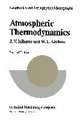
Atmospheric Thermodynamics: Geophysics and Astrophysics Monographs, cartea 6
Editat de Julio V. Iribarne, W. L. Godsonen Limba Engleză Hardback – 31 iul 1981
Din seria Geophysics and Astrophysics Monographs
- 24%
 Preț: 905.19 lei
 - 15%
 Preț: 665.45 lei
 - 24%
 Preț: 1176.08 lei
 -
 Preț: 370.65 lei
 - 18%
 Preț: 979.63 lei
 - 15%
 Preț: 617.57 lei
 - 15%
 Preț: 660.42 lei
 - 18%
 Preț: 982.89 lei
 -
 Preț: 388.57 lei
 - 15%
 Preț: 660.75 lei
 -
 Preț: 386.89 lei
 - 15%
 Preț: 660.97 lei
 - 18%
 Preț: 1259.23 lei
 - 18%
 Preț: 1168.22 lei
 - 18%
 Preț: 1834.10 lei
 - 18%
 Preț: 2164.28 lei
 - 18%
 Preț: 2010.45 lei
 - 18%
 Preț: 977.52 lei
 - 18%
 Preț: 905.74 lei
 - 18%
 Preț: 906.80 lei
 - 18%
 Preț: 1265.72 lei
 - 18%
 Preț: 1173.85 lei
 - 15%
 Preț: 644.30 lei
 -
 Preț: 372.43 lei
 - 15%
 Preț: 670.21 lei
 - 18%
 Preț: 2096.93 lei
 - 18%
 Preț: 1271.53 lei
 -
 Preț: 378.84 lei
 - 18%
 Preț: 906.64 lei
 - 18%
 Preț: 907.10 lei
 -
 Preț: 374.76 lei
 -
 Preț: 383.68 lei
 - 18%
 Preț: 981.32 lei
 - 18%
 Preț: 909.08 lei
Preț: 978.99 lei
Preț vechi: 1193.88 lei
-18%
Puncte Express: 1468
Carte tipărită la comandă
Livrare economică 07-21 decembrie
Livrare prin curier în România Termenul estimat este afișat lângă disponibilitate.
Transport gratuit pentru acest produs Plată online sau ramburs, în funcție de opțiunile comenzii.
Retur gratuit în 14 zile Comandă securizată și suport în română.
Specificații
ISBN-13: 9789027712967
ISBN-10: 9027712964
Pagini: 280
Ilustrații: XV, 260 p.
Dimensiuni: 160 x 241 x 20 mm
Greutate: 0.54 kg
Ediția:Second Edition 1981
Editura: Springer
Colecția Geophysics and Astrophysics Monographs
Seria Geophysics and Astrophysics Monographs
Locul publicării:Dordrecht, Netherlands
ISBN-10: 9027712964
Pagini: 280
Ilustrații: XV, 260 p.
Dimensiuni: 160 x 241 x 20 mm
Greutate: 0.54 kg
Ediția:Second Edition 1981
Editura: Springer
Colecția Geophysics and Astrophysics Monographs
Seria Geophysics and Astrophysics Monographs
Locul publicării:Dordrecht, Netherlands
Public țintă
ResearchCuprins
I. Review of Basic Concepts and Systems of Units.- 1.1 Systems.- 1.2 Properties.- 1.3 Composition and State of a System.- 1.4 Equilibrium.- 1.5 Temperature. Temperature Scales.- 1.6 Systems of Units.- 1.7 Work of Expansion.- 1.8 Modifications and Processes. Reversibility.- 1.9 State Variables and State Functions. Equation of State.- 1.10 Equation of State for Gases.- 1.11 Mixture of Ideal Gases.- 1.12 Atmospheric Air Composition.- Problems.- II. The First Principle of Thermodynamics.- 2.1. Internal Energy.- 2.2 Heat.- 2.3 The First Principle. Enthalpy.- 2.4 Expressions of Q. Heat Capacities.- 2.5 Calculation of Internal Energy and Enthalpy.- 2.6 Latent Heats of Pure Substances. Kirchhoff’s Equation.- 2.7 Adiabatic Processes in Ideal Gases. Potential Temperature.- 2.8 Polytropic Processes.- Problems.- III. The Second Principle of Thermodynamics.- 3.1 The Entropy.- 3.2 Thermodynamic Scale of Absolute Temperature.- 3.3 Formulations of the Second Principle.- 3.4 Lord Kelvin’s and Clausius’ Statements of the Second Principle.- 3.5 Joint Mathematical Expressions of the First and Second Principles. Thermodynamic Potentials.- 3.6 Equilibrium Conditions and the Sense of Natural Processes.- 3.7 Calculation of Entropy.- 3.8 Thermodynamic Equations of State. Calculation of Internal Energy and Enthalpy.- 3.9 Thermodynamic Functions of Ideal Gases.- 3.10 Entropy of Mixing for Ideal Gases.- 3.11 Difference Between Heat Capacities at Constant Pressure and at Constant Volume.- Problems.- IV. Water-Air Systems.- 4.1 Heterogeneous Systems.- 4.2 Fundamental Equations for Open Systems.- 4.3 Equations for the Heterogeneous System. Internal Equilibrium.- 4.4 Summary of Basic Formulas for Heterogeneous Systems.- 4.5 Number of Independent Variables.- 4.6 Phase-Transition Equilibria forWater.- 4.7 Thermodynamic Surface for Water Substance.- 4.8 Clausius-Clapeyron Equation.- 4.9 Variation of Latent Heat Along the Equilibrium Curve.- 4.10 Water Vapor and Moist Air.- 4.11 Humidity Variables.- 4.12 Heat Capacities of Moist Air.- 4.13 Moist Air Adiabats.- 4.14 Enthalpy, Internal Energy and Entropy of Moist Air and of a Cloud.- Problems.- V. Equilibrium with Small Droplets and Crystals.- 5.1 Vapor Pressure of Small Droplets of a Pure Substance.- 5.2 Vapor Pressure of Solution Droplets.- 5.3 Sublimation and Freezing of Small Crystals.- Problems.- VI. Aerological Diagrams.- 6.1 Purpose of Aerological Diagrams and Selection of Coordinates.- 6.2 Clapeyron Diagram.- 6.3 Tephigram.- 6.4 Curves for Saturated Adiabatic Expansion. Relative Orientation of Fundamental Lines.- 6.5 Emagram or Neuhoff Diagram.- 6.6 Refsdal Diagram.- 6.7 Pseudoadiabatic or Stüve Diagram.- 6.8 Area Equivalence.- 6.9 Summary of Diagrams.- 6.10 Determination of Mixing Ratio from the Relative Humidity.- 6.11 Area Computation and Energy Integrals.- Problems.- VII. Thermodynamic Processes in the Atmosphere.- 7.1 Isobaric Cooling. Dew and Frost Points.- 7.2 Condensation in the Atmosphere by Isobaric Cooling.- 7.3 Adiabatic Isobaric (Isenthalpic) Processes. Equivalent and Wet-Bulb Temperatures.- 7.4 Adiabatic Isobaric Mixing (Horizontal Mixing) Without Condensation.- 7.5 Adiabatic Isobaric Mixing with Condensation.- 7.6 Adiabatic Expansion in the Atmosphere.- 7.7 Saturation of Air by Adiabatic Ascent.- 7.8 Reversible Saturated Adiabatic Process.- 7.9 Pseudoadiabatic Process.- 7.10 Effect of Freezing in a Cloud.- 7.11 Polytropic Expansion.- 7.12 Vertical Mixing.- 7.13 Pseudo- or Adiabatic Equivalent and Wet-Bulb Temperatures.- 7.14 Summary of Temperature and Humidity Parameters. ConservativeProperties.- Problems.- VIII. Atmospheric Statics.- 8.1 The Geopotential Field.- 8.2 The Hydrostatic Equation.- 8.3 Equipotential and Isobaric Surfaces. Dynamic and Geopotential Height.- 8.4 Thermal Gradients.- 8.5 Constant-Lapse-Rate Atmospheres.- 8.6 Atmosphere of Homogeneous Density.- 8.7 Dry-Adiabatic Atmosphere.- 8.8 Isothermal Atmosphere.- 8.9 Standard Atmosphere.- 8.10 Altimeter.- 8.11 Integration of the Hydrostatic Equation.- Problems.- IX. Vertical Stability.- 9.1 The Parcel Method.- 9.2 Stability Criteria.- 9.3 Lapse Rates for Atmospheric Ascents.- 9.4 The Lapse Rates of the Parcel and of the Environment.- 9.5 Stability Criteria for Adiabatic Processes.- 9.6 Conditional Instability.- 9.7 Oscillations in a Stable Layer.- 9.8 The Layer Method for Analyzing Stability.- 9.9 Entrainment.- 9.10 Potential or Convective Instability.- 9.11 Processes Producing Stability Changes for Dry Air.- 9.12 Stability Parameters of Saturated and Unsaturated Air, and Their Time Changes.- 9.13 Radiative Processes and Their Thermodynamic Consequences.- 9.14 Maximum Rate of Precipitation.- 9.15 Internal and Potential Energy in the Atmosphere.- 9.16 Internal and Potential Energy of a Layer with Constant Lapse Rate.- 9.17 Margules’ Calculations on Overturning of Air Masses.- 9.18 Transformations of a Layer with Constant Lapse Rate.- 9.19 The Available Potential Energy.- Problems.- Appendix I: Table of Physical constants.- Answers to Problems.