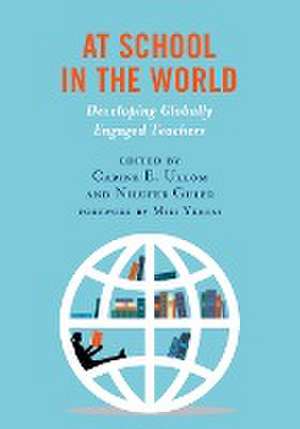
At School in the World: Developing Globally Engaged Teachers: Global Teacher Education
Editat de Carine E. Ullom, Nilufer Guler Cuvânt înainte de Miri Yeminien Limba Engleză Paperback – 2 feb 2023
This volume includes the voices of forty-seven emerging and distinguished intercultural education scholars from ten countries, providing a breadth and depth of experiences and practices never before collected in one book. This is an ideal resource for division leaders of EPP at colleges and universities, education policy developers, teacher preparation faculty, preservice teachers (undergraduate and graduate), and practicing teachers.
Through insights from the field and practical examples, along with its broad scope, this comprehensive work aims to help these education practitioners
develop their awareness of the importance of internationalization of teacher education;develop their intercultural competence; andlearn strategies for incorporating global approaches in their courses and programs.
Preț: 279.75 lei
Preț vechi: 334.29 lei
-16%
Puncte Express: 420
Carte tipărită la comandă
Livrare economică 02-16 decembrie
Livrare prin curier în România Termenul estimat este afișat lângă disponibilitate.
Transport gratuit de la 400.00 lei Plată online sau ramburs, în funcție de opțiunile comenzii.
Retur gratuit în 14 zile Comandă securizată și suport în română.
Specificații
ISBN-13: 9781538153833
ISBN-10: 1538153831
Pagini: 440
Ilustrații: 17 b/w illustrations; 27 tables; 15 textboxes
Dimensiuni: 179 x 249 x 23 mm
Greutate: 0.76 kg
Editura: Bloomsbury Publishing
Colecția Rowman & Littlefield
Seria Global Teacher Education
Locul publicării:New York, United States
ISBN-10: 1538153831
Pagini: 440
Ilustrații: 17 b/w illustrations; 27 tables; 15 textboxes
Dimensiuni: 179 x 249 x 23 mm
Greutate: 0.76 kg
Editura: Bloomsbury Publishing
Colecția Rowman & Littlefield
Seria Global Teacher Education
Locul publicării:New York, United States
Cuprins
Foreword (Miri Yemini)
Preface
Acknowledgments
SECTION I. GLOBAL COMPETENCE
1 Intercultural Competence as the Core to Developing Globally Engaged Teachers (Nanda Dimitrov and Darla K. Deardorff)
What Competencies Do Globally Engaged Teachers Need?
Developing the Core: Intercultural Competence
Figure 1.1: Process Model of Intercultural Competence
Attitudes
Knowledge
Skills
Internal Outcomes
External Outcomes
Implications for Teaching Development
Developing Further: Intercultural Teaching Competence
Textbox 1.1: Intercultural Teaching Competence Framework
Current Trends and Gaps in Instructor Development
Gaps
Textbox 1.2: Example from the Field: Language Teachers' Intercultural Competence Development (Hungary)
Mentoring for ITC: Current Approaches and Future Possibilities
Organization-/Curriculum-Level Preparation
Individual Instructor Development: Beyond Awareness
Textbox 1.3: Example from the Field: Intercultural Engagement at the IÉSEG School of Management (France)
Developing Perspective-Taking and Awareness of Positionality
Textbox 1.4: Walk with Your Students Activity
Experiential and Community-Engaged Approaches
Facilitation Skill Practice with Feedback
Developing Curriculum Design Competencies
Textbox 1.5: Example from the Field: Teaching Assistant Development at the Hong Kong University of Science and Technology
Textbox 1.6: UNESCO Story Circles Vignette
Guided Reflection
Textbox 1.7: Self-Reflection Questions for Teachers
Summary
References
2 Global Competence Education Strategies: A View from around the World and Considerations for Implementation (Elisa Briga, Sarah-Louise Jones, Corinna Howland, and Melissa Liles)
International Intergovernmental Conceptions of GComEd
Table 2.1: Relevant Abbreviations and Their Associated Terms
OECD
UNESCO
CoE
EU
Discussion of Conceptions of Global Competence
From Intergovernmental Strategies to Practical Implementation
Selected National Conceptions of GComEd
Table 2.2: Examples of Additional Intergovernmental Organizations Tactics
Belgium (Flanders)
Brazil
Canada
Egypt
Finland
Greece
Italy
New Zealand
Singapore
South Korea
UK
United States
Comparing National Strategies
Approaches
Key Actors
Teacher Preparation
Considerations for Successfully Embedding Global Competence in School Education
Stakeholder Alignment
Holistic Approach
Professional Development for Teachers and Teacher Trainees
Summary
Acknowledgments
References
3 The Nonformal Education Sector and Global Competence Education (Corinna Howland, Sarah-Louise Jones, Melissa Liles, and Carla Rey Vasquez)
Defining the NFE Sector in the Context of Global Competence
Table 3.1: Ideal-Typical Characteristics of Formal, Nonformal, and Informal Education
Research Design
Textbox 3.1: Interview Questions and Sequence
Subject Pool and Participant Selection
Textbox 3.2: NFE Organizations Considered for Analysis
Limitations
Preliminary Findings
Defining Global Competence in the NFE Sector
Overview of Key GCE Offerings
NFE-FE GCE Relationships
Table 3.2: Links between Nonformal Educators and Other Education Actors
Case Studies
Discussion
Conclusion
Acknowledgments
References
SECTION II. SUPPORTING GLOBAL COMPETENCE DEVELOPMENT IN PRESERVICE TEACHERS
4 Developing Global Perspectives in Preservice Teachers: Approaches from the Field (Melissa Collum, Gerardo Aponte-Safe, and Heather Linville)
Defining Global Education
Global Education in Our Teaching Context
Teaching Approaches: Opportunities in Global Education
Table 4.1: Teaching Global Perspectives across the Curriculum
Melissa's Approach: Application of Human Rights Education
Heather's Approach: International Cooperation
Gerardo's Approach: Critical Global Education
Common Activities
Challenges in Global Education
Conclusion
References
5 Global Competence Development through the Lens of Graduate Students in Action Research Courses (Alina Slapac, Sarah A. Coppersmith, and Jingxin Cheng)
Global Competence in Schools of Education
Globally Competent Learning Continuum
Action Research Framework
Theoretical Framework
Context and Participants
Table 5.1: Participant Demographics
Methodology
Data Collection
Table 5.2: Data Sources
Findings and Discussion
Qualitative Data Analysis
Table 5.3: Globally Competent Learning Continuum: Examples of Participant Perspectives
Quantitative Data Analysis
Table 5.4: Globally Competent Learning Continuum Self-Assessment Values at Time 1
Table 5.5: Values for Each Element of the Globally Competent Learning Continuum at Time 1 and Time 2
Discussion of Results
Limitations
Figure 5.1: Transformative Learning via Action Research
Conclusion
References
6 Through Their Lenses: Preservice Teachers' Perceptions of the Value of Their International Teaching Experiences (Kimberly Howard)
Developing Global Competence and Empathy
Complications with Studying ITEs
Understanding ITEs through the Lenses of Preservice Teachers
Table 6.1: Participant Demographics
Methodology
Data Analysis
Findings
Forming Relationships
Gaining Experience as Teachers
Gaining Personal and Professional Self-Confidence
Figure 6.1: Kelly's Photo, England
Contextual Learning
Figure 6.2: Rachel's Photo, Japan
Expanding Their Worldview
Analyzing Multiple Perspectives of Education
Figure 6.3: Katie's Photo, New Zealand
Discussion
Implications and Recommendations
Conclusion
References
7 The "Five Cs" of Cultural Immersion: Adding Depth and Meaning to International Student Teaching (Laura L. Stachowski, Kimberly Howard, Ken Pritchard, and Amara Stuehling)
World-Readiness Standards for Learning Languages
In a Nutshell: Global Gateway for Teachers
Predeparture Preparation
On-Site Support
Program Design
The Five Cs: Learning Languages and Student Teacher Immersion
Table 7.1: Summary of the "Five Cs" from the Perspectives of "Learning Languages" and "International/Intercultural Student Teaching"
In Support of the Structure
The Five Cs in Student Teaching Immersion Experiences
Communication
Figure 7.1: On-Site Field Assignments Topics Aligned with the Five C Goal Areas
Cultures
Connections
Comparisons
Communities
Discussion
References
SECTION III. INTERNATIONAL COLLABORATION IN TEACHER PREPARATION
8 Developing an Equitable Global South-North Partnership in Support of Transformative Study Abroad: A Botswana Case Study (Agreement L. Jotia, Karen L. Biraimah, and Brianna A. Kurtz)
The Transformation of the Rewards and Challenges of US Study Abroad Programs
Intercultural Competence in Teacher Education
Issues Related to Global South-North Partnerships
Notions of Decoloniality and "Othering"
Developing Sustainable and Equitable Global South-North Partnerships
The University of Botswana and the University of Central Florida Partnership
The Challenge of Overcommitted Faculty from the Global South
The Challenge of Linking Collaborative Partnerships to Quality Programs
Financial Hurdles
Theoretical Perspectives on the Impact of Globalization, Study Abroad, and Global Partnerships
Internationalization and Global Competence
Colonialism, Decoloniality, and Their Impact on Globalization
Critical Cosmopolitan and Social Justice
Global Citizenship
Moving from Theory to Practice
Methodology
Participant Demographics
Results
Basic Knowledge Acquisition
Figure 8.1: Racial Self-Identification of Program Participants
Figure 8.2: Academic Standing of Program Participants
Figure 8.3: Degree Intentions of Program Participants
Participants' Most Rewarding Experiences
Participants' Most Challenging Experiences
Professional Development and Personal Growth
Conclusion
References
9 Building Bridges: A Case Study of a Kenya-US Faculty Exchange and Emerging Partnership (Michelle D. Cude, Florence Kisirkoi, Beatrice N. Manyasi, Nila Akinyi, Elizabeth Asewe, and Lankeu Reson)
Context and Components of Partnership
Conceptual Framework
Research Questions
Review of the Literature
Benefits of Teacher Exchange
Impacts of Global Partnerships
Call for Social Justice
Method
Qualitative Inquiry/Case Study
Data Collection and Analysis
Description of the Participants
Findings
Finding 1: Impact Was Felt on Both the Individual and the Institutional Level
Table 9.1: Impacts of Global Partnership
Finding 2: Benefit Was Mutual
Table 9.2: Student/Faculty Responses on Teaching Impact
Finding 3: Building Relationships as the Essential Foundation for Partnership
Finding 4: Challenges Offer Opportunities to Practice the Bold Honesty and Open Dialogues that Sustain Healthy Partnerships
Next Steps: Stepping up with Social Justice
Discussion
Conclusion
References
10 Fostering Preservice Teachers' Social Justice Awareness and Intercultural Competence through a Virtual Global Community of Practice (Bima K. Sapkota, Lili Zhou, Rose Mbewe, Jill Newton, and JoAnn Phillion)
Review of Relevant Literature and Theoretical Perspectives
Social Justice in Teacher Education
Intercultural Competence
Community of Practice
Course Design and Implementation
Table 10.1: GSJE Curricular Activity Summary
Textbox 10.1: Identities Activity
Course and Study Participants
Research Methods
Study Participants
Data Sources
Table 10.2: Participant Demographics
Data Analysis
Table 10.3: Data Analysis Framework
Findings
Awareness of Local and Global Social Justice
Intercultural Competence Development
Discussion
Learning through Engagement in the GSJE Community
Anticipated Use of GSJE in Their Future Teaching
Conclusion
References
11 Modeling Global Teaching Pedagogies in Virtual Teacher Exchange (Laura Boynton Hauerwas, Davide Capperucci, and Ilaria Salvadori)
Global Values and Competencies in Teaching
Collaborative Virtual Exchange
Italian-US American Collaborative Virtual Exchange
Modeling and Authentic Practice of Global Teaching
Situating Issues in Global and Local Context
Counternarratives
Dialogical Experiences and Thinking Routines
Four Phases of the Virtual Exchange
Designing Virtual Exchange for Developing Global Competence
Scaffolding Intercultural Communication
Experiencing Global Teaching and Applying It Authentically
Integrating Reflexivity
Conclusions for Teacher Educators
References
SECTION IV. PROFESSIONAL DEVELOPMENT FOR TEACHER EDUCATORS
12 Internationalizing Teaching and Learning through Faculty Inquiry Circles (Shea Kerkhoff, Natalie Bolton, Chudi Zhou, and Lihong Wang)
Review of Relevant Literature
Theoretical Framework
Globally Competent Learning Continuum
Teaching for Global Readiness
Figure 12.1: Globally Competent Learning Continuum
Figure 12.2: Four Dimensions of Teaching for Global Readiness
Table 12.1: Crosswalk of the 12 GCLC Elements and the Four Dimensions of TGR
Methods and Context
Table 12.2: Presence of GCLC Elements and TGR Scale Items in Assigned Readings
Participants
Data Collection and Analysis
Results
Results from Pre- and Postexperience Surveys
Table 12.3: Themes and Categorical Codes Extracted from Participant-Generated Written Reflections
Agreement with Implementing Global Teaching Practices
Figure 12.3: Implementing Global Teaching Practices Pre- and Postintervention (N = 10)
Figure 12.4: Agreement with Implementing Global Teaching Practices Pre- and Postintervention (N = 10)
Participant Ratings of Proficiency in Global Learning
Figure 12.5: Participant Ratings of Proficiency in Global Learning Elements Pre- and Postintervention (N = 10)
Results from Changes to Syllabi
Results from Action Research Reports
Table 12.4: Frequency Change of Global Teaching in Course Syllabi (N = 9)
Findings from the Reflections
Discussion and Conclusion
Appendix: Assessment Instruments and Tools
Acknowledgments
References
13 Supporting Education for Sustainable Development through an Online Global Forum for Teacher Educators: An Emerging Community of Practice (Ingrid Schudel, Lorna Down, Rosalyn McKeown, Stefan Baumann, Andrew Petersen, and Shepherd Urenje)
Online Learning Communities
Knowledge Navigation and Stewarding in Communities of Practice
A Reflexive, Realistic Evaluative Study
Data-Generation Methods and Analysis
Figure 13.1: Representation of the Analytic Process for the Evaluation
Findings and Discussion
Knowledge Navigation in Our CoP
Knowledge Stewarding in Our CoP
Table 13.1: Responses to: What parts of the monthly thematic units are most helpful?
Relational Dynamics across Boundaries in Our CoP
Contextual Dynamics of Participation in Our CoP
Table 13.2: Rating Technical Support in the Forum (5 = Excellent)
Conclusion
Appendix: Online Global Forum on ESD for Teacher Educators Participant Survey
References
14 Engaging Globally Oriented Literacies in Teacher Education: A Guide to Syllabus Revision (Delane Bender-Slack)
My Evolution as an International Educator
Global Learning
Global Learning and Global Literacy
Internationalizing a Course
General Process for Internationalizing a Course
Step 1: Choose a Global Competence Framework
Step 2: Plan an Intercultural Project
Step 3: Integrate Global Competencies into Each Syllabus Section
Table 14.1: Course Internationalization Process
Applying the Course Revision Process to a Content Area Literacy Course
Step 1: Choose Global Competence Framework
Table 14.2: Outcomes Aligned to Standards and Global Competency Framework
Step 2: Plan an Intercultural Project
Step 3: Integrate GCs into Each Syllabus Section
Table 14.3: Modified Schedule
Textbox 14.1: Vocabulary Activity
Textbox 14.2: Critical Literacy Text Search
Textbox 14.3: Textbook Analysis
Conclusion
References
15 Challenges Encountered in Embedding Global Perspectives in Teacher Preparation Curriculum (Nilufer Guler and Carine Ullom)
Review of the Literature
Global Education
Teacher Preparation and Global Competence Development
Teacher Preparation Faculty and Global Education
Theory and Framework
Core Conceptual Dimensions of Global Citizenship Education (UNESCO)
Table 15.1: Core Conceptual Dimensions of Global Citizenship Education as Actualized in the Faculty Development Program
Transformative Learning Theory
Research Methods
Research Question
Research Context
Research Participants
Table 15.2: Participant Information Sorted by Institution Type and Years of Experience
Data Collection
Data Analysis
Results and Discussion
Lack of Interest and Support within Their Department
Student Lack of Interest
Lack of Opportunities and Time
Additional, Positive Findings
Discussion
Limitations
Implications and Recommendations
References
Bibliography
Index
About the Contributors
Preface
Acknowledgments
SECTION I. GLOBAL COMPETENCE
1 Intercultural Competence as the Core to Developing Globally Engaged Teachers (Nanda Dimitrov and Darla K. Deardorff)
What Competencies Do Globally Engaged Teachers Need?
Developing the Core: Intercultural Competence
Figure 1.1: Process Model of Intercultural Competence
Attitudes
Knowledge
Skills
Internal Outcomes
External Outcomes
Implications for Teaching Development
Developing Further: Intercultural Teaching Competence
Textbox 1.1: Intercultural Teaching Competence Framework
Current Trends and Gaps in Instructor Development
Gaps
Textbox 1.2: Example from the Field: Language Teachers' Intercultural Competence Development (Hungary)
Mentoring for ITC: Current Approaches and Future Possibilities
Organization-/Curriculum-Level Preparation
Individual Instructor Development: Beyond Awareness
Textbox 1.3: Example from the Field: Intercultural Engagement at the IÉSEG School of Management (France)
Developing Perspective-Taking and Awareness of Positionality
Textbox 1.4: Walk with Your Students Activity
Experiential and Community-Engaged Approaches
Facilitation Skill Practice with Feedback
Developing Curriculum Design Competencies
Textbox 1.5: Example from the Field: Teaching Assistant Development at the Hong Kong University of Science and Technology
Textbox 1.6: UNESCO Story Circles Vignette
Guided Reflection
Textbox 1.7: Self-Reflection Questions for Teachers
Summary
References
2 Global Competence Education Strategies: A View from around the World and Considerations for Implementation (Elisa Briga, Sarah-Louise Jones, Corinna Howland, and Melissa Liles)
International Intergovernmental Conceptions of GComEd
Table 2.1: Relevant Abbreviations and Their Associated Terms
OECD
UNESCO
CoE
EU
Discussion of Conceptions of Global Competence
From Intergovernmental Strategies to Practical Implementation
Selected National Conceptions of GComEd
Table 2.2: Examples of Additional Intergovernmental Organizations Tactics
Belgium (Flanders)
Brazil
Canada
Egypt
Finland
Greece
Italy
New Zealand
Singapore
South Korea
UK
United States
Comparing National Strategies
Approaches
Key Actors
Teacher Preparation
Considerations for Successfully Embedding Global Competence in School Education
Stakeholder Alignment
Holistic Approach
Professional Development for Teachers and Teacher Trainees
Summary
Acknowledgments
References
3 The Nonformal Education Sector and Global Competence Education (Corinna Howland, Sarah-Louise Jones, Melissa Liles, and Carla Rey Vasquez)
Defining the NFE Sector in the Context of Global Competence
Table 3.1: Ideal-Typical Characteristics of Formal, Nonformal, and Informal Education
Research Design
Textbox 3.1: Interview Questions and Sequence
Subject Pool and Participant Selection
Textbox 3.2: NFE Organizations Considered for Analysis
Limitations
Preliminary Findings
Defining Global Competence in the NFE Sector
Overview of Key GCE Offerings
NFE-FE GCE Relationships
Table 3.2: Links between Nonformal Educators and Other Education Actors
Case Studies
Discussion
Conclusion
Acknowledgments
References
SECTION II. SUPPORTING GLOBAL COMPETENCE DEVELOPMENT IN PRESERVICE TEACHERS
4 Developing Global Perspectives in Preservice Teachers: Approaches from the Field (Melissa Collum, Gerardo Aponte-Safe, and Heather Linville)
Defining Global Education
Global Education in Our Teaching Context
Teaching Approaches: Opportunities in Global Education
Table 4.1: Teaching Global Perspectives across the Curriculum
Melissa's Approach: Application of Human Rights Education
Heather's Approach: International Cooperation
Gerardo's Approach: Critical Global Education
Common Activities
Challenges in Global Education
Conclusion
References
5 Global Competence Development through the Lens of Graduate Students in Action Research Courses (Alina Slapac, Sarah A. Coppersmith, and Jingxin Cheng)
Global Competence in Schools of Education
Globally Competent Learning Continuum
Action Research Framework
Theoretical Framework
Context and Participants
Table 5.1: Participant Demographics
Methodology
Data Collection
Table 5.2: Data Sources
Findings and Discussion
Qualitative Data Analysis
Table 5.3: Globally Competent Learning Continuum: Examples of Participant Perspectives
Quantitative Data Analysis
Table 5.4: Globally Competent Learning Continuum Self-Assessment Values at Time 1
Table 5.5: Values for Each Element of the Globally Competent Learning Continuum at Time 1 and Time 2
Discussion of Results
Limitations
Figure 5.1: Transformative Learning via Action Research
Conclusion
References
6 Through Their Lenses: Preservice Teachers' Perceptions of the Value of Their International Teaching Experiences (Kimberly Howard)
Developing Global Competence and Empathy
Complications with Studying ITEs
Understanding ITEs through the Lenses of Preservice Teachers
Table 6.1: Participant Demographics
Methodology
Data Analysis
Findings
Forming Relationships
Gaining Experience as Teachers
Gaining Personal and Professional Self-Confidence
Figure 6.1: Kelly's Photo, England
Contextual Learning
Figure 6.2: Rachel's Photo, Japan
Expanding Their Worldview
Analyzing Multiple Perspectives of Education
Figure 6.3: Katie's Photo, New Zealand
Discussion
Implications and Recommendations
Conclusion
References
7 The "Five Cs" of Cultural Immersion: Adding Depth and Meaning to International Student Teaching (Laura L. Stachowski, Kimberly Howard, Ken Pritchard, and Amara Stuehling)
World-Readiness Standards for Learning Languages
In a Nutshell: Global Gateway for Teachers
Predeparture Preparation
On-Site Support
Program Design
The Five Cs: Learning Languages and Student Teacher Immersion
Table 7.1: Summary of the "Five Cs" from the Perspectives of "Learning Languages" and "International/Intercultural Student Teaching"
In Support of the Structure
The Five Cs in Student Teaching Immersion Experiences
Communication
Figure 7.1: On-Site Field Assignments Topics Aligned with the Five C Goal Areas
Cultures
Connections
Comparisons
Communities
Discussion
References
SECTION III. INTERNATIONAL COLLABORATION IN TEACHER PREPARATION
8 Developing an Equitable Global South-North Partnership in Support of Transformative Study Abroad: A Botswana Case Study (Agreement L. Jotia, Karen L. Biraimah, and Brianna A. Kurtz)
The Transformation of the Rewards and Challenges of US Study Abroad Programs
Intercultural Competence in Teacher Education
Issues Related to Global South-North Partnerships
Notions of Decoloniality and "Othering"
Developing Sustainable and Equitable Global South-North Partnerships
The University of Botswana and the University of Central Florida Partnership
The Challenge of Overcommitted Faculty from the Global South
The Challenge of Linking Collaborative Partnerships to Quality Programs
Financial Hurdles
Theoretical Perspectives on the Impact of Globalization, Study Abroad, and Global Partnerships
Internationalization and Global Competence
Colonialism, Decoloniality, and Their Impact on Globalization
Critical Cosmopolitan and Social Justice
Global Citizenship
Moving from Theory to Practice
Methodology
Participant Demographics
Results
Basic Knowledge Acquisition
Figure 8.1: Racial Self-Identification of Program Participants
Figure 8.2: Academic Standing of Program Participants
Figure 8.3: Degree Intentions of Program Participants
Participants' Most Rewarding Experiences
Participants' Most Challenging Experiences
Professional Development and Personal Growth
Conclusion
References
9 Building Bridges: A Case Study of a Kenya-US Faculty Exchange and Emerging Partnership (Michelle D. Cude, Florence Kisirkoi, Beatrice N. Manyasi, Nila Akinyi, Elizabeth Asewe, and Lankeu Reson)
Context and Components of Partnership
Conceptual Framework
Research Questions
Review of the Literature
Benefits of Teacher Exchange
Impacts of Global Partnerships
Call for Social Justice
Method
Qualitative Inquiry/Case Study
Data Collection and Analysis
Description of the Participants
Findings
Finding 1: Impact Was Felt on Both the Individual and the Institutional Level
Table 9.1: Impacts of Global Partnership
Finding 2: Benefit Was Mutual
Table 9.2: Student/Faculty Responses on Teaching Impact
Finding 3: Building Relationships as the Essential Foundation for Partnership
Finding 4: Challenges Offer Opportunities to Practice the Bold Honesty and Open Dialogues that Sustain Healthy Partnerships
Next Steps: Stepping up with Social Justice
Discussion
Conclusion
References
10 Fostering Preservice Teachers' Social Justice Awareness and Intercultural Competence through a Virtual Global Community of Practice (Bima K. Sapkota, Lili Zhou, Rose Mbewe, Jill Newton, and JoAnn Phillion)
Review of Relevant Literature and Theoretical Perspectives
Social Justice in Teacher Education
Intercultural Competence
Community of Practice
Course Design and Implementation
Table 10.1: GSJE Curricular Activity Summary
Textbox 10.1: Identities Activity
Course and Study Participants
Research Methods
Study Participants
Data Sources
Table 10.2: Participant Demographics
Data Analysis
Table 10.3: Data Analysis Framework
Findings
Awareness of Local and Global Social Justice
Intercultural Competence Development
Discussion
Learning through Engagement in the GSJE Community
Anticipated Use of GSJE in Their Future Teaching
Conclusion
References
11 Modeling Global Teaching Pedagogies in Virtual Teacher Exchange (Laura Boynton Hauerwas, Davide Capperucci, and Ilaria Salvadori)
Global Values and Competencies in Teaching
Collaborative Virtual Exchange
Italian-US American Collaborative Virtual Exchange
Modeling and Authentic Practice of Global Teaching
Situating Issues in Global and Local Context
Counternarratives
Dialogical Experiences and Thinking Routines
Four Phases of the Virtual Exchange
Designing Virtual Exchange for Developing Global Competence
Scaffolding Intercultural Communication
Experiencing Global Teaching and Applying It Authentically
Integrating Reflexivity
Conclusions for Teacher Educators
References
SECTION IV. PROFESSIONAL DEVELOPMENT FOR TEACHER EDUCATORS
12 Internationalizing Teaching and Learning through Faculty Inquiry Circles (Shea Kerkhoff, Natalie Bolton, Chudi Zhou, and Lihong Wang)
Review of Relevant Literature
Theoretical Framework
Globally Competent Learning Continuum
Teaching for Global Readiness
Figure 12.1: Globally Competent Learning Continuum
Figure 12.2: Four Dimensions of Teaching for Global Readiness
Table 12.1: Crosswalk of the 12 GCLC Elements and the Four Dimensions of TGR
Methods and Context
Table 12.2: Presence of GCLC Elements and TGR Scale Items in Assigned Readings
Participants
Data Collection and Analysis
Results
Results from Pre- and Postexperience Surveys
Table 12.3: Themes and Categorical Codes Extracted from Participant-Generated Written Reflections
Agreement with Implementing Global Teaching Practices
Figure 12.3: Implementing Global Teaching Practices Pre- and Postintervention (N = 10)
Figure 12.4: Agreement with Implementing Global Teaching Practices Pre- and Postintervention (N = 10)
Participant Ratings of Proficiency in Global Learning
Figure 12.5: Participant Ratings of Proficiency in Global Learning Elements Pre- and Postintervention (N = 10)
Results from Changes to Syllabi
Results from Action Research Reports
Table 12.4: Frequency Change of Global Teaching in Course Syllabi (N = 9)
Findings from the Reflections
Discussion and Conclusion
Appendix: Assessment Instruments and Tools
Acknowledgments
References
13 Supporting Education for Sustainable Development through an Online Global Forum for Teacher Educators: An Emerging Community of Practice (Ingrid Schudel, Lorna Down, Rosalyn McKeown, Stefan Baumann, Andrew Petersen, and Shepherd Urenje)
Online Learning Communities
Knowledge Navigation and Stewarding in Communities of Practice
A Reflexive, Realistic Evaluative Study
Data-Generation Methods and Analysis
Figure 13.1: Representation of the Analytic Process for the Evaluation
Findings and Discussion
Knowledge Navigation in Our CoP
Knowledge Stewarding in Our CoP
Table 13.1: Responses to: What parts of the monthly thematic units are most helpful?
Relational Dynamics across Boundaries in Our CoP
Contextual Dynamics of Participation in Our CoP
Table 13.2: Rating Technical Support in the Forum (5 = Excellent)
Conclusion
Appendix: Online Global Forum on ESD for Teacher Educators Participant Survey
References
14 Engaging Globally Oriented Literacies in Teacher Education: A Guide to Syllabus Revision (Delane Bender-Slack)
My Evolution as an International Educator
Global Learning
Global Learning and Global Literacy
Internationalizing a Course
General Process for Internationalizing a Course
Step 1: Choose a Global Competence Framework
Step 2: Plan an Intercultural Project
Step 3: Integrate Global Competencies into Each Syllabus Section
Table 14.1: Course Internationalization Process
Applying the Course Revision Process to a Content Area Literacy Course
Step 1: Choose Global Competence Framework
Table 14.2: Outcomes Aligned to Standards and Global Competency Framework
Step 2: Plan an Intercultural Project
Step 3: Integrate GCs into Each Syllabus Section
Table 14.3: Modified Schedule
Textbox 14.1: Vocabulary Activity
Textbox 14.2: Critical Literacy Text Search
Textbox 14.3: Textbook Analysis
Conclusion
References
15 Challenges Encountered in Embedding Global Perspectives in Teacher Preparation Curriculum (Nilufer Guler and Carine Ullom)
Review of the Literature
Global Education
Teacher Preparation and Global Competence Development
Teacher Preparation Faculty and Global Education
Theory and Framework
Core Conceptual Dimensions of Global Citizenship Education (UNESCO)
Table 15.1: Core Conceptual Dimensions of Global Citizenship Education as Actualized in the Faculty Development Program
Transformative Learning Theory
Research Methods
Research Question
Research Context
Research Participants
Table 15.2: Participant Information Sorted by Institution Type and Years of Experience
Data Collection
Data Analysis
Results and Discussion
Lack of Interest and Support within Their Department
Student Lack of Interest
Lack of Opportunities and Time
Additional, Positive Findings
Discussion
Limitations
Implications and Recommendations
References
Bibliography
Index
About the Contributors
Recenzii
At School in the World moves deftly among research, practitioner experiences, conceptual synthesis, and essential models to affirm the value of our field and to explore its breadth and the opportunities it provides. This text could serve as a primer for those beginning to explore global education and, for those with more experience, as a reference text and a professional-learning resource.
This is a very timely publication that provides a wealth of examples and insights into how global competence is being introduced into teacher education programs around the globe. I particularly appreciated the numerous case studies, which employ virtual exchanges and online networks to develop international communities of practice.
We should all be asking whose knowledge is being privileged and whose voices are missing-and the contributors to this book certainly do. If you seek research-based frameworks or partnerships and exchange experience information to decolonize your curriculum, then this book is an excellent resource. Equally good for teacher educators and preservice teachers alike.
At School in the World: Developing Globally Engaged Teachers is an outstanding tool kit for anyone interested in helping teachers adopt a global perspective in their classrooms and lives. Ullom and Guler's work considers the voices of a multitude of authors in its fifteen chapters. The book provides context, theory, practical considerations, and areas for caution. It will surely be used well by teachers, teacher-educators, and educational researchers alike.
Broad in scope and rich in illustrative detail, At School in the World offers us theoretical frames (e.g., Globally Competent Learning Continuum, Global Citizenship, Critical Cosmopolitan Theory) for developing teachers' intercultural competence and teaching competence, as well as examples of promising initiatives in both educational and non-education institutions. Global education that is lifelong, individualized, contextualized, recursive, self-focused, and supported by intercultural learning communities comes to life in the stories of courses, initiatives, and global student teaching experiences described in this book.
The terrain explored in this collection is vast-from examining international and national policy contexts and their impacts on global education initiatives, to case studies of methodologies used in pre-service courses, such as literature circles, critical analyses of curriculum and syllabus revision by faculty, and reflective writing. Perspectives of pre-service and student teachers are incorporated in data collection and analysis, illustrating themes about liberatory pedagogies, intercultural dialogue, and social justice issues with student voices.
The editors acknowledge that the frameworks drawn from are largely from the Global North and rooted in Western perspectives, though authors are solicited and represented from around the globe, for example in the chapter on issues in a decade-long partnership between two universities-a university in Botswana and one in the southern US.
At School in the World invites the reader to imagine teaching future global citizens and educators.
As a preservice teacher educator, I believe the focus to integrate tools and methods to produce globally engaged teachers is important and necessary in today's interconnected world. The scope of the topics covered in the book provides the material needed to ensure new teachers (and veterans) bring global engagement to their classrooms.
This book provides educators with a range of intercultural competency tools that are central to teaching and learning acts that embody social justice and inclusion.
This book makes an important contribution to the discourse around sustainability, human rights, and global citizenship. It brings in voices and perspectives from a wide range of actors with a focus on strategies for practice and development of intercultural competencies for a more inclusive education worldwide.
This book is comprehensive and extremely useful-it covers key questions like the use of technology to connect people in distant places, offering many suggestions for globalizing education for students who lack the resources to study abroad. The explorations of the place of language in globalization and the need for exchange relationships to be reciprocal make this an important contribution to the literature of teacher education for social justice. Chapters touch on policy, theory, and practice, making this book indispensable to all stakeholders in the effort to internationalize teacher education.
While truly drawing from a wide and diverse array of influential scholars, this book provides a vital exploration of how to support the praxis of teacher global competencies. In light of growing trends that lean towards insularity and nationalism, it is more timely than ever to support teachers who play a critical role in opening minds and building students' global mindsets. A welcome and critical addition to the field.
Through a unique array of empirical studies that will be relevant to a wide range of audiences at all levels of education and around the globe, At School in the World: Developing Globally Engaged Teachers offers critical, practical, and innovative perspectives on teacher development in the current age. Capturing a delicate balance of pragmatic optimism that is crucial in the field of education, this book makes a timely and important contribution to the burgeoning area of globally oriented education.
Ullom, Guler, and authors highlight critical intersections of interculturality, teacher education, and global learning through fifteen in-depth collaborative case studies around the world. The authors meaningfully bridge theory and practice as well as research and concrete strategies to demonstrate the multiple scales of impact possible when integrating relevant perspectives and approaches. The chapters allow the readers to truly explore the complexity, tensions, and possibilities of building relationships in pursuit of a more just world.
At School in the World: Developing Globally Engaged Teachers is a collaborative volume par excellence, in which the editors Carine E. Ullom and Nilufer Guler give voice to more than forty-five authors. This book offers a truly engaging and in-depth exploration of contemporary issues in global education, such as intercultural competence, global citizenship, inclusive and equitable pedagogies, and social justice. As a collection of models, examples, and approaches for developing globally engaged teachers, it appeals to both researchers and practitioners alike. If you want to know about globally oriented teacher education, this is the book for you.
This is a very timely publication that provides a wealth of examples and insights into how global competence is being introduced into teacher education programs around the globe. I particularly appreciated the numerous case studies, which employ virtual exchanges and online networks to develop international communities of practice.
We should all be asking whose knowledge is being privileged and whose voices are missing-and the contributors to this book certainly do. If you seek research-based frameworks or partnerships and exchange experience information to decolonize your curriculum, then this book is an excellent resource. Equally good for teacher educators and preservice teachers alike.
At School in the World: Developing Globally Engaged Teachers is an outstanding tool kit for anyone interested in helping teachers adopt a global perspective in their classrooms and lives. Ullom and Guler's work considers the voices of a multitude of authors in its fifteen chapters. The book provides context, theory, practical considerations, and areas for caution. It will surely be used well by teachers, teacher-educators, and educational researchers alike.
Broad in scope and rich in illustrative detail, At School in the World offers us theoretical frames (e.g., Globally Competent Learning Continuum, Global Citizenship, Critical Cosmopolitan Theory) for developing teachers' intercultural competence and teaching competence, as well as examples of promising initiatives in both educational and non-education institutions. Global education that is lifelong, individualized, contextualized, recursive, self-focused, and supported by intercultural learning communities comes to life in the stories of courses, initiatives, and global student teaching experiences described in this book.
The terrain explored in this collection is vast-from examining international and national policy contexts and their impacts on global education initiatives, to case studies of methodologies used in pre-service courses, such as literature circles, critical analyses of curriculum and syllabus revision by faculty, and reflective writing. Perspectives of pre-service and student teachers are incorporated in data collection and analysis, illustrating themes about liberatory pedagogies, intercultural dialogue, and social justice issues with student voices.
The editors acknowledge that the frameworks drawn from are largely from the Global North and rooted in Western perspectives, though authors are solicited and represented from around the globe, for example in the chapter on issues in a decade-long partnership between two universities-a university in Botswana and one in the southern US.
At School in the World invites the reader to imagine teaching future global citizens and educators.
As a preservice teacher educator, I believe the focus to integrate tools and methods to produce globally engaged teachers is important and necessary in today's interconnected world. The scope of the topics covered in the book provides the material needed to ensure new teachers (and veterans) bring global engagement to their classrooms.
This book provides educators with a range of intercultural competency tools that are central to teaching and learning acts that embody social justice and inclusion.
This book makes an important contribution to the discourse around sustainability, human rights, and global citizenship. It brings in voices and perspectives from a wide range of actors with a focus on strategies for practice and development of intercultural competencies for a more inclusive education worldwide.
This book is comprehensive and extremely useful-it covers key questions like the use of technology to connect people in distant places, offering many suggestions for globalizing education for students who lack the resources to study abroad. The explorations of the place of language in globalization and the need for exchange relationships to be reciprocal make this an important contribution to the literature of teacher education for social justice. Chapters touch on policy, theory, and practice, making this book indispensable to all stakeholders in the effort to internationalize teacher education.
While truly drawing from a wide and diverse array of influential scholars, this book provides a vital exploration of how to support the praxis of teacher global competencies. In light of growing trends that lean towards insularity and nationalism, it is more timely than ever to support teachers who play a critical role in opening minds and building students' global mindsets. A welcome and critical addition to the field.
Through a unique array of empirical studies that will be relevant to a wide range of audiences at all levels of education and around the globe, At School in the World: Developing Globally Engaged Teachers offers critical, practical, and innovative perspectives on teacher development in the current age. Capturing a delicate balance of pragmatic optimism that is crucial in the field of education, this book makes a timely and important contribution to the burgeoning area of globally oriented education.
Ullom, Guler, and authors highlight critical intersections of interculturality, teacher education, and global learning through fifteen in-depth collaborative case studies around the world. The authors meaningfully bridge theory and practice as well as research and concrete strategies to demonstrate the multiple scales of impact possible when integrating relevant perspectives and approaches. The chapters allow the readers to truly explore the complexity, tensions, and possibilities of building relationships in pursuit of a more just world.
At School in the World: Developing Globally Engaged Teachers is a collaborative volume par excellence, in which the editors Carine E. Ullom and Nilufer Guler give voice to more than forty-five authors. This book offers a truly engaging and in-depth exploration of contemporary issues in global education, such as intercultural competence, global citizenship, inclusive and equitable pedagogies, and social justice. As a collection of models, examples, and approaches for developing globally engaged teachers, it appeals to both researchers and practitioners alike. If you want to know about globally oriented teacher education, this is the book for you.