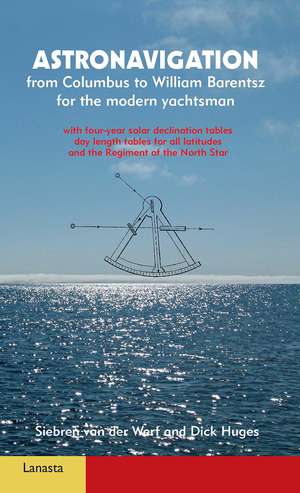
Astronavigation: From Columbus to William Barentsz for the modern yachtsman
Autor Siebren Werf, Dick Hugesen Limba Engleză Paperback – 28 iun 2018
For the sixteenth century navigator this meant finding your latitude. Five centuries ago, to the year, the first nautical handbooks on celestial navigation appeared in print with declination tables written for 1517-1520. They explained how you can find your position taking the height of the sun or the Pole Star. And which course to steer to find your port. These are techniques that have proven their value through the centuries.
In this book Siebren van der Werf and Dick Huges revive this format for the modern sailor, who has a sextant and an accurate clock. There are modern declination tables for four years, 2017-2020, but which may also be used for at least twelve years, without significant loss of accuracy. Also tables that give the length of the day light period, the time between sunrise and sunset. They let you find your longitude, which in the sixteenth century was not really possible. And of course there is the Regiment of the North Star in a new and user-friendly version. The story of a Trans-Atlantic crossing of Dick Huges, where he used celestial navigation, at first out of necessity, later by passion, illustrates the procedures.
Preț: 103.95 lei
Preț vechi: 122.28 lei
-15%
Puncte Express: 156
Carte indisponibilă temporar
Doresc să fiu notificat când acest titlu va fi disponibil:
Se trimite...
Specificații
ISBN-13: 9789086163427
ISBN-10: 9086163424
Pagini: 80
Dimensiuni: 125 x 205 x 7 mm
Greutate: 0.2 kg
Ediția:1
Editura: Amsterdam University Press
Colecția Lanasta
Locul publicării:Oxford, United Kingdom
ISBN-10: 9086163424
Pagini: 80
Dimensiuni: 125 x 205 x 7 mm
Greutate: 0.2 kg
Ediția:1
Editura: Amsterdam University Press
Colecția Lanasta
Locul publicării:Oxford, United Kingdom
Public țintă
Academic and GeneralCuprins
Preface, History of celestial navigation, Our solar system, Meridian altitude and zenith angle, Measuring height with a sextant, Refraction and horizon dip, The regiment of the North Star, Finding your latitude from a meridian altitude, Longitude and latitude from sunrise and sunset, Emergency astro during an ocean crossing, Day length tables for all latitudes, Four-year solar declination tables, Bibliography and sources, The authors
Notă biografică
Siebren van der Werf (1942) is a retired physicist of the University of Groningen, The Netherlands. Besides sailing, his current interest and work is on the history of navigation and on refraction of light in the atmosphere and computer simulations of its anomalies, such as the fata morgana and the Novaya Zemlya phenomenon. In 1997 he received the Samuel Burka Award of the American Institute of Navigation for his study on the lunar distance method.
Dick Huges (1944) is a chest physician by profession (retired). He made several long-distances sailing journeys including a solo-circumnavigation of the world. In 2000 and 2003 he received the "Voorzittersprijs der Nederlandsche Vereeniging van Kustzeilers (the Chairman’s award of the Dutch Association of Coastal Yachtsmen), and in 2005 he won the "Trans-Ocean-Medaille für hervorragende hochseeseglerische Leistungen" (T-O- Medaille for extraordinary ocean-sailing achievements). Dick’s conclusion after 70.000 miles on the high seas is: "stay in touch with the basics and focus on the essentials, not on luxuries".
Dick Huges (1944) is a chest physician by profession (retired). He made several long-distances sailing journeys including a solo-circumnavigation of the world. In 2000 and 2003 he received the "Voorzittersprijs der Nederlandsche Vereeniging van Kustzeilers (the Chairman’s award of the Dutch Association of Coastal Yachtsmen), and in 2005 he won the "Trans-Ocean-Medaille für hervorragende hochseeseglerische Leistungen" (T-O- Medaille for extraordinary ocean-sailing achievements). Dick’s conclusion after 70.000 miles on the high seas is: "stay in touch with the basics and focus on the essentials, not on luxuries".
Descriere
Five centuries ago, celestial navigation guides explained how to find latitude using the sun or Pole Star. Siebren van der Werf and Dick Huges revive these techniques for modern sailors, with updated declination tables, daylight period data, and tools for finding longitude. Dick Huges’ Trans-Atlantic journey illustrates these methods.